Measurement
Before or after the water change? Event order changes the arithmetic
An ideal-mixing example shows why a water-change percentage is incomplete without the event sequence.
By FishyMag · Published · Updated
Worked arithmetic example · Not a clinical review or treatment recommendation.
Quick answer
The order of an addition and a water change changes an ideal mass balance. A percentage alone cannot reconstruct what remains. Record the sequence, and do not use this simplified model to decide a redose.

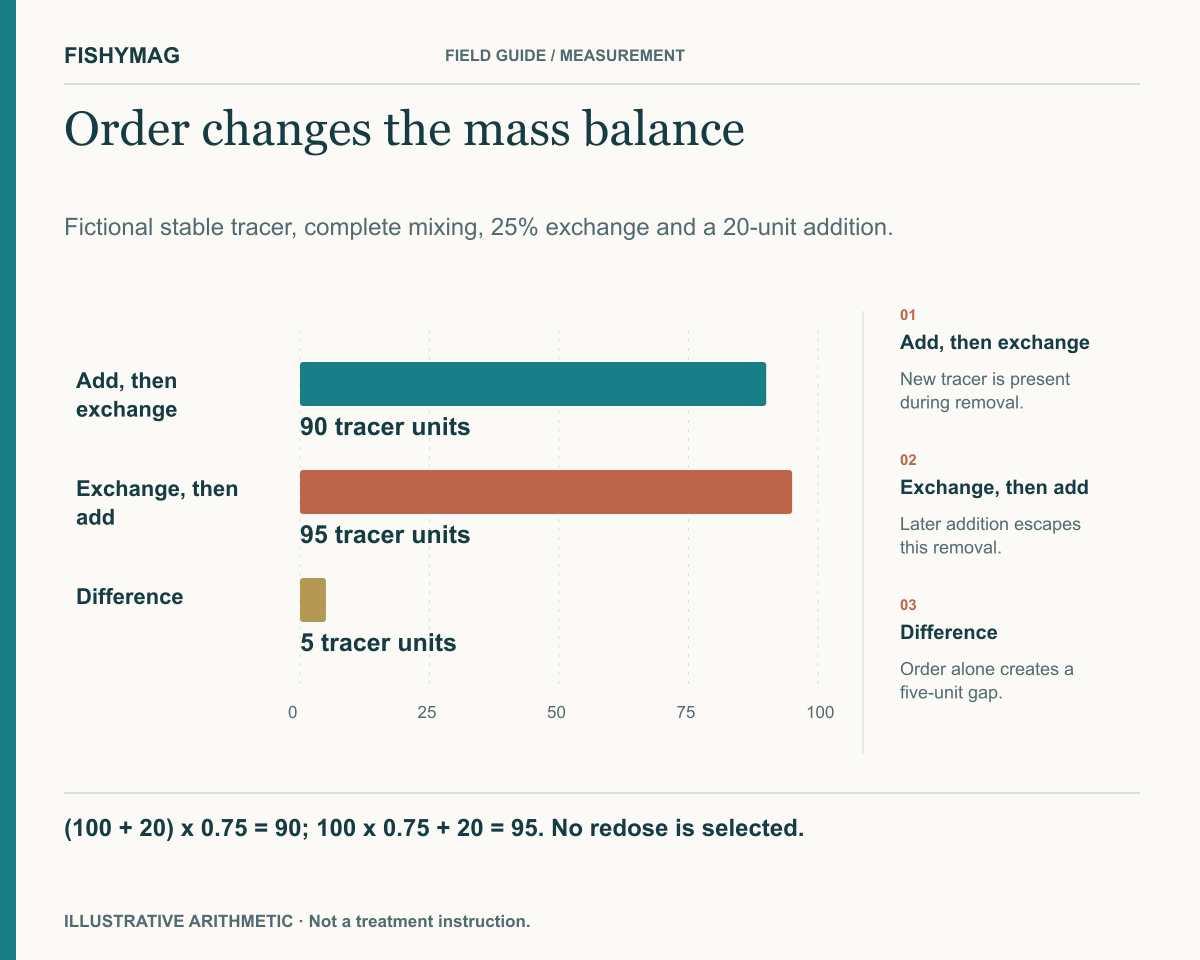
Figure data and explanation
Fictional stable tracer, complete mixing, 25% exchange and a 20-unit addition.
- Add, then exchange
- 90 tracer units. New tracer is present during removal.
- Exchange, then add
- 95 tracer units. Later addition escapes this removal.
- Difference
- 5 tracer units. Order alone creates a five-unit gap.
(100 + 20) x 0.75 = 90; 100 x 0.75 + 20 = 95. No redose is selected.
Define a model without a treatment recommendation
Imagine 100 arbitrary units of a perfectly mixed, stable tracer in a tank. A water change removes 25% of the mixed water and replaces it with tracer-free water, restoring the original volume. A separate addition contains 20 tracer units. Assume no binding, filtration, degradation or other losses. The tracer is fictional; it does not represent the actual behaviour of a medication.
Calculate both sequences
In sequence A, add the 20 units first: 100 plus 20 equals 120. Removing 25% leaves 120 times 0.75, or 90 units. In sequence B, change the water first: 100 times 0.75 leaves 75 units. Adding 20 afterward gives 95 units. The same change and addition produce a five-unit difference because the order changed.
Explain the difference precisely
In sequence A, the water change removes a quarter of the newly added material as well as a quarter of the original material. In B, none of the later addition is present during removal. This reasoning depends on complete mixing and equal restored volume. It cannot tell you what an unmeasured product actually did in a tank.
Record order before using a calculator
A log should list removal, replacement and addition as separate timed events, with units and actual completion status. If order is uncertain, preserve that gap. Do not pick whichever sequence gives the preferred result. Product instructions and appropriate advice govern treatment decisions; this model only checks whether a proposed arithmetic explanation is internally consistent.
Put it into practice
Your checklist
- List removal, replacement and addition in actual order.
- State the complete-mixing and no-other-loss assumptions.
- Do not turn the modelled difference into a redosing instruction.
Sources and scope
This article distinguishes manufacturer statements from FishyMag’s own workflows and arithmetic examples. Linked formulation records retain their own evidence dates; publishing this article does not refresh those records.
- FishyMag water-change planner: ideal model and limits ↗
- FishyMag evidence methodology and editorial scope ↗
AI-assisted writing and development. Not hands-on product testing or veterinary review. How we publish →
FishyMag reports what manufacturers say, quoted and linked. It does not diagnose illness or recommend a treatment, and it never infers that a product is safe from the absence of a warning — where no statement exists, it says so.
Formulations change. Always read the label on the bottle in your hand, and contact the manufacturer if your tank contains anything valuable or unusual.