Measurement
A drifting pH number does not identify a failing probe
Work an unequal-time pH trace and separate the observed drift from unsupported claims about electrode failure or sample change.
By FishyMag · Published
Worked evidence example · Not a clinical review or treatment recommendation.
Quick answer
Keep elapsed time, temperature and sample exposure with the trace. In the fictional record, pH falls by 0.06 in the first 60 seconds and by 0.04 over the next 120. Those observations do not identify electrode failure, sample chemistry or a stable endpoint. A meter’s stability setting also needs its documented meaning.
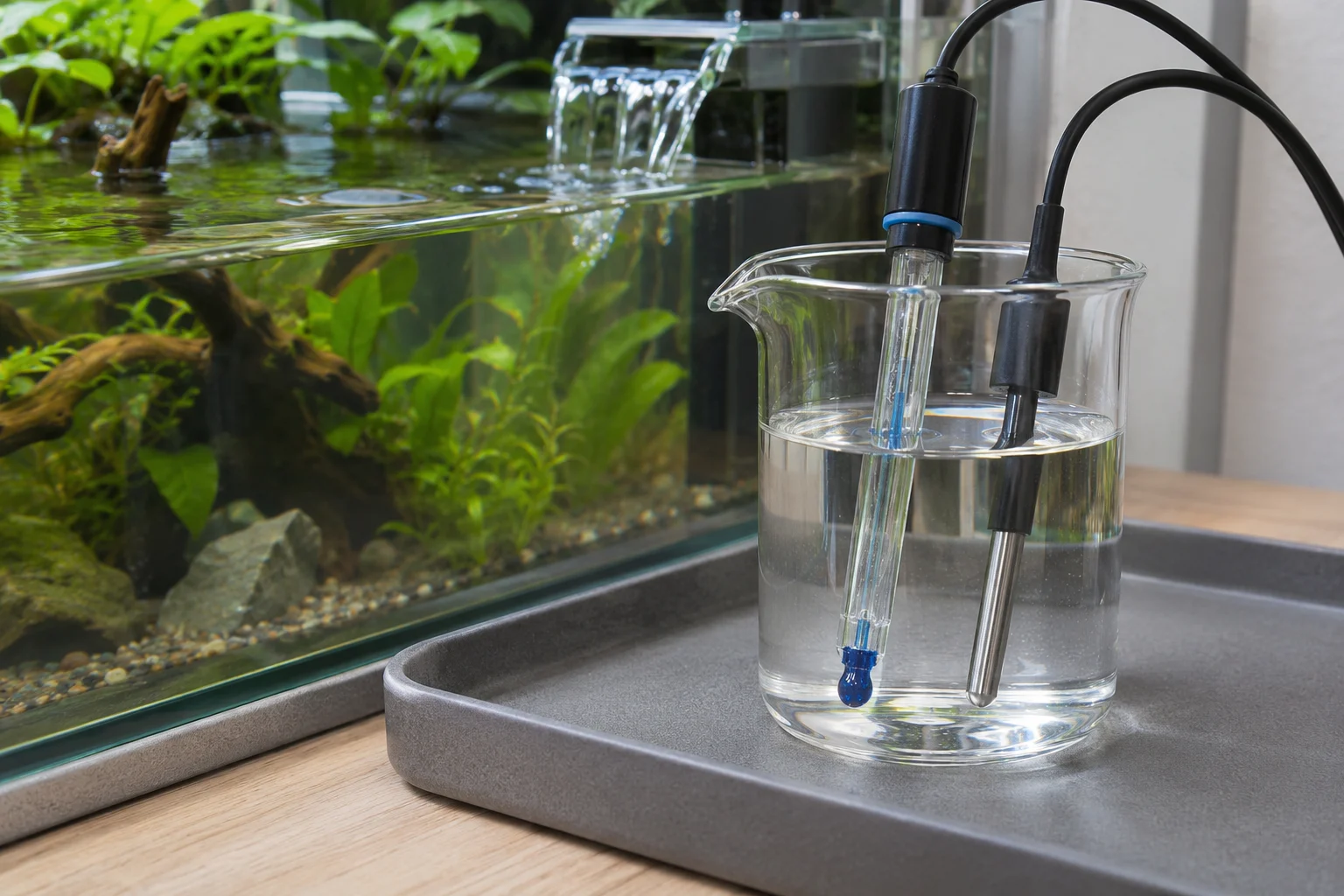
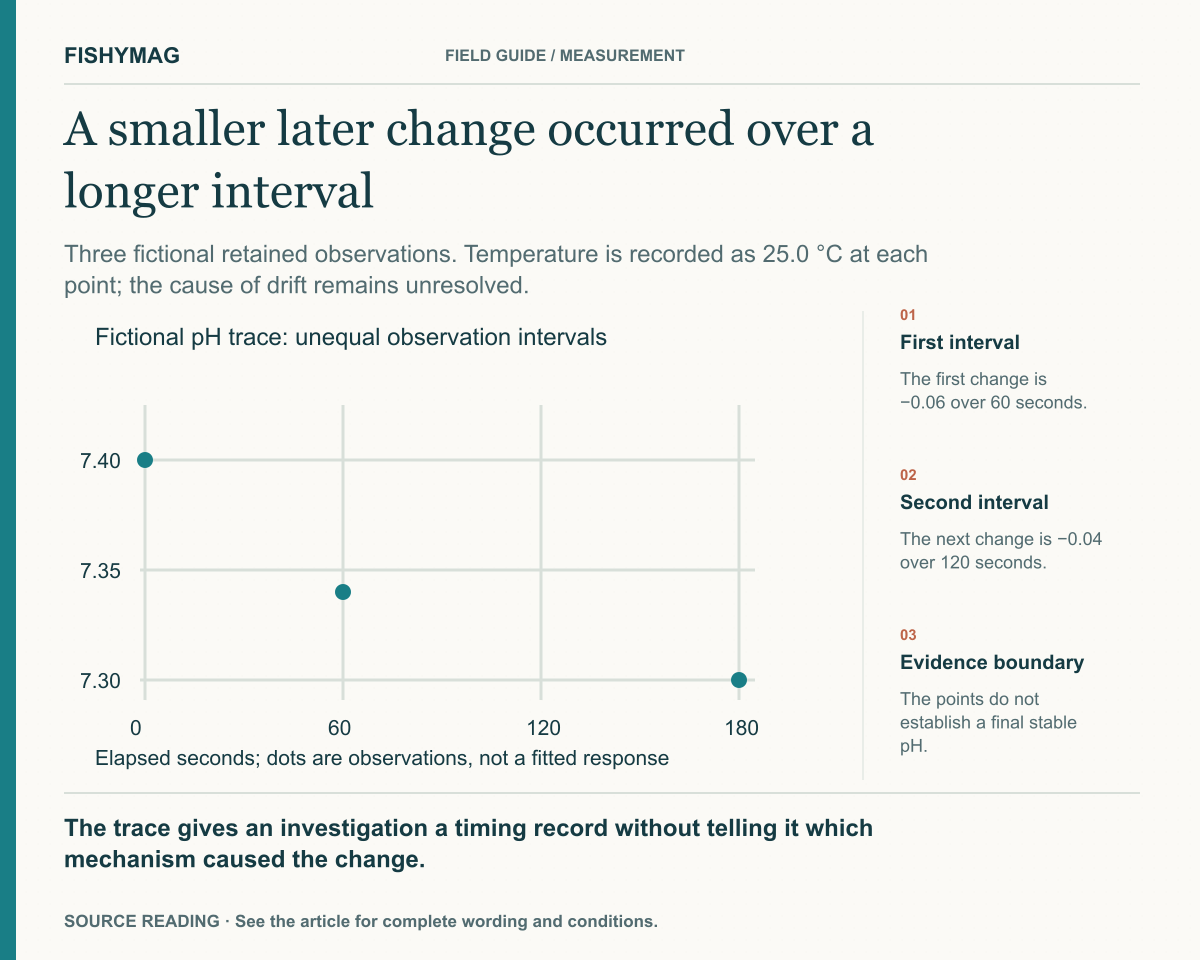
Figure data and explanation
Three fictional retained observations. Temperature is recorded as 25.0 °C at each point; the cause of drift remains unresolved.
- First interval
- The first change is −0.06 over 60 seconds.
- Second interval
- The next change is −0.04 over 120 seconds.
- Evidence boundary
- The points do not establish a final stable pH.
The trace gives an investigation a timing record without telling it which mechanism caused the change.
Preserve the observation conditions before explaining the drift
This invented packet records an open sample vessel beside an aquarium, one electrode and a temperature of 25.0 °C at each retained observation. Exposure duration increases as the sequence proceeds. The edge manual offers different stability-log settings and describes calibration response diagnostics. Neither feature turns an arbitrary downward trace into proof of a failed probe. Sample evolution, electrode response and record gaps need separate consideration.
Calculate changes over the actual intervals
The times are deliberately unequal. Plotting the three observations at equally spaced horizontal positions would conceal that distinction. No continuous pH curve was observed between these points.
| Elapsed time | pH | Recorded temperature | Change from prior observation |
|---|---|---|---|
| 0 s | 7.40 | 25.0 °C | Initial retained value |
| 60 s | 7.34 | 25.0 °C | −0.06 over 60 s |
| 180 s | 7.30 | 25.0 °C | −0.04 over 120 s |
| Entire retained span | −0.10 pH unit | Same recorded temperature | No cause or endpoint assigned |
Complete an evidence request rather than a diagnosis
Recover the meter’s actual stability configuration, raw flags, calibration response record and probe identity. Retain collection time, exposure conditions and the laboratory-approved handling method for the sample. A comparison designed to distinguish sample change from electrode response needs appropriate independent controls and documented conditions; simply repeating an exposed sample does not isolate the cause. The supplied record supports a descriptive drift and a request for those missing details. It does not support an invented “stable after three minutes” threshold, a correction of +0.10 or replacement of the probe on this evidence alone.
Use your own details
A drifting pH number does not identify a failing probe worksheet
Download the editable text file, fill it in on your device and keep it with the relevant record. This blank worksheet records your information; it does not verify entries or approve treatment.
- Aquarium and sample boundary
- Complete meter, probe and document revision
- Sample quantity and temperature basis
- Original observations with timestamps
- Relevant manufacturer claim and conditions
- Completed comparison or calculation
- What the available evidence cannot resolve
- Specific next document or comparison required
Put it into practice
Your checklist
- Plot actual elapsed times.
- Retain stability settings and sample exposure separately.
- Do not diagnose the cause from the shape of three observations.
Sources and scope
This article distinguishes manufacturer statements from FishyMag’s own workflows and arithmetic examples. Linked formulation records retain their own evidence dates; publishing this article does not refresh those records.
- Hanna edge pH/EC/DO manual, document380; reviewed November 8, 2026 ↗
- HORIBA: pH automatic temperature compensation; reviewed November 8, 2026 ↗
AI-assisted writing and development. Not hands-on product testing or veterinary review. How we publish →
FishyMag reports what manufacturers say, quoted and linked. It does not diagnose illness or recommend a treatment, and it never infers that a product is safe from the absence of a warning — where no statement exists, it says so.
Formulations change. Always read the label on the bottle in your hand, and contact the manufacturer if your tank contains anything valuable or unusual.