Measurement
Does one sample represent your connected aquarium?
Compare matched readings at four connected-system points before assuming a sump measurement represents the display and refugium.
By FishyMag · Published
Worked arithmetic example · Not a clinical review or treatment recommendation.
Quick answer
A shared water circuit does not establish equal readings at every point. In the fictional matched record, the refugium outlet is 12 µS/cm above the sump reference in both rounds. The observations identify a repeated local contrast for review, without proving its cause or establishing a universal equivalence limit.
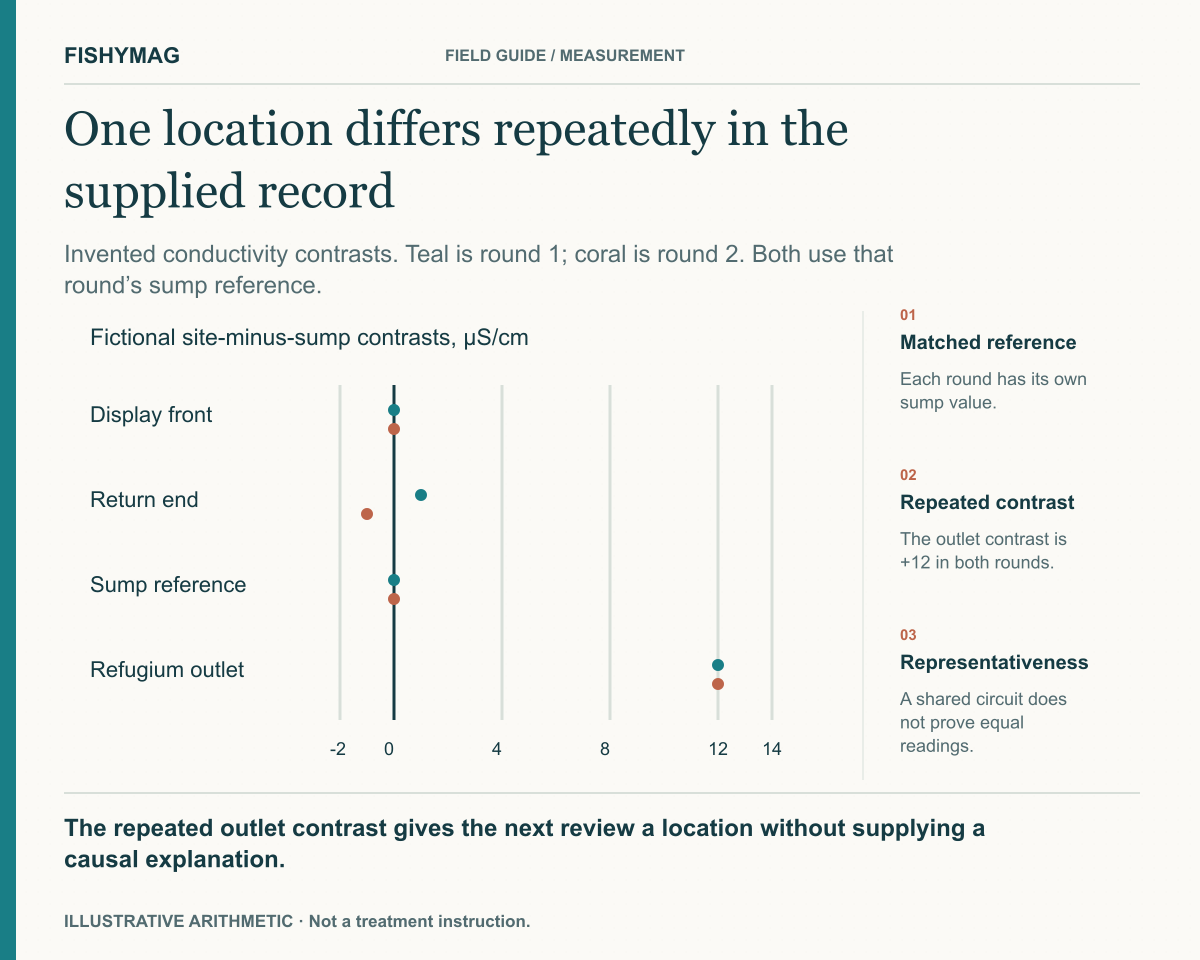
Figure data and explanation
Invented conductivity contrasts. Teal is round 1; coral is round 2. Both use that round’s sump reference.
- Matched reference
- Each round has its own sump value.
- Repeated contrast
- The outlet contrast is +12 in both rounds.
- Representativeness
- A shared circuit does not prove equal readings.
The repeated outlet contrast gives the next review a location without supplying a causal explanation.
Define where the reading is supposed to apply
A reading taken at one point directly describes that measurement location and time. Extending it to a display, sump and refugium is a representativeness question. Record the actual system boundary and accessible points first. In this invented case, all conductivity records use the same declared temperature-compensation basis. No actual aquarium measurements or treatment performance are represented.
Compare within each matched round
Use the contemporaneous sump reading as the reference in each round. Do not compare round 2 with round 1’s reference or silently average the two rounds before looking at location.
| Point | Round 1, µS/cm | Point minus sump | Round 2, µS/cm | Point minus sump |
|---|---|---|---|---|
| Display front | 500 | 0 | 501 | 0 |
| Display return end | 501 | +1 | 500 | −1 |
| Sump return chamber | 500 | 0 | 501 | 0 |
| Refugium outlet | 512 | +12 | 513 | +12 |
Close the claim at the observed boundary
The refugium outlet has a repeated +12 µS/cm contrast in the supplied data. That finding makes it inappropriate to treat the sump value as a demonstrated description of every mapped point. It does not identify evaporation, dosing, mixing or instrument placement as the cause. The smaller display contrasts also do not establish equivalence without a suitable criterion and measurement uncertainty. Preserve the site map, sequence, timestamps and method settings. A useful next investigation can focus on the repeated location contrast, with the relevant measurement and sampling support; it should not begin by changing aquarium operation to force agreement.
Use your own details
Does one sample represent your connected aquarium? worksheet
Download the editable text file, fill it in on your device and keep it with the relevant record. This blank worksheet records your information; it does not verify entries or approve treatment.
- Question the observations must answer
- Aquarium boundary and exact site identities
- Method, units and compensation settings
- Observation times and operating-state record
- Matched raw values and qualifiers
- Completed descriptive calculation
- Unsupported cause or interval inference
- Next evidence needed for the declared question
Put it into practice
Your checklist
- Name the locations a single reading is claimed to represent.
- Calculate contrasts within each matched round.
- Keep a repeated contrast separate from its unproved cause.
Sources and scope
This article distinguishes manufacturer statements from FishyMag’s own workflows and arithmetic examples. Linked formulation records retain their own evidence dates; publishing this article does not refresh those records.
- Australian and New Zealand water-quality field sampling guidance; reviewed November 8, 2026 ↗
- Australian and New Zealand guidelines: water-quality data analysis; reviewed November 8, 2026 ↗
AI-assisted writing and development. Not hands-on product testing or veterinary review. How we publish →
FishyMag reports what manufacturers say, quoted and linked. It does not diagnose illness or recommend a treatment, and it never infers that a product is safe from the absence of a warning — where no statement exists, it says so.
Formulations change. Always read the label on the bottle in your hand, and contact the manufacturer if your tank contains anything valuable or unusual.