Measurement
What an aquarium total-ammonia result includes
Resolve the ammonia pool, nitrogen basis and missing fraction before comparing a total-ammonia report with a free-ammonia statement.
By FishyMag · Published
Worked arithmetic example · Not a clinical review or treatment recommendation.
Quick answer
A total-ammonia result does not identify how much was free ammonia in the aquarium. First check the method and reporting basis. Even when both statements use mg/L as nitrogen, a total value needs an applicable fraction measurement or model before it can answer an NH₃-only question.
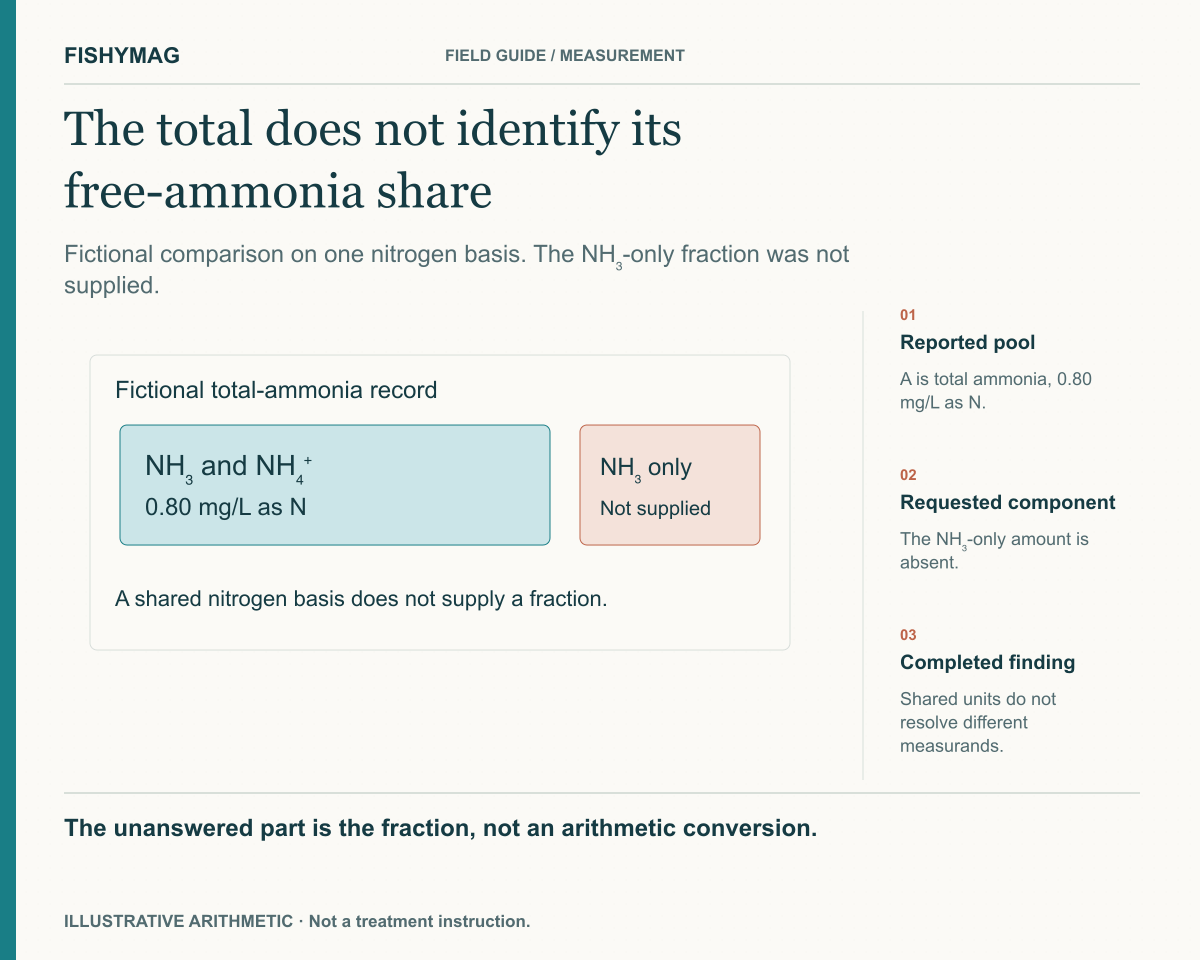
Figure data and explanation
Fictional comparison on one nitrogen basis. The NH₃-only fraction was not supplied.
- Reported pool
- A is total ammonia, 0.80 mg/L as N.
- Requested component
- The NH₃-only amount is absent.
- Completed finding
- Shared units do not resolve different measurands.
The unanswered part is the fraction, not an arithmetic conversion.
Read the analyte before the number
Seachem defines total ammonia as NH₃ plus NH₄⁺, and free ammonia as NH₃ only. EPA Method 350.1 reports ammonia nitrogen. Its laboratory processing does not directly report the free fraction that existed at the aquarium’s original conditions. The exact method matters, especially when a report uses shorthand such as “ammonia” or “NH₃-N”. The letters may name the reporting basis rather than a direct measurement of ambient NH₃ alone.
Complete the comparison without inventing a fraction
The following records are entirely fictional. A laboratory confirms that record A is total ammonia on a nitrogen mass basis. Statement B asks for free ammonia, also as nitrogen. The common basis removes one possible mismatch, but it does not turn a total into one component. No pH, temperature or applicable fraction measurement accompanies A.
| Record | Original wording | Basis | What can be concluded |
|---|---|---|---|
| A | Total ammonia: 0.80 mg/L | As N; NH₃ plus NH₄⁺ | The total is supplied |
| B | Question about NH₃ only | As N | One component is requested |
| Reconciliation | Same nitrogen basis | Different included forms | Direct substitution is unsupported |
Ask for the missing evidence
The completed finding is: “Record A supplies total ammonia as N. It does not supply ambient NH₃ as N, so the NH₃-only comparison remains unanswered.” Ask the laboratory to confirm the result definition and qualifiers. A documented free-ammonia measurement or a suitable equilibrium calculation may address a different part of the question. Neither is supplied merely by changing the column heading. Preserve A in the original record and add any later calculation as a separate derived entry with its inputs and model. This distinction avoids both reporting 0.80 as free ammonia and reporting an unsupported zero.
Use your own details
What an aquarium total-ammonia result includes worksheet
Download the editable text file, fill it in on your device and keep it with the relevant record. This blank worksheet records your information; it does not verify entries or approve treatment.
- Aquarium and sample identity
- Exact analyte wording
- Reporting unit and chemical basis
- Sample fraction and method revision
- Original values and qualifiers
- Permitted comparison or calculation
- Remaining scope or evidence gap
- Completed interpretation and source
Put it into practice
Your checklist
- Confirm included ammonia forms with the method.
- Retain the original nitrogen or molecular reporting basis.
- Keep the missing free fraction explicit.
Sources and scope
This article distinguishes manufacturer statements from FishyMag’s own workflows and arithmetic examples. Linked formulation records retain their own evidence dates; publishing this article does not refresh those records.
- EPA Method 350.1, Revision 2.0; reviewed November 8, 2026 ↗
- Seachem MultiTest Ammonia manufacturer page; reviewed November 8, 2026 ↗
AI-assisted writing and development. Not hands-on product testing or veterinary review. How we publish →
FishyMag reports what manufacturers say, quoted and linked. It does not diagnose illness or recommend a treatment, and it never infers that a product is safe from the absence of a warning — where no statement exists, it says so.
Formulations change. Always read the label on the bottle in your hand, and contact the manufacturer if your tank contains anything valuable or unusual.