Measurement
Total-recoverable metal and an aquarium copper test
Compare a total-recoverable laboratory result with a manufacturer-described aquarium copper test without labelling their difference particulate copper or instrument failure.
By FishyMag · Published
Worked arithmetic example · Not a clinical review or treatment recommendation.
Quick answer
The fictional 0.30 versus 0.20 mg Cu/L results differ by 0.10 mg/L, or 100 µg/L. That difference does not identify a particulate amount or prove the aquarium test failed. Preparation, sample identity, test response and sample-specific performance evidence still need to match.
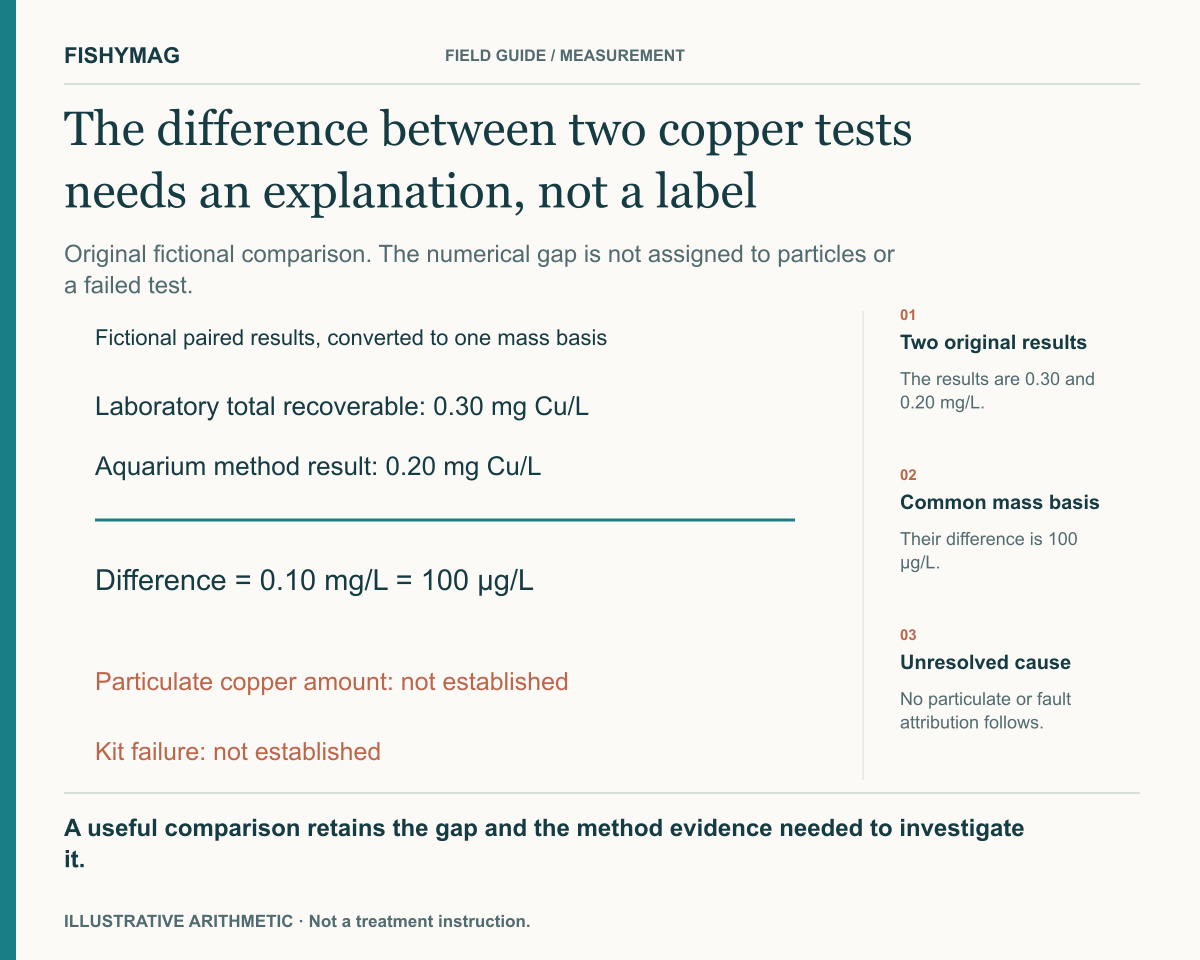
Figure data and explanation
Original fictional comparison. The numerical gap is not assigned to particles or a failed test.
- Two original results
- The results are 0.30 and 0.20 mg/L.
- Common mass basis
- Their difference is 100 µg/L.
- Unresolved cause
- No particulate or fault attribution follows.
A useful comparison retains the gap and the method evidence needed to investigate it.
Use the method names without assuming they are equivalent
The laboratory packet names a documented total-recoverable preparation. Seachem describes MultiTest Copper as a catalytic compleximetric test responding to ionic and chelated copper, with a supplied reference. That manufacturer statement is retained as a product claim; it does not provide this fictional sample’s recovery, uncertainty or a direct equivalence to the laboratory preparation.
Complete the bounded numerical comparison
The constructed values are 0.30 and 0.20 mg Cu/L. They replace a lower-concentration draft example so the article does not depend on claiming a near-limit reading is exact. No product concentration target or dosing calculation is involved.
| Comparison field | Packet evidence | Decision |
|---|---|---|
| Numerical basis | Both expressed as mg elemental Cu/L | 0.30 − 0.20 = 0.10 mg/L |
| Same original sample and time | Incomplete collection attachment | Comparability unresolved |
| Preparation equivalence | Different named analytical approaches | Not established by result labels |
| Reference check | No actual check result attached | Supplied reference is not a documented pass |
| Particulate allocation | No matched retained-fraction result | Cannot call the difference particles |
| Instrument error | No usable combined performance evidence | Cannot diagnose test failure |
Ask a question the laboratory and test supplier can answer
Retain both original reports and ask how each response relates to the submitted matrix and preparation. Obtain any actual reference check, qualifier and uncertainty information rather than inferring a pass from the kit’s contents. Even exact agreement would not prove that every copper form or system compartment was measured. The finished comparison reports the arithmetic and its evidence gaps, with the cause of the difference unresolved.
Use your own details
Total-recoverable metal and an aquarium copper test worksheet
Download the editable text file, fill it in on your device and keep it with the relevant record. This blank worksheet records your information; it does not verify entries or approve treatment.
- Paired collection identity and measurement times
- Laboratory fraction and total-recoverable preparation
- Aquarium test identity and original result
- Manufacturer response claim and applicable range
- Reference or matrix-specific performance evidence
- Common elemental mass basis
- Difference with uncertainty still retained
- Unresolved explanation and required clarification
Put it into practice
Your checklist
- Normalize the units while preserving the method identities.
- Do not allocate a difference to particles without matched fraction evidence.
- Separate a manufacturer capability claim from this sample’s performance record.
Sources and scope
This article distinguishes manufacturer statements from FishyMag’s own workflows and arithmetic examples. Linked formulation records retain their own evidence dates; publishing this article does not refresh those records.
- US EPA Method 200.8 revision 5.4 (1994); reviewed November 9, 2026 ↗
- Seachem MultiTest Copper manufacturer page; reviewed November 9, 2026 ↗
- NIST TN1297 Appendix D1: measurement terminology; reviewed November 8, 2026 ↗
AI-assisted writing and development. Not hands-on product testing or veterinary review. How we publish →
FishyMag reports what manufacturers say, quoted and linked. It does not diagnose illness or recommend a treatment, and it never infers that a product is safe from the absence of a warning — where no statement exists, it says so.
Formulations change. Always read the label on the bottle in your hand, and contact the manufacturer if your tank contains anything valuable or unusual.