Measurement
Round at the end: keep intermediate conversions out of the result
A gallon-conversion example makes the cost of early rounding visible.
By FishyMag · Published
Worked arithmetic example · Not a clinical review or treatment recommendation.
Quick answer
Keep enough precision through the calculation and round the final reported quantity to an appropriate resolution. Early rounding can move the result, while extra calculator digits do not establish extra measurement accuracy.

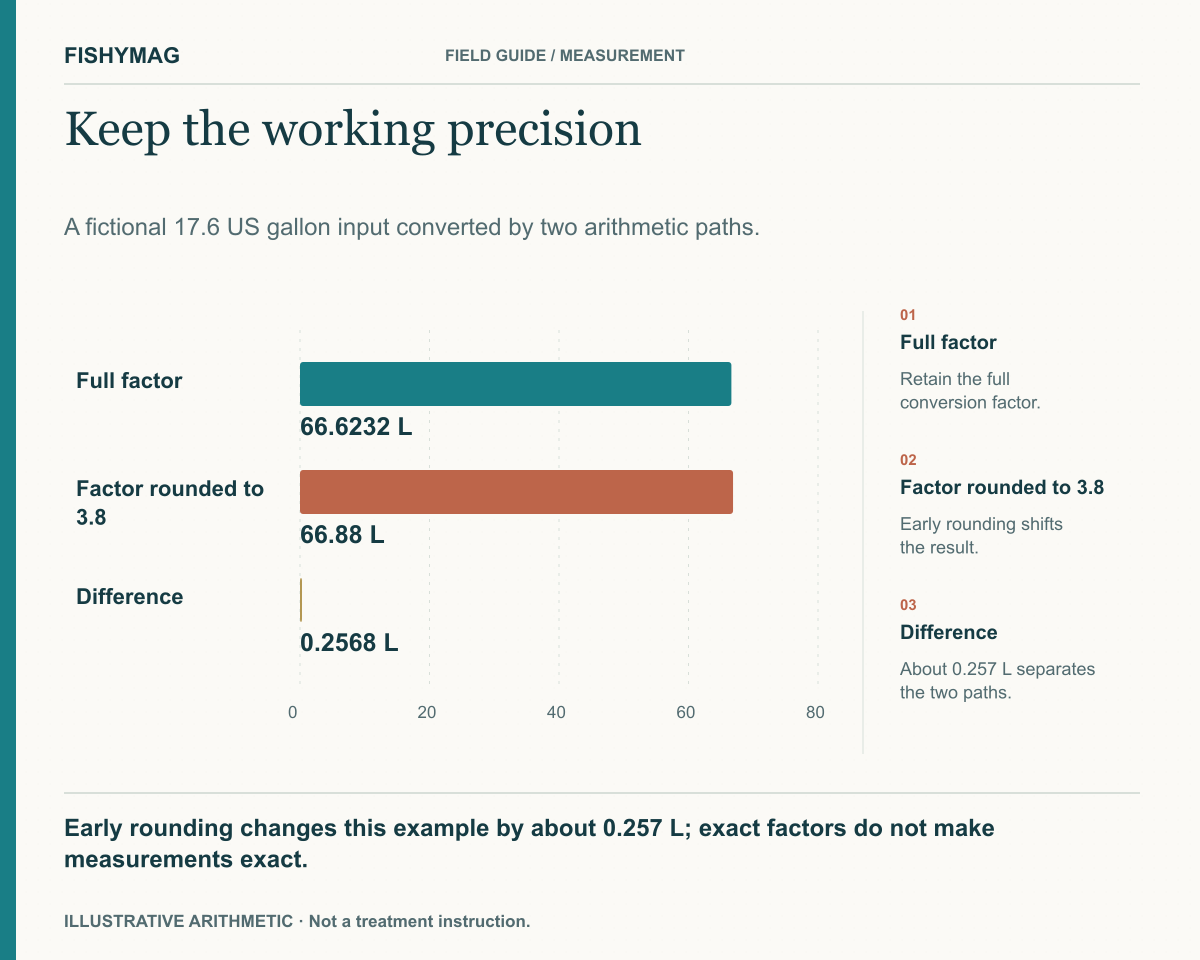
Figure data and explanation
A fictional 17.6 US gallon input converted by two arithmetic paths.
- Full factor
- 66.6232 L. Retain the full conversion factor.
- Factor rounded to 3.8
- 66.88 L. Early rounding shifts the result.
- Difference
- 0.2568 L. About 0.257 L separates the two paths.
Early rounding changes this example by about 0.257 L; exact factors do not make measurements exact.
Define the exact and measured parts
A US liquid gallon has a fixed conversion of 3.785411784 litres in FishyMag’s unit calculations. The volume you measured may be much less precise. Keep those two facts separate: an exact conversion factor does not make a rough bucket reading exact. Start by recording the input and its method, then decide how the final result should be presented.
Compare two arithmetic paths
For a fictional 17.6 US gallon input, the full-factor conversion is 66.6232473984 L. Replacing the factor with 3.8 first gives 66.88 L, a difference of about 0.257 L. Both could later be rounded for display, but they did not follow the same calculation. The table retains the working so the difference can be checked.
| Path | Working | Result before display rounding |
|---|---|---|
| Full factor | 17.6 x 3.785411784 | 66.6232473984 L |
| Early-rounded factor | 17.6 x 3.8 | 66.88 L |
| Arithmetic difference | 66.88 - 66.6232473984 | About 0.257 L |
Do not round every step of a chain
A sequence of unit conversion, proportional scaling and total aggregation can repeat rounding errors at each stage. Keep unrounded working values internally when the operation is defined, then round the reported output. Do not take a displayed rounded output and feed it back as if it were the original measurement.
Choose a display for the actual task
There is no universal number of decimal places for every aquarium record. The measuring method, available device and purpose matter. If a calculation returns a quantity the measuring method cannot support, more digits are not the solution. Preserve the result and its limitation rather than presenting a fictional level of control.
Leave a traceable working line
Write “17.6 US gal x 3.785411784 L/US gal = 66.623... L; displayed as [chosen resolution]”. Name the gallon standard. This guide checks arithmetic only. It does not determine net tank volume, select a treatment amount or say which rounding decision is acceptable for a particular product.
Put it into practice
Your checklist
- Keep the named unit and full conversion factor in the working.
- Avoid feeding rounded display values back into calculations.
- Match reported precision to evidence from the measuring method.
Sources and scope
This article distinguishes manufacturer statements from FishyMag’s own workflows and arithmetic examples. Linked formulation records retain their own evidence dates; publishing this article does not refresh those records.
AI-assisted writing and development. Not hands-on product testing or veterinary review. How we publish →
FishyMag reports what manufacturers say, quoted and linked. It does not diagnose illness or recommend a treatment, and it never infers that a product is safe from the absence of a warning — where no statement exists, it says so.
Formulations change. Always read the label on the bottle in your hand, and contact the manufacturer if your tank contains anything valuable or unusual.