Measurement
Repeat readings or a reference check? They answer different questions
A dot plot shows why tightly grouped results can still disagree with an independent reference.
By FishyMag · Published
Worked arithmetic example · Not a clinical review or treatment recommendation.
Quick answer
Repeating the same sample shows how closely the reported readings cluster under those conditions. A suitable reference check addresses a different question. Closely grouped readings alone do not establish accuracy or that a method is appropriate for a treatment.

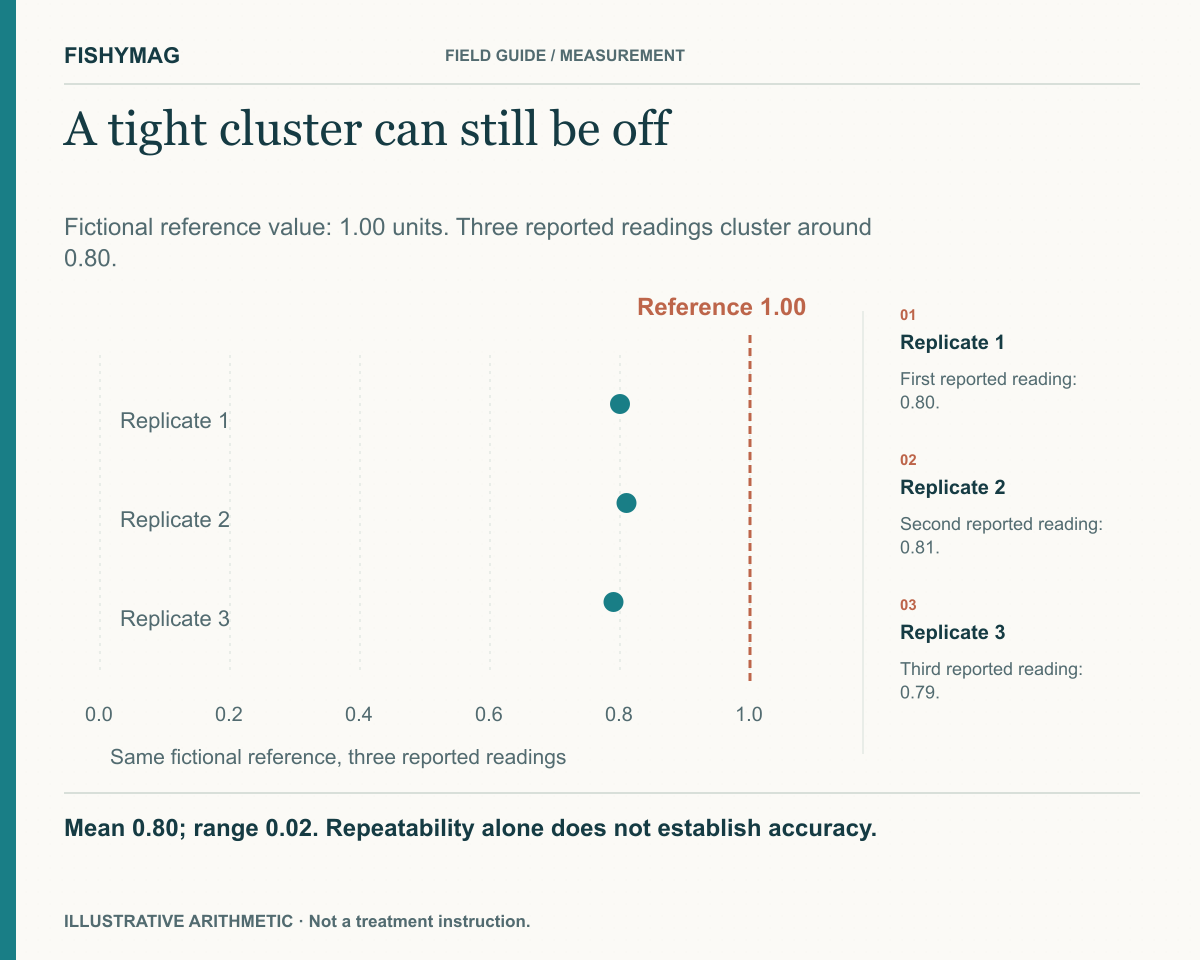
Figure data and explanation
Fictional reference value: 1.00 units. Three reported readings cluster around 0.80.
- Replicate 1
- 0.8 units. First reported reading: 0.80.
- Replicate 2
- 0.81 units. Second reported reading: 0.81.
- Replicate 3
- 0.79 units. Third reported reading: 0.79.
Mean 0.80; range 0.02. Repeatability alone does not establish accuracy.
Define the two tasks
Replicate readings use the same defined sample and procedure to examine repeatability. A reference check uses a material with an established value under the applicable instructions. Seachem’s MultiTest Copper page, for example, describes a supplied reference for checking performance. Follow the actual kit procedure; this article does not substitute its fictional values for that reference.
Read the fictional dot plot
Imagine a reference material whose stated value for the example is 1.00 units. Three reported readings are 0.80, 0.81 and 0.79 units. Their mean is 0.80 and their range is 0.02. The results cluster closely, but the mean differs from the example reference value by 0.20. That combination illustrates repeatability without agreement with the reference; it does not identify the cause.
| Fictional observation | Value | What it describes |
|---|---|---|
| Reference value | 1.00 units | Stated value for this example |
| Replicates | 0.80, 0.81, 0.79 | Closely grouped readings |
| Mean and range | 0.80; range 0.02 | Repeatability alone does not establish agreement |
Do not diagnose the instrument from the picture
A discrepancy could involve procedure, material identity, expiry, conditions, reading method or other factors. The example cannot tell you which occurred. Nor does repeating an unsuitable method make it appropriate for a particular formulation. Retain the method, sample identity, reference identity and instructions used so an informed question can be asked.
Compare against the documented acceptance conditions
A real check needs the manufacturer’s applicable procedure, reference value and any stated tolerance or interpretation. Do not invent a pass band from the size of the replicate spread. If no applicable criterion is available, record the discrepancy and ask for guidance rather than declaring the system calibrated.
Keep the record useful
Save individual readings rather than only their average, along with units, time, operator and any deviations from the instructions. Keep aquarium-sample results separate from reference results. This article supplies no treatment target, residue clearance threshold or conclusion about a specific kit’s performance.
Put it into practice
Your checklist
- Keep replicate readings and reference checks as separate tasks.
- Retain individual results, reference identity and applicable instructions.
- Do not infer accuracy or invent acceptance limits from a tight cluster.
Sources and scope
This article distinguishes manufacturer statements from FishyMag’s own workflows and arithmetic examples. Linked formulation records retain their own evidence dates; publishing this article does not refresh those records.
- Seachem MultiTest Copper: supplied reference and performance check, read November 8, 2026 ↗
- FishyMag evidence methodology ↗
AI-assisted writing and development. Not hands-on product testing or veterinary review. How we publish →
FishyMag reports what manufacturers say, quoted and linked. It does not diagnose illness or recommend a treatment, and it never infers that a product is safe from the absence of a warning — where no statement exists, it says so.
Formulations change. Always read the label on the bottle in your hand, and contact the manufacturer if your tank contains anything valuable or unusual.