Measurement
Follow one replacement-water batch to the aquarium
Compare storage and delivery stages of one replacement-water batch while keeping the retained comparison portion’s own limitations visible.
By FishyMag · Published
Worked arithmetic example · Not a clinical review or treatment recommendation.
Quick answer
Use contemporaneous comparisons at each stage. In the fictional batch, storage-window readings differ by +19 µS/cm between batch and retained portion, while the delivery outlet differs from the contemporaneous batch by +1. The storage comparison shows the earlier larger contrast. It does not prove a storage-vessel effect.
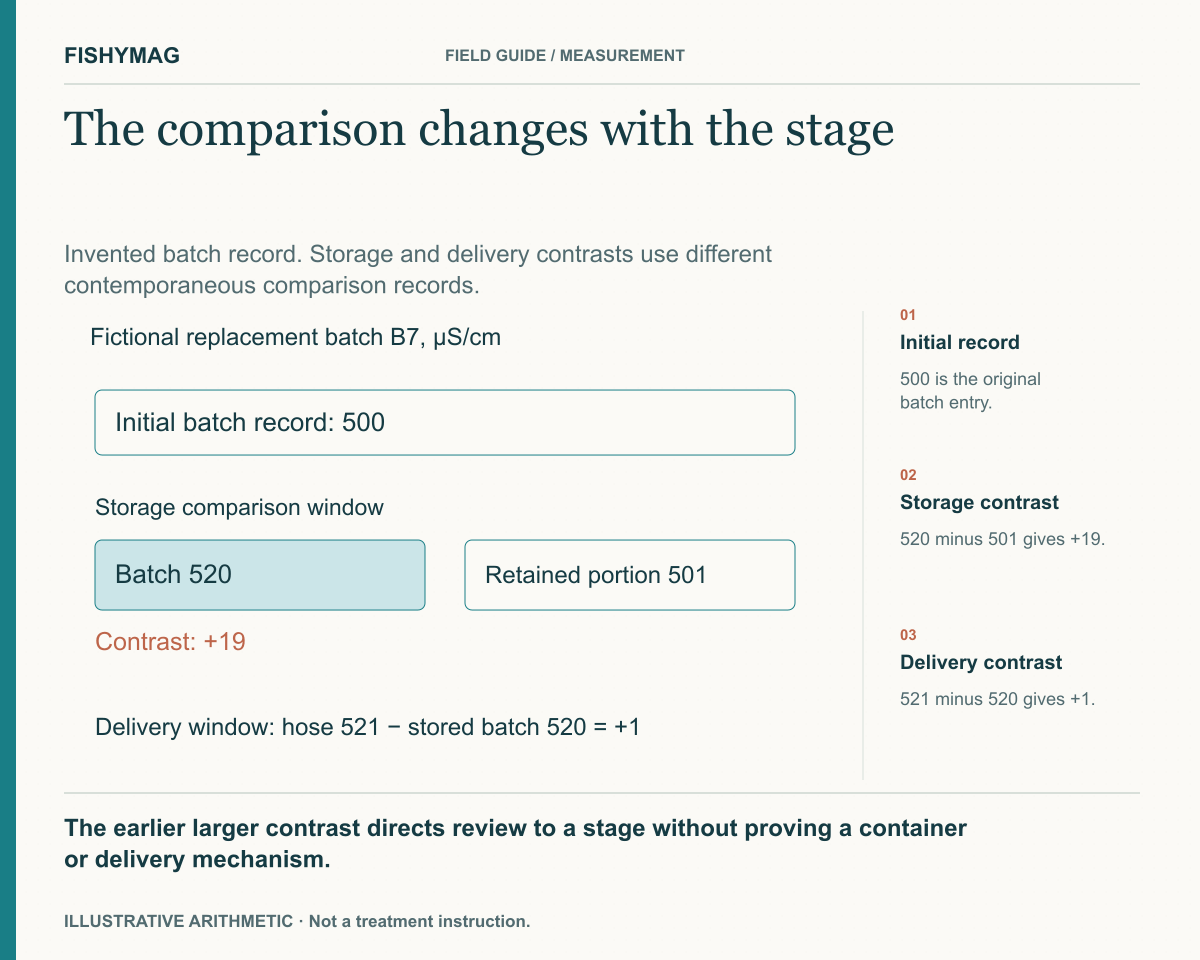
Figure data and explanation
Invented batch record. Storage and delivery contrasts use different contemporaneous comparison records.
- Initial record
- 500 is the original batch entry.
- Storage contrast
- 520 minus 501 gives +19.
- Delivery contrast
- 521 minus 520 gives +1.
The earlier larger contrast directs review to a stage without proving a container or delivery mechanism.
Keep one batch identity through the pathway
The invented record follows replacement-water batch B7. Its initial conductivity is 500 µS/cm on the declared measurement basis. A separately retained comparison portion is part of a laboratory-agreed comparison record, not a universal household storage protocol. Its own container, handling and elapsed time may differ and must remain visible.
Use each stage’s matched comparison
The storage comparison uses the retained portion observed at that same window. The delivery comparison uses the contemporaneous stored batch, rather than the initial 500 value.
| Stage | Observed record, µS/cm | Matched comparison, µS/cm | Descriptive contrast |
|---|---|---|---|
| Initial batch | 500 | No separate initial contrast supplied | Baseline entry only |
| Storage window | Batch 520 | Retained portion 501 | +19 |
| Delivery window | Hose outlet 521 | Stored batch 520 | +1 |
Do not promote the comparison portion to a perfect control
The earlier larger contrast belongs to the storage comparison. It could include differences in the retained portion’s container or conditions; it does not isolate the batch vessel as the cause. The +1 delivery contrast likewise needs the measurement uncertainty and timing before any equivalence claim. Conductivity does not identify the changed constituent or establish whether the water meets a treatment compatibility requirement. Preserve the batch label, original readings, stage times, container identities and analytical agreement. The completed record locates where the supplied comparison first shows the larger contrast, while retaining what the comparison itself cannot exclude.
Use your own details
Follow one replacement-water batch to the aquarium worksheet
Download the editable text file, fill it in on your device and keep it with the relevant record. This blank worksheet records your information; it does not verify entries or approve treatment.
- Declared comparison question
- Exact sites, parent samples or batch identity
- Method, units and reporting basis
- Observation times and pathway conditions
- Matched raw values with qualifiers
- Calculation and completed descriptive finding
- What the comparison does not resolve
- Specific next evidence or coverage gap
Put it into practice
Your checklist
- Follow the same batch identity through every stage.
- Use a contemporaneous comparator for each stage.
- Review the retained portion’s own pathway rather than assuming it is unchanged.
Sources and scope
This article distinguishes manufacturer statements from FishyMag’s own workflows and arithmetic examples. Linked formulation records retain their own evidence dates; publishing this article does not refresh those records.
- Australian and New Zealand water-quality field sampling guidance; reviewed November 8, 2026 ↗
- Australian and New Zealand guidelines: water-quality data analysis; reviewed November 8, 2026 ↗
AI-assisted writing and development. Not hands-on product testing or veterinary review. How we publish →
FishyMag reports what manufacturers say, quoted and linked. It does not diagnose illness or recommend a treatment, and it never infers that a product is safe from the absence of a warning — where no statement exists, it says so.
Formulations change. Always read the label on the bottle in your hand, and contact the manufacturer if your tank contains anything valuable or unusual.