Measurement
How much original water remains after several changes?
A decay curve explains repeated exchange without pretending it measures medication removal.
By FishyMag · Published
Worked arithmetic example · Not a clinical review or treatment recommendation.
Quick answer
With ideal mixing and replacement to the same volume, repeated 25% changes leave 0.75 to the power n of the original water. Five changes leave about 23.73%. The model does not measure treatment residues or choose a water-change schedule.
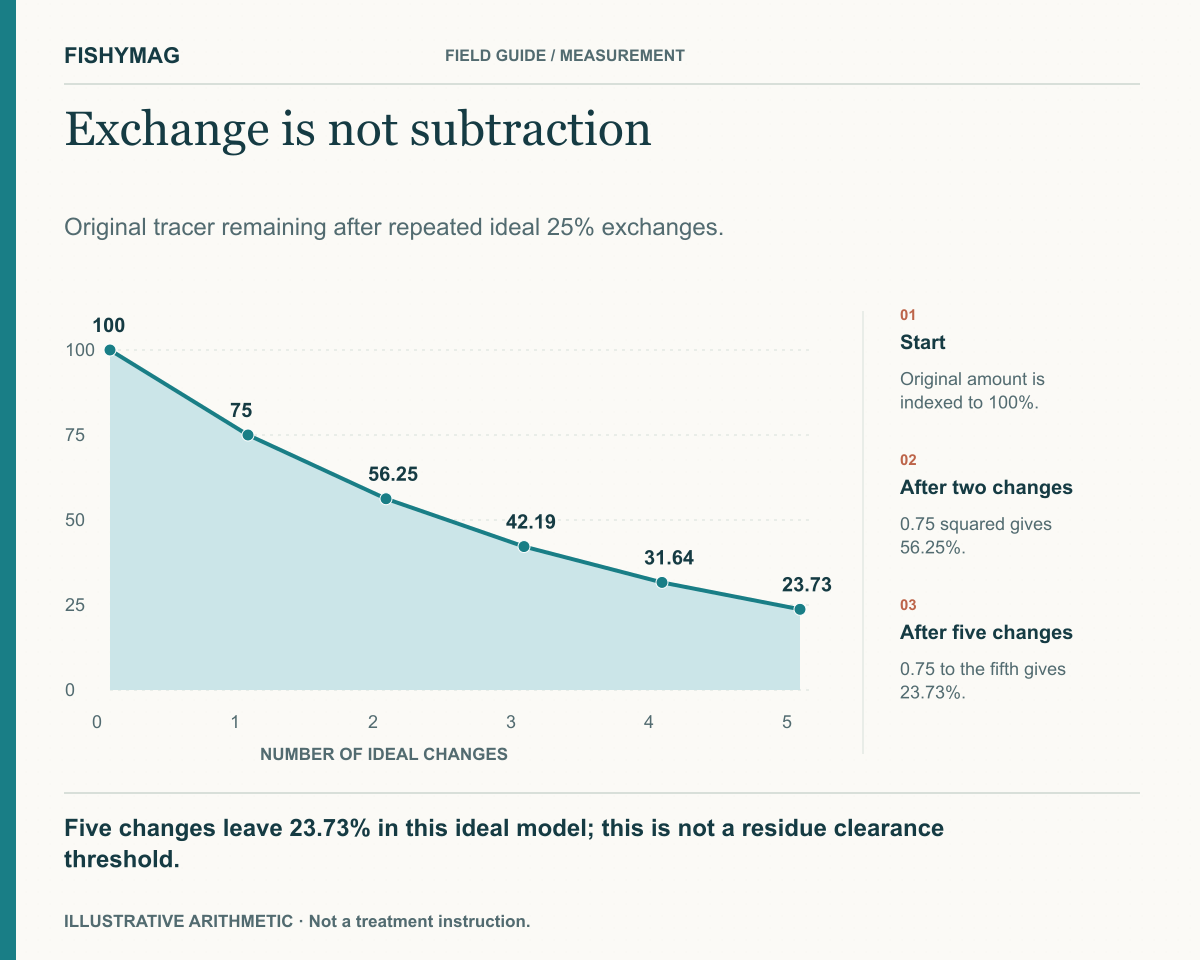
Figure data and explanation
Original tracer remaining after repeated ideal 25% exchanges.
- Start
- 100 % original. Original amount is indexed to 100%.
- After two changes
- 56.25 % original. 0.75 squared gives 56.25%.
- After five changes
- 23.7305 % original. 0.75 to the fifth gives 23.73%.
Five changes leave 23.73% in this ideal model; this is not a residue clearance threshold.
State the model before using the curve
Each example change removes one quarter of a completely mixed system and replaces it with water containing none of a fictional stable tracer. The operating volume is restored each time. There are no connected stagnant spaces, additions, binding, degradation or other removal processes. These assumptions are deliberately simpler than a real treated aquarium.
Multiply the remaining fractions
After one change, 75% of the original tracer remains. After two, 75% of that 75% remains, or 56.25% of the original. Continuing the multiplication gives 42.19%, 31.64% and 23.73% after three, four and five changes. Five changes do not remove five times 25% of the original because later removals draw from an already diluted mixture.
| Number of 25% changes | Original fraction | Original percentage |
|---|---|---|
| 1 | 0.75 | 75% |
| 2 | 0.75² | 56.25% |
| 3 | 0.75³ | 42.19% |
| 4 | 0.75⁴ | 31.64% |
| 5 | 0.75⁵ | 23.73% |
Read a threshold as an arithmetic question
For the purely mathematical question “when does this ideal model first fall below one quarter of its starting amount?”, compare successive values. Four changes leave 31.64%, above a quarter; five leave 23.73%, below it. This demonstrates a threshold crossing. It does not establish that a quarter, or any other fraction, is a safe residue level.
Do not confuse exchanged volume with original water removed
Five quarter-volume changes involve a cumulative exchanged volume of 125% of the system volume. Some replacement water is removed in later changes. That is why exchanging more than one tank-volume in cumulative quantities does not imply every original molecule has left. Keep exchanged litres and modelled original-water fraction as different measures.
Use the calculator inside its boundary
The water-change planner can show ideal remaining fractions for your chosen example inputs. It does not select timing, interpret symptoms or account for an actual product’s persistence. For a treatment-removal or return question, keep the manufacturer’s conditions, system history and relevant measurements. Do not use this curve as clearance for livestock.
Put it into practice
Your checklist
- Multiply the remaining fractions instead of adding removed percentages.
- Separate cumulative exchanged volume from original-water fraction.
- Do not interpret the curve as measured medication removal or livestock clearance.
Sources and scope
This article distinguishes manufacturer statements from FishyMag’s own workflows and arithmetic examples. Linked formulation records retain their own evidence dates; publishing this article does not refresh those records.
AI-assisted writing and development. Not hands-on product testing or veterinary review. How we publish →
FishyMag reports what manufacturers say, quoted and linked. It does not diagnose illness or recommend a treatment, and it never infers that a product is safe from the absence of a warning — where no statement exists, it says so.
Formulations change. Always read the label on the bottle in your hand, and contact the manufacturer if your tank contains anything valuable or unusual.