Measurement
Ten small transfers or one larger transfer? Track possible measurement error
A hypothetical error budget shows why repeated measurements do not automatically become more accurate.
By FishyMag · Published · Updated
Worked arithmetic example · Not a clinical review or treatment recommendation.
Quick answer
Repeated transfers can repeat a systematic error. Adding several small readings does not guarantee a more accurate delivered total. Use the device’s applicable instructions and accuracy information rather than assuming errors cancel.

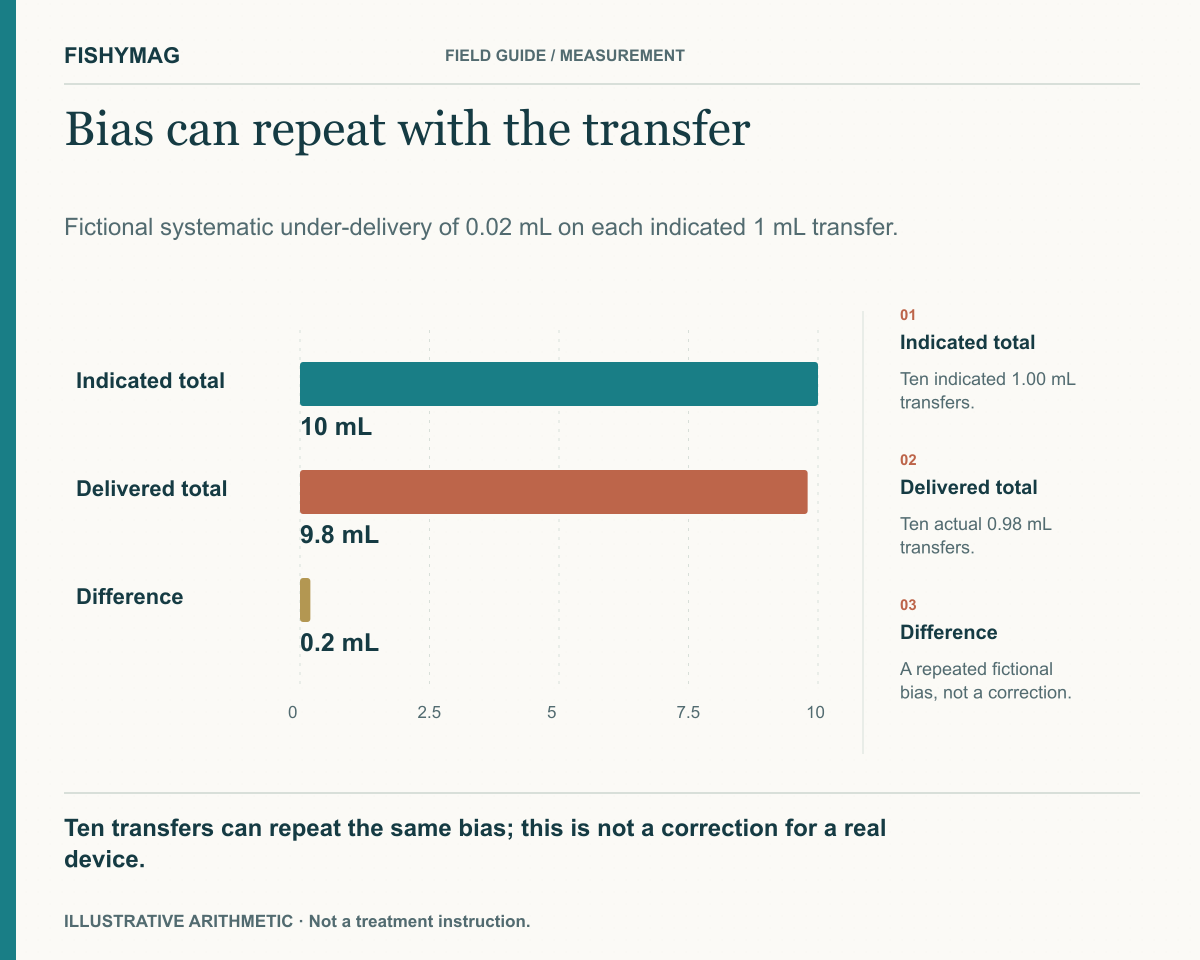
Figure data and explanation
Fictional systematic under-delivery of 0.02 mL on each indicated 1 mL transfer.
- Indicated total
- 10 mL. Ten indicated 1.00 mL transfers.
- Delivered total
- 9.8 mL. Ten actual 0.98 mL transfers.
- Difference
- 0.2 mL. A repeated fictional bias, not a correction.
Ten transfers can repeat the same bias; this is not a correction for a real device.
Define the hypothetical error before calculating
Imagine a device that consistently delivers 0.02 mL less than each indicated 1.00 mL transfer under a specified fictional setup. Each actual transfer would be 0.98 mL. This is an invented systematic error for explaining the arithmetic, not a claim about syringes or an accuracy specification for any product.
Sum the repeated bias
Ten such transfers would deliver 9.8 mL, while the sum of indicated readings is 10.0 mL. The difference is 0.2 mL. A single nominal 10 mL transfer on a different device cannot be declared better from this example, because its own accuracy, reading method and delivery behaviour have not been established.
Do not confuse worst-case bounds with random uncertainty
If all you know is an absolute bound per transfer, adding bounds gives a conservative bound for a sum. A statistical combination assumes an error model that must be justified; it cannot be selected simply because it produces a smaller number. Common calibration bias does not disappear when the same device is used repeatedly.
Make a measurement plan that can be checked
Record the desired quantity, device identity, scale, instructed reading point, transfer count and available accuracy information. If the method cannot support the required quantity, ask about an appropriate method for that product. This example provides no dilution recipe or correction factor to apply to real treatment amounts.
Put it into practice
Your checklist
- Identify whether the stated uncertainty is a bound, bias or justified statistical estimate.
- Record transfer count and applicable device information.
- Resolve measurement limitations instead of applying a fictional correction.
Sources and scope
This article distinguishes manufacturer statements from FishyMag’s own workflows and arithmetic examples. Linked formulation records retain their own evidence dates; publishing this article does not refresh those records.
AI-assisted writing and development. Not hands-on product testing or veterinary review. How we publish →
FishyMag reports what manufacturers say, quoted and linked. It does not diagnose illness or recommend a treatment, and it never infers that a product is safe from the absence of a warning — where no statement exists, it says so.
Formulations change. Always read the label on the bottle in your hand, and contact the manufacturer if your tank contains anything valuable or unusual.