Evidence decisions
Keep an offline evidence copy you can identify later
A small archive manifest connects a saved label or document to its source, capture time and file fingerprint.
By FishyMag · Published
FishyMag editorial workflow · Not a clinical review or treatment recommendation.
Quick answer
A saved evidence file needs provenance as well as a filename. Keep its source URL, capture time, product identity and an integrity fingerprint if you use one. A matching checksum can help identify unchanged file bytes; it does not prove that the document is authentic or applicable.
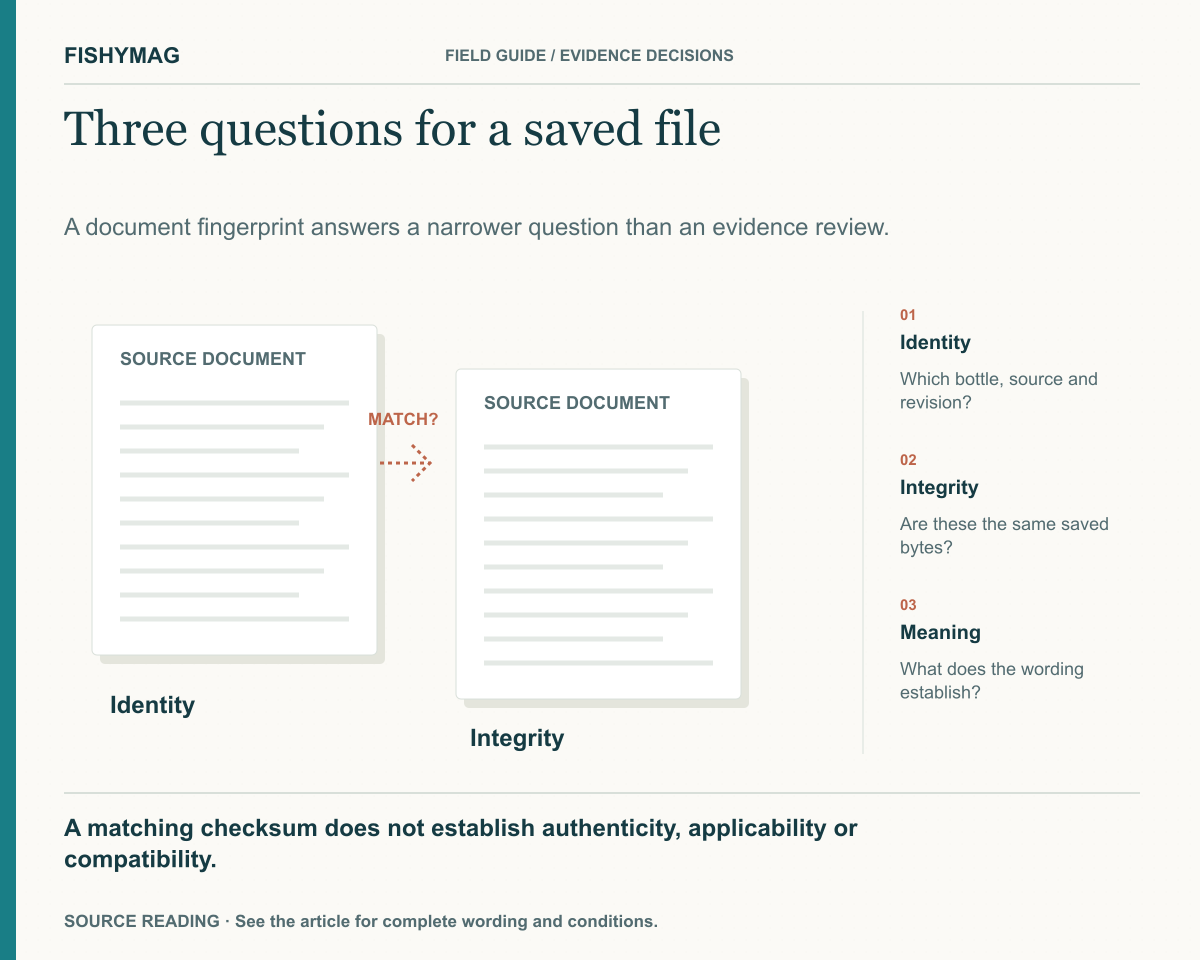
Figure data and explanation
A document fingerprint answers a narrower question than an evidence review.
- Identity
- Which bottle, source and revision?
- Integrity
- Are these the same saved bytes?
- Meaning
- What does the wording establish?
A matching checksum does not establish authenticity, applicability or compatibility.
Save the context before the page disappears
For a manufacturer document or label you already have permission to retain, save the file together with the original URL, product and market, relevant section and access time. If the source states a revision date, record that separately. A file called “latest-label.pdf” is not enough to identify which version was read or why it mattered.
Use a manifest rather than a clever filename
A short text manifest can hold: local filename, source URL, capture timestamp, document revision, bottle identity and the claim being checked. Keep a local identifier for the record. Do not put private correspondence or customer details into a public source archive. A captured page can contain unrelated personal or account information, so review what was actually saved before sharing it.
| Question | Record to retain | Does not establish |
|---|---|---|
| Identity | Product, market, URL and revision | That the bytes stayed unchanged |
| Integrity | Fingerprint for the saved bytes | That the document is authentic |
| Meaning | Applicable wording and human review | A universal safety claim |
Understand what a checksum adds
The Apache Software Foundation’s verification guidance distinguishes file-integrity checking from authenticity guarantees. A SHA-256 checksum of an unchanged file should match a checksum you recorded for those same bytes. An edit, recompression or different download can change the fingerprint. The fingerprint does not tell you which bottle the document applies to or whether its manufacturer claim is supported.
Use an optional local check carefully
On a Mac with the standard command available, the pattern is “shasum -a 256” followed by the path of the file you intend to fingerprint. Use the actual saved file and retain the output in the manifest. This article does not ask you to run a downloaded program or upload a document. If checksums are unfamiliar, a clear provenance record is still more useful than an unexplained renamed file.
Keep identity, integrity and review separate
Three questions remain: Is this the relevant document? Is my saved copy unchanged? What does its wording actually establish? Answering one does not answer the others. FishyMag formulation changes still require human evidence review, and an offline copy does not refresh an old source-check date or create compatibility clearance.
Put it into practice
Your checklist
- Store source, capture time and stated revision separately.
- Treat checksums as file-integrity aids, not authenticity or compatibility certificates.
- Review a saved file for private content before sharing it.
Sources and scope
This article distinguishes manufacturer statements from FishyMag’s own workflows and arithmetic examples. Linked formulation records retain their own evidence dates; publishing this article does not refresh those records.
- Apache Software Foundation: checksum and authenticity distinctions, read November 8, 2026 ↗
- FishyMag evidence methodology ↗
AI-assisted writing and development. Not hands-on product testing or veterinary review. How we publish →
FishyMag reports what manufacturers say, quoted and linked. It does not diagnose illness or recommend a treatment, and it never infers that a product is safe from the absence of a warning — where no statement exists, it says so.
Formulations change. Always read the label on the bottle in your hand, and contact the manufacturer if your tank contains anything valuable or unusual.