Evidence decisions
Could nitrite explain two aquarium nitrate results?
Use HI781’s actual interference statement to assess a nitrate disagreement without inventing a nitrite correction factor.
By FishyMag · Published
Manufacturer-source commentary · Not a clinical review or treatment recommendation.
Quick answer
Hanna lists nitrite and copper as HI781 interferences. Its linked manual does not provide a nitrite correction factor. If a comparison sample contains nitrite, retain that limitation and ask for applicable method evidence. The statement supports flagging the comparison, not subtracting a guessed amount from nitrate.
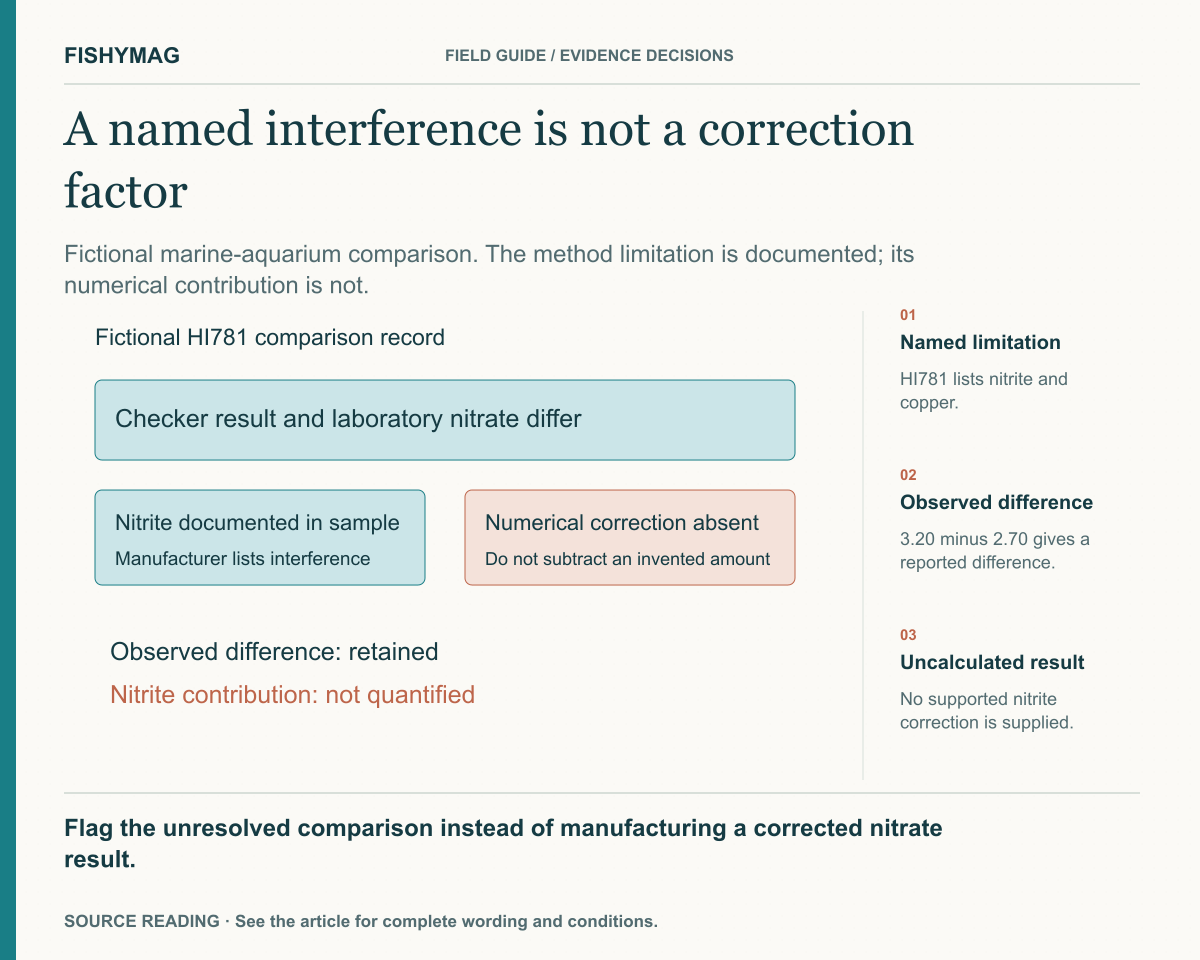
Figure data and explanation
Fictional marine-aquarium comparison. The method limitation is documented; its numerical contribution is not.
- Named limitation
- HI781 lists nitrite and copper.
- Observed difference
- 3.20 minus 2.70 gives a reported difference.
- Uncalculated result
- No supported nitrite correction is supplied.
Flag the unresolved comparison instead of manufacturing a corrected nitrate result.
Use the statement for the exact checker
The HI781 instructions identify nitrite and copper as interferences and specify a seawater method. The linked document does not quantify a nitrate-equivalent nitrite contribution. This is enough to identify an analytical limitation; it is not enough to calculate its size. Another method’s reduction chemistry or correction cannot be silently imported into the checker’s result.
Complete a comparison with a real unresolved quantity
All numbers in this teaching packet are invented. The marine-aquarium sample is identified as M7. Its HI781 record is 3.20 ppm as NO₃, while a laboratory separately confirms a compatible nitrate-only result, using the same ppm convention, of 2.70 ppm as NO₃. A nitrite report is also present. The numerical difference is 0.50 in the stated concentration basis. It remains a difference between reported results, without a demonstrated mechanism.
| Item | Supplied evidence | Permissible use |
|---|---|---|
| HI781 | 3.20 ppm as NO₃; M7 | Retain the original result and method |
| Laboratory nitrate | 2.70 ppm as NO₃; matched M7 | Retain nitrate-only definition |
| Nitrite | Presence documented in the matched sample | Flag the named interference |
| Difference | 3.20 − 2.70 = 0.50 | Descriptive difference, not a nitrite correction |
| Contribution model | No validated factor supplied | Corrected checker result is not calculated |
Avoid a false resolution
The completed finding is: “The reports differ by 0.50 on the declared matching basis. HI781’s nitrite limitation applies to the comparison, but the supplied evidence does not quantify its contribution.” Other differences, including sample timing, processing and measurement uncertainty, still need review. A nitrite interference statement does not prove it explains the entire difference. EPA 353.2 illustrates that a method may deliberately distinguish a combined nitrate-plus-nitrite measurement from nitrite alone; that does not authorize changing HI781 chemistry or assigning an EPA response factor. Ask the instrument manufacturer and laboratory what evidence can support this exact comparison.
Use your own details
Could nitrite explain two aquarium nitrate results? worksheet
Download the editable text file, fill it in on your device and keep it with the relevant record. This blank worksheet records your information; it does not verify entries or approve treatment.
- Sample identity and time
- Test and mode used
- Original displayed quantity
- Chemical reporting basis
- Applicable source and revision
- Other method and sample match
- Supported comparison
- Specific unresolved evidence
Put it into practice
Your checklist
- Match the checker model and sample matrix.
- Flag a documented interferent without guessing its contribution.
- Keep the observed difference separate from a validated correction.
Sources and scope
This article distinguishes manufacturer statements from FishyMag’s own workflows and arithmetic examples. Linked formulation records retain their own evidence dates; publishing this article does not refresh those records.
- Hanna HI781 manufacturer specifications; reviewed November 8, 2026 ↗
- Hanna HI781 instructions IST781 09/20; reviewed November 8, 2026 ↗
- EPA Method 353.2, Revision 2.0; reviewed November 8, 2026 ↗
AI-assisted writing and development. Not hands-on product testing or veterinary review. How we publish →
FishyMag reports what manufacturers say, quoted and linked. It does not diagnose illness or recommend a treatment, and it never infers that a product is safe from the absence of a warning — where no statement exists, it says so.
Formulations change. Always read the label on the bottle in your hand, and contact the manufacturer if your tank contains anything valuable or unusual.