Evidence decisions
A changed ammonia test after Prime: separate the two claims
Build a competing-explanations record when a conditioner is followed by a changed ammonia result, without treating a manufacturer explanation as an independent assay.
By FishyMag · Published
Manufacturer-source commentary · Not a clinical review or treatment recommendation.
Quick answer
A changed test result after a conditioner can raise both a water-chemistry question and an analytical-response question. The time sequence alone does not distinguish them. Keep the named formulation, exact test chemistry and result definition together, and attribute Seachem’s interference explanation rather than treating it as an independently demonstrated outcome in your tank.
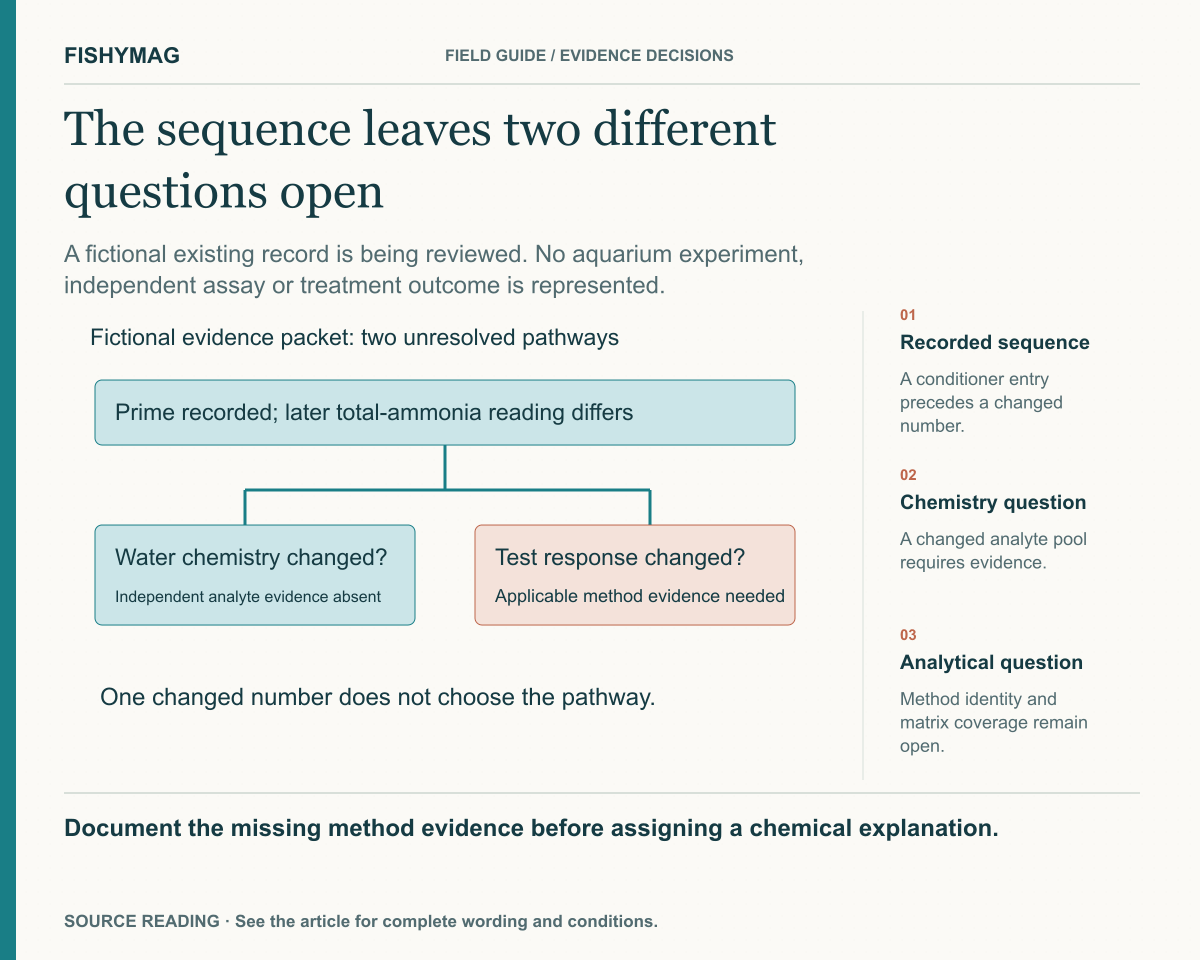
Figure data and explanation
A fictional existing record is being reviewed. No aquarium experiment, independent assay or treatment outcome is represented.
- Recorded sequence
- A conditioner entry precedes a changed number.
- Chemistry question
- A changed analyte pool requires evidence.
- Analytical question
- Method identity and matrix coverage remain open.
Document the missing method evidence before assigning a chemical explanation.
Separate the statements being assessed
Seachem’s Prime FAQ says reducing agents or ammonia binders can affect certain reagent-based ammonia tests and contrasts its MultiTest method. This is the manufacturer’s explanation. It is not a complete independent validation dataset for every test and aquarium matrix. Nor does a claim about ammonia binding by itself establish how much of the analyte a particular assay should report. Keep the chemistry claim and the test-response claim as separate rows.
Work through the available evidence
In this fictional packet, the treatment log records Prime. The keeper later copies a different total-ammonia value, but the kit revision is missing. There is no matched independent assay. No actual conditioner trial, livestock response or analytical performance is represented.
| Proposed explanation | Evidence present | Discriminating evidence absent | Case conclusion |
|---|---|---|---|
| Defined ammonia pool changed | Earlier and later numbers | Matched measurand and applicable assay validation | Not established |
| Analytical response changed | Manufacturer interference explanation | Exact test chemistry, revision and matrix match | Plausible question, not demonstrated here |
| Records are not comparable | Kit revision is missing | Original method and reporting basis | A definite record gap remains |
Finish with a question that could be answered
The completed question is: “For this exact Prime formulation and this named ammonia method, what does the result measure, and which validation documents address the conditioner-containing matrix?” Attach the original kit document and treatment record. Ask what independent analytical evidence would distinguish actual analyte change from altered response, including its sample preparation and limitations. Do not choose an alternative test merely because its number is lower. This packet cannot justify a zero reading, a diagnosis or a universal waiting period. Preserve the changed readings unchanged and mark the comparison unresolved until the method identity and applicability are established.
Use your own details
A changed ammonia test after Prime: separate the two claims worksheet
Download the editable text file, fill it in on your device and keep it with the relevant record. This blank worksheet records your information; it does not verify entries or approve treatment.
- Sample identity and time
- Test and mode used
- Original displayed quantity
- Chemical reporting basis
- Applicable source and revision
- Other method and sample match
- Supported comparison
- Specific unresolved evidence
Put it into practice
Your checklist
- List chemistry and test-response explanations separately.
- Attribute the manufacturer claim and retain its conditions.
- Ask for method-specific validation rather than selecting a preferred number.
Sources and scope
This article distinguishes manufacturer statements from FishyMag’s own workflows and arithmetic examples. Linked formulation records retain their own evidence dates; publishing this article does not refresh those records.
- Seachem Prime FAQ: ammonia test readings; reviewed November 8, 2026 ↗
- Seachem MultiTest Ammonia manufacturer page; reviewed November 8, 2026 ↗
- FishyMag evidence methodology; reviewed November 8, 2026 ↗
AI-assisted writing and development. Not hands-on product testing or veterinary review. How we publish →
FishyMag reports what manufacturers say, quoted and linked. It does not diagnose illness or recommend a treatment, and it never infers that a product is safe from the absence of a warning — where no statement exists, it says so.
Formulations change. Always read the label on the bottle in your hand, and contact the manufacturer if your tank contains anything valuable or unusual.