Measurement
Nitrate or nitrate as nitrogen? Read the result’s full name
Two reports can both say mg/L and still use different reporting bases.
By FishyMag · Published
Worked arithmetic example · Not a clinical review or treatment recommendation.
Quick answer
A result expressed as nitrate-nitrogen is not numerically interchangeable with nitrate ion. For that specific conversion, multiply nitrate-nitrogen by about 4.43 to express it as nitrate. Confirm the analyte before converting; combined nitrate-plus-nitrite results are a different case.
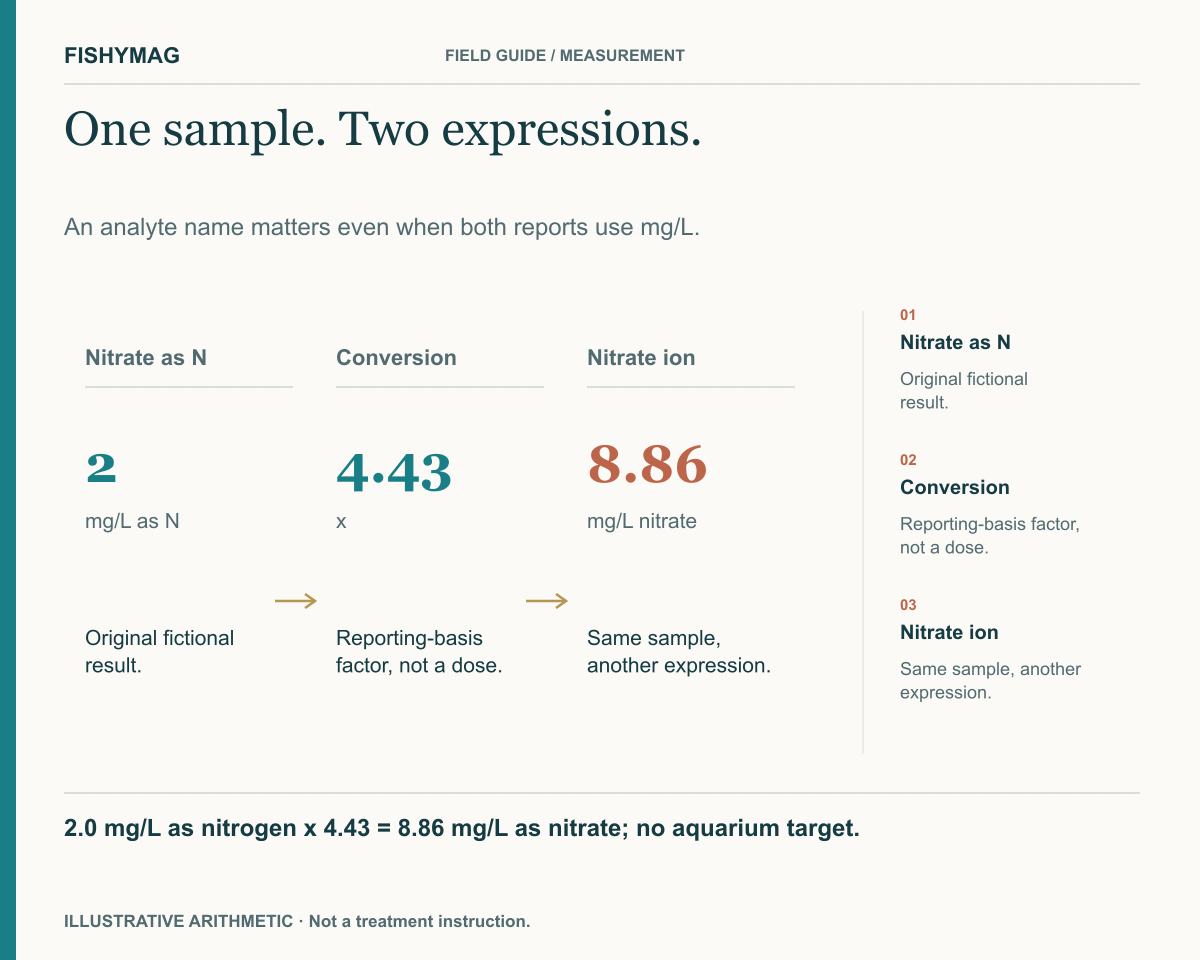
Figure data and explanation
An analyte name matters even when both reports use mg/L.
- Nitrate as N
- 2 mg/L as N. Original fictional result.
- Conversion
- 4.43 x. Reporting-basis factor, not a dose.
- Nitrate ion
- 8.86 mg/L nitrate. Same sample, another expression.
2.0 mg/L as nitrogen x 4.43 = 8.86 mg/L as nitrate; no aquarium target.
Look beyond the unit column
The University of Georgia laboratory guidance distinguishes nitrate ion from nitrate reported as nitrogen. Both may be written in mg/L. A unit match therefore does not prove that two instruments or reports express the same quantity. Copy the complete analyte name, including “as N” or the chemical notation, into the record before comparing results.
Convert an explicitly defined example
A fictional report of 2.0 mg/L nitrate as nitrogen corresponds to approximately 8.86 mg/L as nitrate using the 4.43 factor. Reversing the expression means dividing by the factor. The converted figure describes the same reported sample quantity on another basis; it does not mean the aquarium’s nitrate increased between tests.
| Expression | Worked value | Meaning |
|---|---|---|
| Nitrate as nitrogen | 2.0 mg/L | Original fictional result |
| Nitrate ion | 2.0 x 4.43 = 8.86 mg/L | Converted expression |
| Combined nitrate plus nitrite | Not converted here | Different stated analyte |
Check what is included in the measurement
Some laboratory reporting combines nitrate and nitrite as nitrogen. Do not relabel that combined result as nitrate alone by applying the factor. Also keep the sample location, collection time and method. Two correctly converted numbers may still concern different samples or methods, and conversion does not resolve their disagreement.
Preserve the original alongside the conversion
Use fields for original value, original unit, full reporting basis, conversion factor and converted expression. Keep the source for the factor attached. If the original report is unclear, ask the laboratory or kit manufacturer how the result is expressed instead of choosing the version that makes two numbers agree.
Keep interpretation outside this calculation
This article provides no aquarium target range, diagnosis or treatment response. The linked university page discusses drinking-water reporting; its human drinking-water standards are not aquarium husbandry limits. Only the reporting distinction and conversion are used here. The figure is an invented worked example, not a test of any aquarium kit.
Put it into practice
Your checklist
- Copy the full analyte name, including any “as nitrogen” qualifier.
- Retain the original value beside any converted expression.
- Do not convert a combined nitrate-plus-nitrite result as nitrate alone.
Sources and scope
This article distinguishes manufacturer statements from FishyMag’s own workflows and arithmetic examples. Linked formulation records retain their own evidence dates; publishing this article does not refresh those records.
- University of Georgia AESL: nitrate reporting bases and units, read November 8, 2026 ↗
- FishyMag evidence methodology ↗
AI-assisted writing and development. Not hands-on product testing or veterinary review. How we publish →
FishyMag reports what manufacturers say, quoted and linked. It does not diagnose illness or recommend a treatment, and it never infers that a product is safe from the absence of a warning — where no statement exists, it says so.
Formulations change. Always read the label on the bottle in your hand, and contact the manufacturer if your tank contains anything valuable or unusual.