Measurement
mg/L and µg/L: prevent a thousandfold transcription error
A unit ladder and worked record help you normalise a result without changing what was measured.
By FishyMag · Published
Worked arithmetic example · Not a clinical review or treatment recommendation.
Quick answer
One milligram is 1,000 micrograms. For the same analyte and sample basis, 250 µg/L equals 0.250 mg/L. Keep the unit attached to every value, especially when a device uses a different display scale from a log.

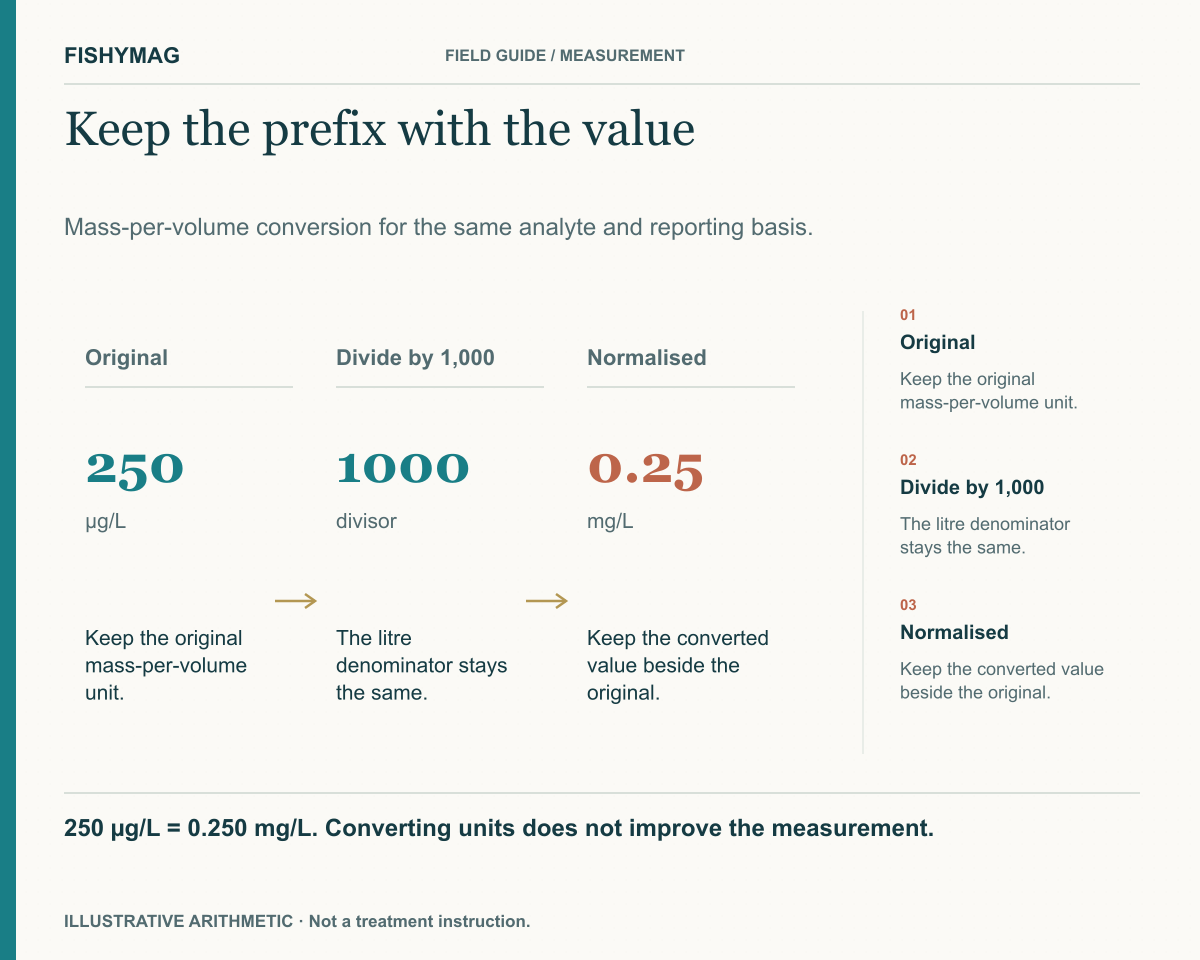
Figure data and explanation
Mass-per-volume conversion for the same analyte and reporting basis.
- Original
- 250 µg/L. Keep the original mass-per-volume unit.
- Divide by 1,000
- 1000 divisor. The litre denominator stays the same.
- Normalised
- 0.25 mg/L. Keep the converted value beside the original.
250 µg/L = 0.250 mg/L. Converting units does not improve the measurement.
Copy the display before normalising it
Record the exact result, unit and analyte shown by the instrument or report. A handwritten “250” loses the information that determines its scale. If a display says ppb rather than µg/L, first check the manufacturer’s definition and method. This article’s exact worked conversion is between mass-per-volume units, not a universal assertion about every use of ppm or ppb.
Use a visible conversion chain
For the invented value 250 micrograms per litre, divide by 1,000 to express milligrams per litre: 0.250 mg/L. Going the other direction multiplies by 1,000. Litres stay in the denominator in this example. Converting the numerator does not change the sampled aquarium or supply new precision.
| Original | Operation | Normalised |
|---|---|---|
| 250 µg/L | Divide by 1,000 | 0.250 mg/L |
| 0.250 mg/L | Multiply by 1,000 | 250 µg/L |
| 250 without a unit | Cannot establish the scale | Resolve the missing unit |
Avoid a decimal that implies extra certainty
Writing 0.250 rather than 0.25 may preserve the original display resolution, but it does not prove the method is accurate to three decimal places. Retain the original report’s significant-figure convention and uncertainty information if provided. A spreadsheet cell format can add zeros without adding measurement evidence.
Compare after identity and basis are matched
A copper result and a nitrate result cannot be merged just because both are now mg/L. Nor does normalising units settle a difference between free and total measurements, or between a constituent and that constituent expressed on another basis. Make these identity checks before treating two readings as a trend.
Use a two-column handover
A reliable note could say “Original: 250 µg/L [named analyte, method, sample time]. Normalised: 0.250 mg/L, divided by 1,000.” Keep both values in exported records and label the normalised column. The conversion is not a concentration target or an instruction to add or remove a product.
Put it into practice
Your checklist
- Record the original value, unit and analyte before conversion.
- Show whether the conversion multiplies or divides by 1,000.
- Keep reporting basis and measurement uncertainty separate from formatting.
Sources and scope
This article distinguishes manufacturer statements from FishyMag’s own workflows and arithmetic examples. Linked formulation records retain their own evidence dates; publishing this article does not refresh those records.
- University of Georgia AESL: nitrate reporting bases and units, read November 8, 2026 ↗
- FishyMag evidence methodology ↗
AI-assisted writing and development. Not hands-on product testing or veterinary review. How we publish →
FishyMag reports what manufacturers say, quoted and linked. It does not diagnose illness or recommend a treatment, and it never infers that a product is safe from the absence of a warning — where no statement exists, it says so.
Formulations change. Always read the label on the bottle in your hand, and contact the manufacturer if your tank contains anything valuable or unusual.