Evidence decisions
MetroPlex and repeated warnings: what boilerplate can and cannot show
A source-comparison method distinguishes a repeated instruction from a formulation-specific experiment.
By FishyMag · Published · Updated
Manufacturer-source commentary · Not a clinical review or treatment recommendation.
Quick answer
A repeated manufacturer warning still counts as an instruction. Its appearance across different products does not prove that each formulation was tested in the same way, and it does not justify ignoring the warning.

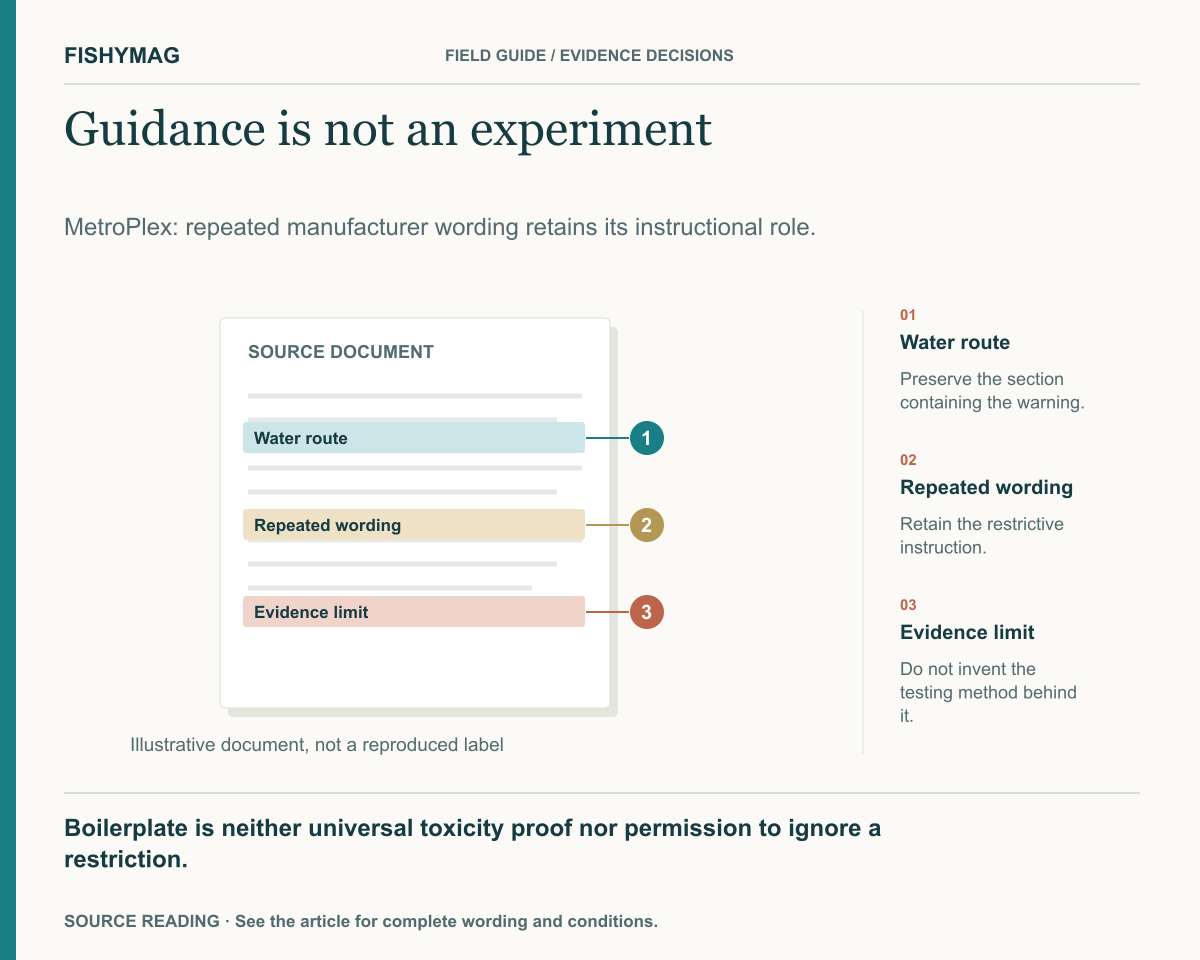
Figure data and explanation
MetroPlex: repeated manufacturer wording retains its instructional role.
- Water route
- Preserve the section containing the warning.
- Repeated wording
- Retain the restrictive instruction.
- Evidence limit
- Do not invent the testing method behind it.
Boilerplate is neither universal toxicity proof nor permission to ignore a restriction.
Identify the statement’s role
MetroPlex’s water-dosing directions include an instruction to remove invertebrates. Similar wording appears elsewhere in Seachem’s medication range. FishyMag treats that as manufacturer guidance. It does not describe the repeated sentence as a published experiment showing a measured response in every invertebrate species.
Make a comparison grid with context
For each page you compare, record the product, market if established, section heading, route, exact warning and source date. A repeated phrase in a water-dosing block is not automatically equivalent to a statement about a prepared food. If one context is missing, leave that row incomplete rather than declaring that the manufacturer contradicted itself.
Avoid opposite shortcuts
One shortcut calls every repeated warning proof that all products have the same toxicity. Another dismisses it as generic wording and calls a product safe. Neither follows from the repetition. A better note says the manufacturer gives this restriction, while the checked passage does not establish the testing method behind it.
Ask about the evidence, not just the conclusion
A focused question names the formulation and route, then asks whether there is current group-specific guidance and what conditions it covers. Keep any reply with the original question. New positive formulation verdicts still need the human evidence-review process; this editorial explanation creates none.
Put it into practice
Your checklist
- Retain the restrictive instruction even when wording repeats.
- Record route and section before comparing similar sentences.
- Distinguish manufacturer guidance from claims about underlying experiments.
Sources and scope
This article distinguishes manufacturer statements from FishyMag’s own workflows and arithmetic examples. Linked formulation records retain their own evidence dates; publishing this article does not refresh those records.
- Seachem Metroplex: manufacturer directions and FAQ, accessed November 7, 2026 ↗
- FishyMag evidence methodology and editorial scope ↗
AI-assisted writing and development. Not hands-on product testing or veterinary review. How we publish →
Read the formulation evidence
These links provide context, not product recommendations.
FishyMag reports what manufacturers say, quoted and linked. It does not diagnose illness or recommend a treatment, and it never infers that a product is safe from the absence of a warning — where no statement exists, it says so.
Formulations change. Always read the label on the bottle in your hand, and contact the manufacturer if your tank contains anything valuable or unusual.