Measurement
Is the pH junction suited to low-conductivity aquarium water?
Compare two documented pH junction designs for a low-conductivity aquarium sample while keeping missing numerical limits and meter compatibility visible.
By FishyMag · Published
Worked evidence example · Not a clinical review or treatment recommendation.
Quick answer
Use the electrode’s documented application scope, junction and complete connection chain. Hanna lists low-conductivity solutions for HI1053B; its HI11310 sheet lists general laboratory use without a numerical low-conductivity limit. The fictional 25 µS/cm sample therefore has a relevant application lead for one probe, but no complete setup approval for either.
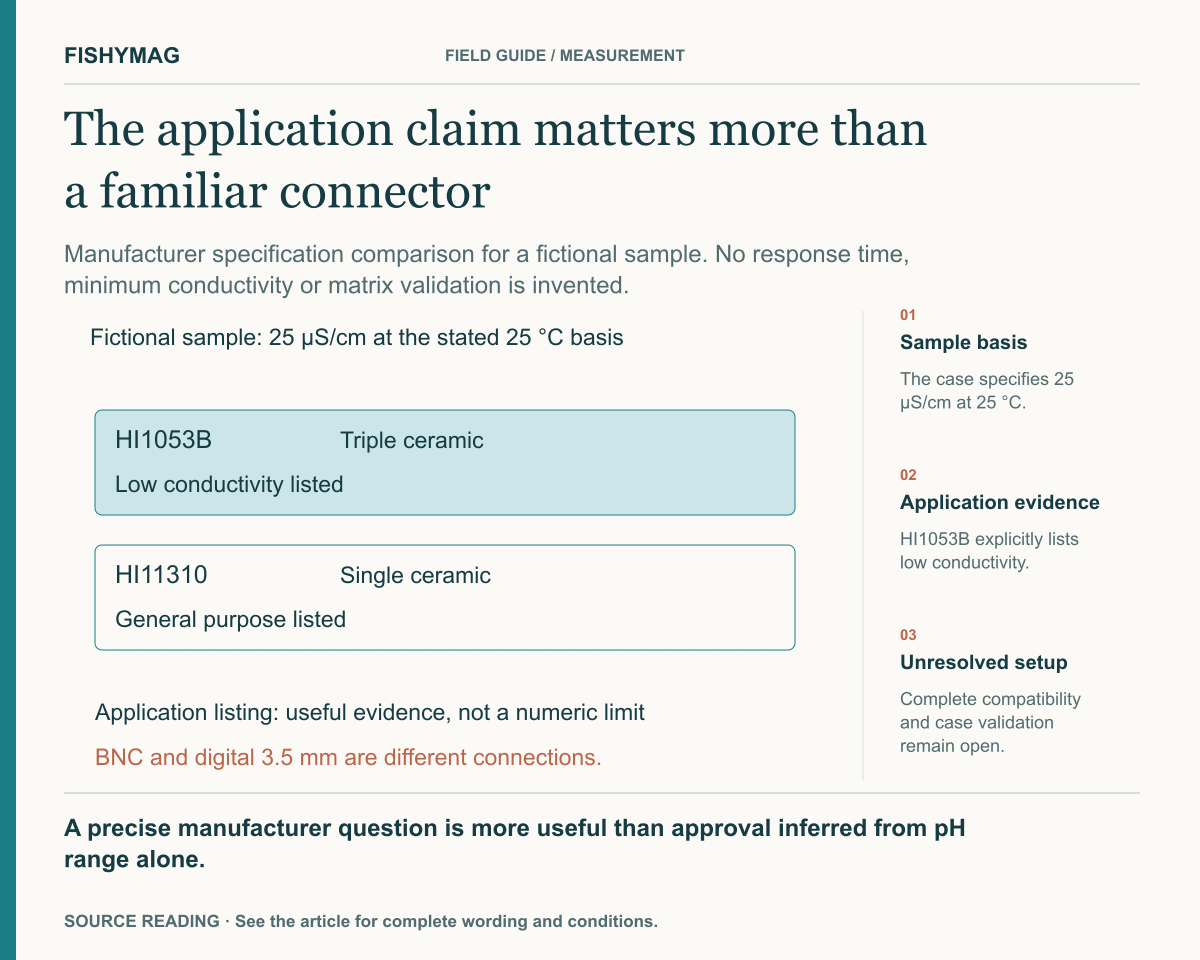
Figure data and explanation
Manufacturer specification comparison for a fictional sample. No response time, minimum conductivity or matrix validation is invented.
- Sample basis
- The case specifies 25 µS/cm at 25 °C.
- Application evidence
- HI1053B explicitly lists low conductivity.
- Unresolved setup
- Complete compatibility and case validation remain open.
A precise manufacturer question is more useful than approval inferred from pH range alone.
A pH range does not answer the junction question
The source packet concerns a fictional replacement-water sample associated with an aquarium evidence review, reported as 25 µS/cm on a 25 °C reference basis. The question is whether the pH measurement chain has documented suitability for that application. A connector that plugs in or a pH range covering the displayed value does not resolve reference-junction behavior. Hanna’s HI1053B page explicitly links its triple ceramic design to low-conductivity applications. This remains a manufacturer application statement, not FishyMag performance testing.
Complete the source-based comparison
The manufacturer sources distinguish the analog HI1053B from the digital HI11310. Their connector types cannot be silently treated as interchangeable. Missing numerical limits remain missing.
| Evidence field | HI1053B | HI11310 |
|---|---|---|
| Reference and junction | Double Ag/AgCl; triple ceramic | Double Ag/AgCl; single ceramic |
| Application wording in cited source | Low-conductivity solutions listed | General laboratory purpose listed |
| Temperature sensor | Not built in | Built in |
| Connection | BNC | Digital 3.5 mm connector |
| Specific 25 µS/cm validation | Not supplied on cited page | Not supplied on cited sheet |
| Completed finding | Relevant application scope; exact case confirmation still needed | Low-conductivity suitability unresolved from this source |
Finish with a question that closes the actual gap
Ask the manufacturer about the complete meter-electrode combination for the stated conductivity basis, sample composition, temperature and observation conditions. Request any numerical lower limit and its measurement basis, along with evidence for the intended use. Do not infer a minimum conductivity from junction flow or translate the listed application into a treatment-safety finding. The useful outcome is a narrowed procurement or laboratory question: one source explicitly addresses the application family, while the other does not establish it. Neither source alone proves that a particular aquarium pH result is accurate.
Use your own details
Is the pH junction suited to low-conductivity aquarium water? worksheet
Download the editable text file, fill it in on your device and keep it with the relevant record. This blank worksheet records your information; it does not verify entries or approve treatment.
- Aquarium and sample boundary
- Complete meter, probe and document revision
- Sample quantity and temperature basis
- Original observations with timestamps
- Relevant manufacturer claim and conditions
- Completed comparison or calculation
- What the available evidence cannot resolve
- Specific next document or comparison required
Put it into practice
Your checklist
- Use application scope alongside junction construction.
- Preserve analog and digital connection differences.
- Ask for the missing case-specific limit instead of inventing one.
Sources and scope
This article distinguishes manufacturer statements from FishyMag’s own workflows and arithmetic examples. Linked formulation records retain their own evidence dates; publishing this article does not refresh those records.
- Hanna HI1053B manufacturer electrode specification; reviewed November 8, 2026 ↗
- Hanna digital-electrode comparison sheet: HI11310, HI11311, HI10530, HI10430; reviewed November 8, 2026 ↗
AI-assisted writing and development. Not hands-on product testing or veterinary review. How we publish →
FishyMag reports what manufacturers say, quoted and linked. It does not diagnose illness or recommend a treatment, and it never infers that a product is safe from the absence of a warning — where no statement exists, it says so.
Formulations change. Always read the label on the bottle in your hand, and contact the manufacturer if your tank contains anything valuable or unusual.