Measurement
Measure the water space, not the outside of the glass
A dimensioned tank drawing shows how glass, water level and radius errors enter a geometric estimate.
By FishyMag · Published
Worked arithmetic example · Not a clinical review or treatment recommendation.
Quick answer
A geometric water-volume estimate needs internal dimensions at the actual water level. Outside dimensions and full tank height describe a different space. For a cylinder, use the radius in the area formula; confusing it with diameter creates a fourfold error.
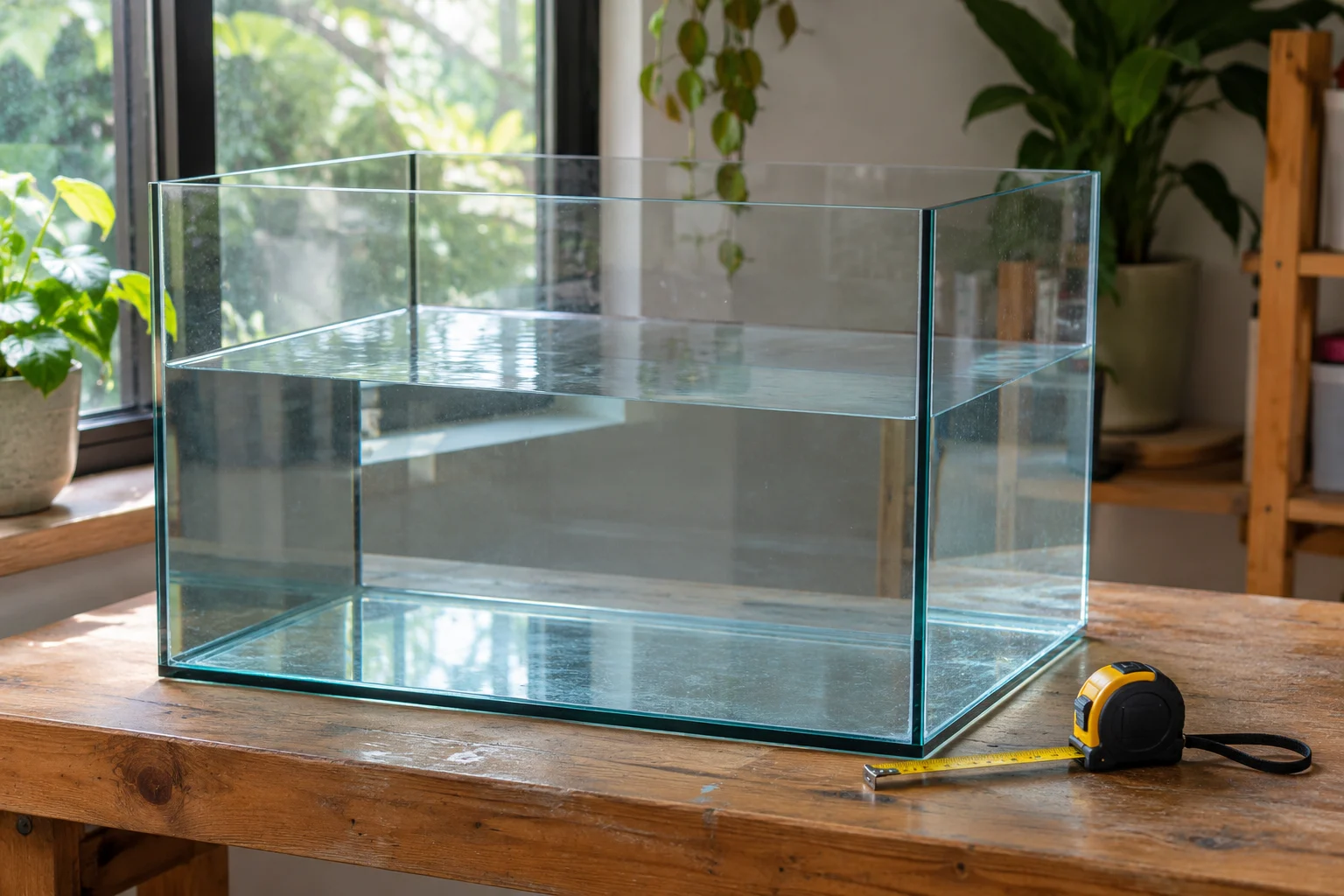
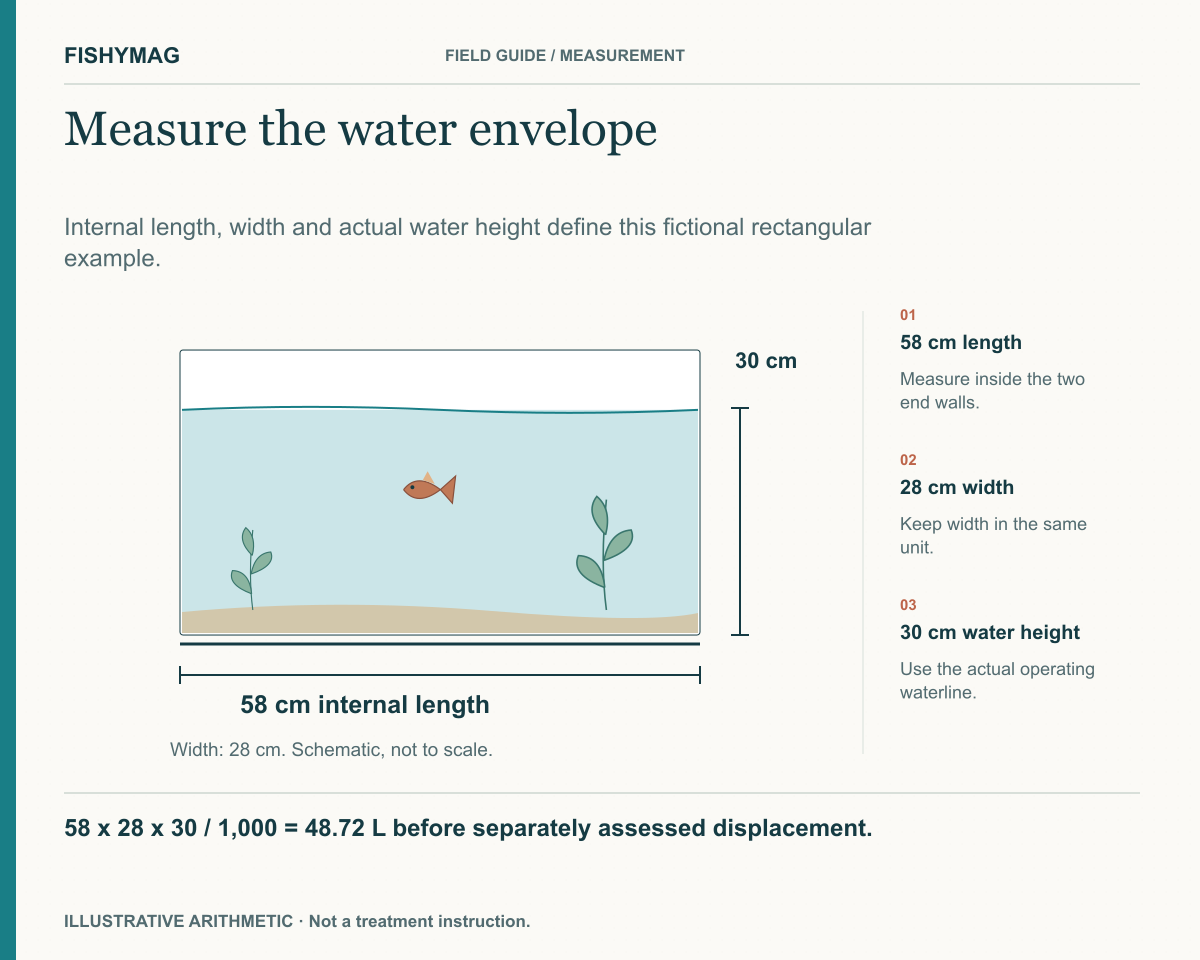
Figure data and explanation
Internal length, width and actual water height define this fictional rectangular example.
- 58 cm length
- 58 cm. Measure inside the two end walls.
- 28 cm width
- 28 cm. Keep width in the same unit.
- 30 cm water height
- 30 cm. Use the actual operating waterline.
58 x 28 x 30 / 1,000 = 48.72 L before separately assessed displacement.
Choose the boundary you mean
A tank sold as 60 cm long may be described by outside dimensions. A volume calculation for water needs the space inside the walls and the height actually filled. Do not subtract an assumed glass thickness simply because it seems typical. Measure or establish the relevant dimensions, identify your method and record uncertainty where an edge is difficult to access.
Work one rectangular example
For an invented internal water space of 58 cm by 28 cm by 30 cm, the rectangular envelope is 48,720 cubic centimetres, or 48.72 L. Using outside dimensions of 60 by 30 with a full height of 35 gives 63 L. The 14.28 L difference in these examples combines different boundaries and levels; it is not an estimate of displacement for a real aquarium.
| Input set | Calculation | Envelope |
|---|---|---|
| Internal example | 58 x 28 x 30 / 1000 | 48.72 L |
| Outside/full-height example | 60 x 30 x 35 / 1000 | 63 L |
| Cylinder example | pi x 15² x 30 / 1000 | About 21.21 L |
Keep the curved-tank input explicit
For a fictional cylinder with an internal diameter of 30 cm and water height of 30 cm, the radius is 15 cm. Its geometric envelope is pi times 15 squared times 30, about 21.21 L. Substituting 30 cm for the radius gives about 84.82 L, four times as much. Write “diameter” or “radius” beside the measured number instead of relying on a bare label such as width.
Envelope volume is still not net water
Substrate, solid decorations and connected equipment change the next part of the estimate. A measured fill record for the assembled system may already include those effects. Do not subtract them again merely because a geometric worksheet also has a displacement field. Keep geometry and fill measurements as separate methods and explain which one supports the final input.
Make the record reproducible
Save a sketch with dimension arrows, the unit, the date, the operating waterline and a note about what is connected. Another keeper should be able to tell whether a later number describes the same configuration. This figure helps audit an input; it does not certify capacity, structural safety or a treatment dose.
Put it into practice
Your checklist
- Use internal boundaries and the actual waterline.
- Label diameter and radius explicitly on curved tanks.
- Separate geometric envelope, displacement and measured fill records.
Sources and scope
This article distinguishes manufacturer statements from FishyMag’s own workflows and arithmetic examples. Linked formulation records retain their own evidence dates; publishing this article does not refresh those records.
AI-assisted writing and development. Not hands-on product testing or veterinary review. How we publish →
FishyMag reports what manufacturers say, quoted and linked. It does not diagnose illness or recommend a treatment, and it never infers that a product is safe from the absence of a warning — where no statement exists, it says so.
Formulations change. Always read the label on the bottle in your hand, and contact the manufacturer if your tank contains anything valuable or unusual.