Measurement
Equal conductivity does not identify aquarium ions
Use a checked local-model counterexample to show how two different ion inventories can give the same conductivity without claiming an aquarium experiment.
By FishyMag · Published
Worked arithmetic example · Not a clinical review or treatment recommendation.
Quick answer
A conductivity value does not uniquely identify an ionic composition. In the original 25 °C model examples, one sodium-chloride state and one potassium-chloride state both give 500 µS/cm while their ions and concentrations differ. These are computed counterexamples, not measured aquarium samples or recipes for preparing water.
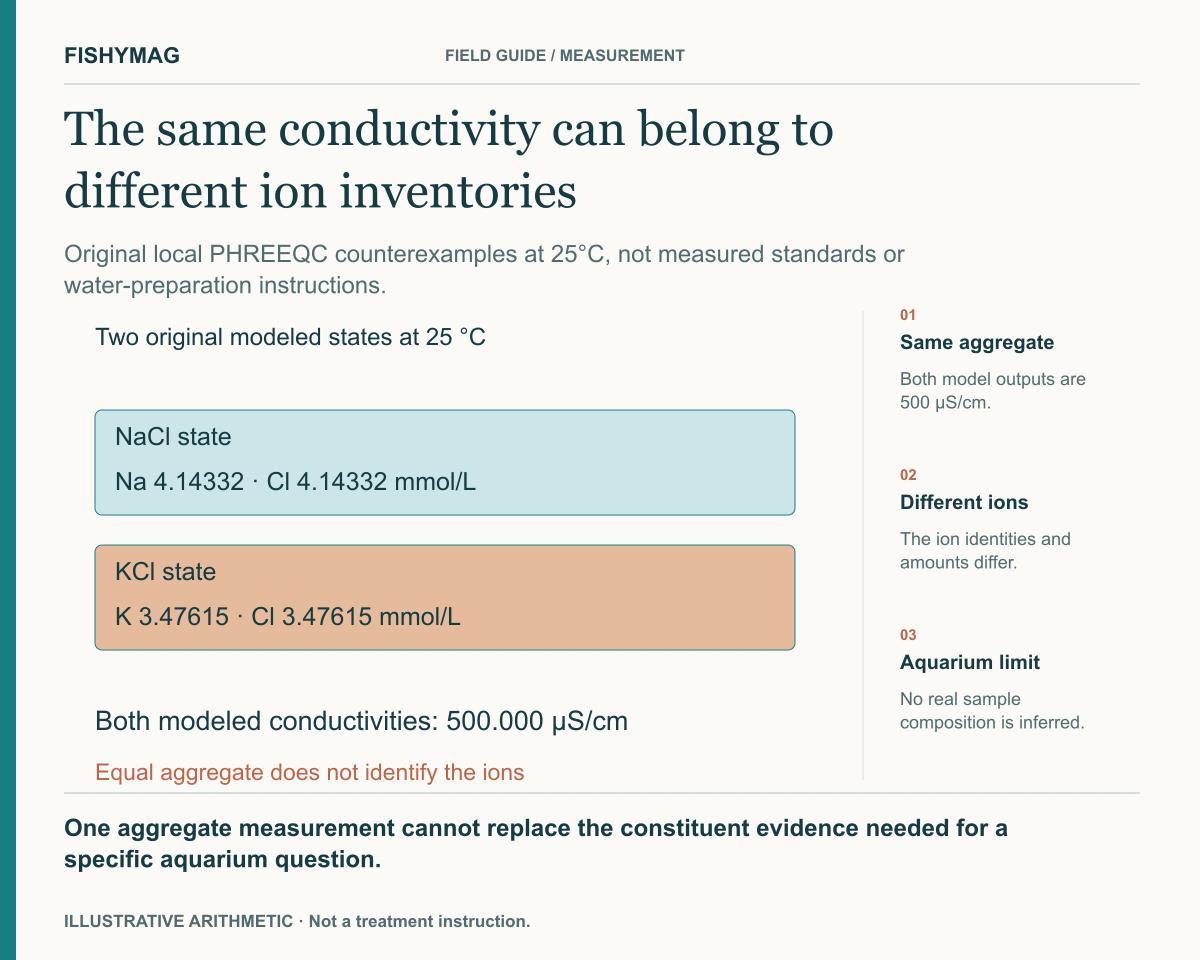
Figure data and explanation
Original local PHREEQC counterexamples at 25°C, not measured standards or water-preparation instructions.
- Same aggregate
- Both model outputs are 500 µS/cm.
- Different ions
- The ion identities and amounts differ.
- Aquarium limit
- No real sample composition is inferred.
One aggregate measurement cannot replace the constituent evidence needed for a specific aquarium question.
Declare what was calculated
FishyMag used the local PHREEQC conductance model through PhreeqPython 1.6.2 with the explicitly selected phreeqc.dat database. Each constructed solution is at 25 °C with calculated density and the stated chloride counterion. A numerical search finds the concentration giving 500 µS/cm in that model. No primary measured conductivity dataset is being relabelled as our experiment, and neither simple solution represents a typical aquarium.
Complete the non-unique comparison
The results match the selected conductivity within 0.00000001 µS/cm computational tolerance. That tolerance describes numerical reproduction, not measurement accuracy. Their sodium and potassium inventories differ even before considering the many additional constituents in real water.
| Original computed state | Cation, mmol/L | Chloride, mmol/L | Modeled conductivity |
|---|---|---|---|
| Sodium chloride | Na: 4.14332 | 4.14332 | 500.000 µS/cm |
| Potassium chloride | K: 3.47615 | 3.47615 | 500.000 µS/cm |
| What matches | One aggregate conductance result | Not the same ion inventory | Numerical equality by construction |
| What does not follow | Same calcium, nutrient content or contaminants | Not established | No aquarium suitability conclusion |
Use the counterexample to limit a real comparison
The example refutes the assumption that one conductivity value determines one mixture. It does not establish the amount of sodium or potassium in an actual sample, and no missing composition can be recovered by picking the more familiar modeled state. For an aquarium report, retain the original conductivity and obtain the constituent evidence required by the actual question. A matching meter display cannot authenticate a salt mix, prove that two water supplies are interchangeable or clear a sample of an unmeasured contaminant.
Use your own details
Equal conductivity does not identify aquarium ions worksheet
Download the editable text file, fill it in on your device and keep it with the relevant record. This blank worksheet records your information; it does not verify entries or approve treatment.
- Original conductivity, temperature and reporting basis
- Actual measured versus computed status
- Declared complete ionic composition if modeled
- Database and calculation version
- Counterion and electrical-balance evidence
- Equal-value numerical tolerance
- Independent composition evidence for real samples
- Claim that remains unanswered by conductivity
Worked example files
These files contain the article’s worked example. Read its source and scope notes, and keep your own current records before opening an example in a tool.
Put it into practice
Your checklist
- Separate computed examples from measured evidence.
- Keep ion identity and aggregate conductivity in different fields.
- Do not infer complete composition from an equal display.
Sources and scope
This article distinguishes manufacturer statements from FishyMag’s own workflows and arithmetic examples. Linked formulation records retain their own evidence dates; publishing this article does not refresh those records.
- USGS PHREEQC Version 3 manual: capabilities and computational scope; reviewed November 9, 2026 ↗
- USGS PHREEQC SOLUTION: units, calculated density, pH and alkalinity; reviewed November 9, 2026 ↗
- Vitens PhreeqPython primary repository and local version 1.6.2; reviewed November 9, 2026 ↗
- Vernier CON-BTA conductivity probe manufacturer manual; reviewed November 8, 2026 ↗
AI-assisted writing and development. Not hands-on product testing or veterinary review. How we publish →
FishyMag reports what manufacturers say, quoted and linked. It does not diagnose illness or recommend a treatment, and it never infers that a product is safe from the absence of a warning — where no statement exists, it says so.
Formulations change. Always read the label on the bottle in your hand, and contact the manufacturer if your tank contains anything valuable or unusual.