Measurement
What dissolved metal means in an aquarium report
Interpret a fictional 12 µg/L dissolved-copper report using its operational fraction, then show what must be withheld when the filtration record is absent.
By FishyMag · Published
Worked arithmetic example · Not a clinical review or treatment recommendation.
Quick answer
In the documented packet, 12 µg Cu/L belongs to the method’s operational filtered fraction. It is not a report of individual copper species. A second packet with the same number but no filtration record does not support the same fraction claim, and that missing document is not evidence of a concentration change.

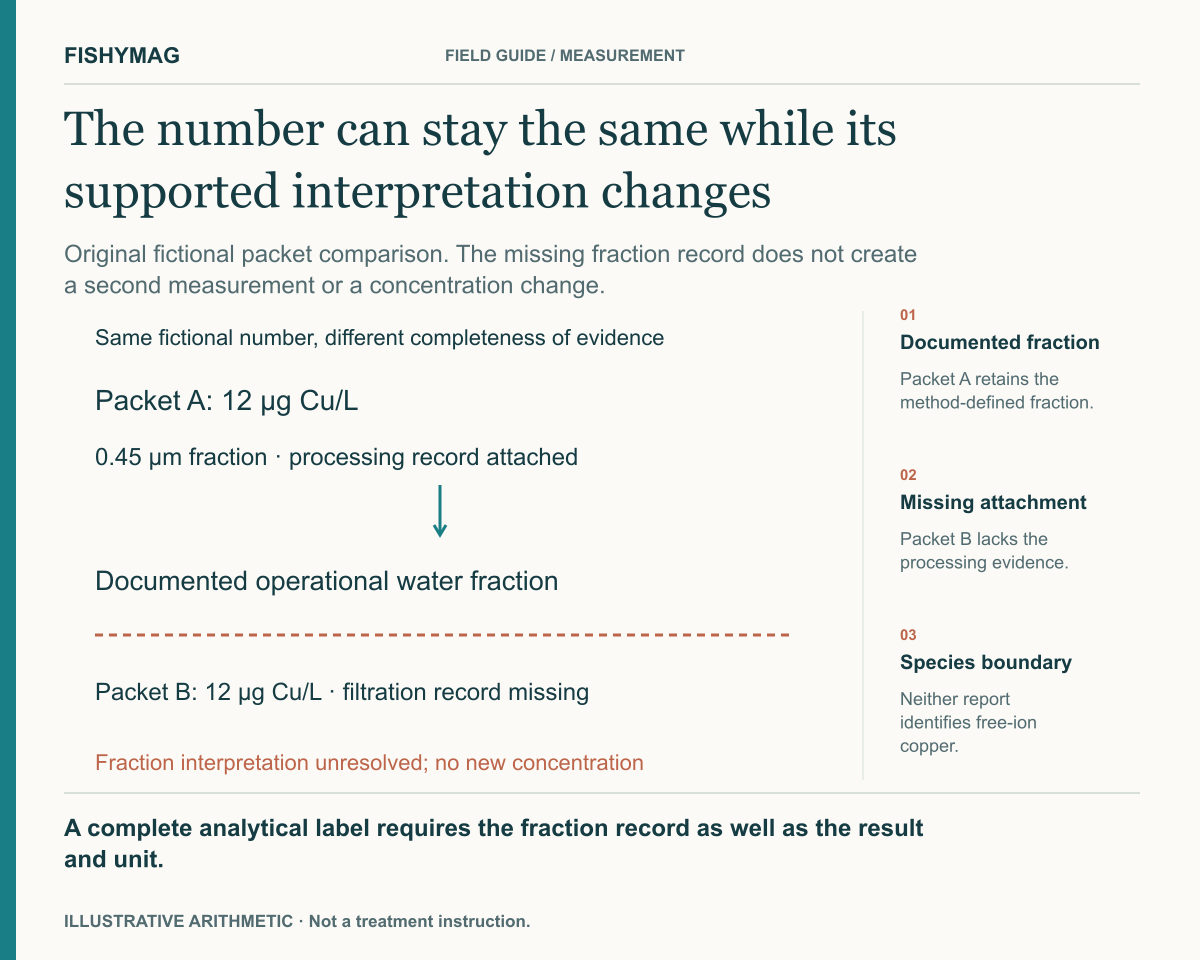
Figure data and explanation
Original fictional packet comparison. The missing fraction record does not create a second measurement or a concentration change.
- Documented fraction
- Packet A retains the method-defined fraction.
- Missing attachment
- Packet B lacks the processing evidence.
- Species boundary
- Neither report identifies free-ion copper.
A complete analytical label requires the fraction record as well as the result and unit.
Read the fraction definition with the result
EPA 200.8 defines dissolved analyte operationally through passage through the specified 0.45 micrometer membrane before acidification. That is a method boundary, not a claim that every passing atom is an uncomplexed free ion. This guide interprets a laboratory record; it does not prescribe sample preservation or filtration.
Complete the two-packet worksheet
Packet A is a fictional record with common sample identity, the selected method and the stated fraction-processing attachment. Packet B repeats the 12 µg/L number but lacks the attachment. No altered laboratory result is assumed.
| Question | Packet A | Packet B |
|---|---|---|
| What number was reported? | 12 µg Cu/L | 12 µg Cu/L |
| Which fraction is documented? | Specified method-defined filtrate | Not established in the supplied packet |
| Were individual Cu species reported? | No | No |
| Can it be called free-ion copper? | No supporting species measurement | No supporting species measurement |
| Did the concentration change? | No paired change supplied | Missing paperwork does not establish a change |
Keep the interpretation within the attached evidence
Retain the actual laboratory terminology, filtration timing, preparation and sample identity when sharing the result. If the fraction record is absent, ask the issuer to clarify what was submitted and processed. Do not fill the gap from a generic expectation that all metal laboratories handle aquarium water the same way. The completed result is a fraction-bounded report, with species identity and any whole-system inference left unanswered.
Use your own details
What dissolved metal means in an aquarium report worksheet
Download the editable text file, fill it in on your device and keep it with the relevant record. This blank worksheet records your information; it does not verify entries or approve treatment.
- Sample and collection identity
- Exact laboratory method and revision
- Membrane specification and processing record
- Preparation sequence documented by the laboratory
- Result and elemental reporting basis
- Laboratory limit, qualifiers and uncertainty
- Species claims actually measured or absent
- Missing fraction evidence in a second packet
Put it into practice
Your checklist
- Attach the operational fraction record to the number.
- Do not substitute dissolved for free-ion.
- Treat missing method evidence as a documentation gap, not a measured change.
Sources and scope
This article distinguishes manufacturer statements from FishyMag’s own workflows and arithmetic examples. Linked formulation records retain their own evidence dates; publishing this article does not refresh those records.
- US EPA Method 200.8 revision 5.4 (1994); reviewed November 9, 2026 ↗
- Thermo Scientific cupric ion-selective electrode user guide; reviewed November 9, 2026 ↗
AI-assisted writing and development. Not hands-on product testing or veterinary review. How we publish →
FishyMag reports what manufacturers say, quoted and linked. It does not diagnose illness or recommend a treatment, and it never infers that a product is safe from the absence of a warning — where no statement exists, it says so.
Formulations change. Always read the label on the bottle in your hand, and contact the manufacturer if your tank contains anything valuable or unusual.