Measurement
A total of 12 mL added is not today’s tank concentration
A ledger example separates cumulative bottle use from material present after removals and other changes.
By FishyMag · Published · Updated
Worked arithmetic example · Not a clinical review or treatment recommendation.
Quick answer
Adding recorded quantities gives cumulative use, not a measured current concentration. Water removals, changes in system volume and product behaviour can make the two very different records.
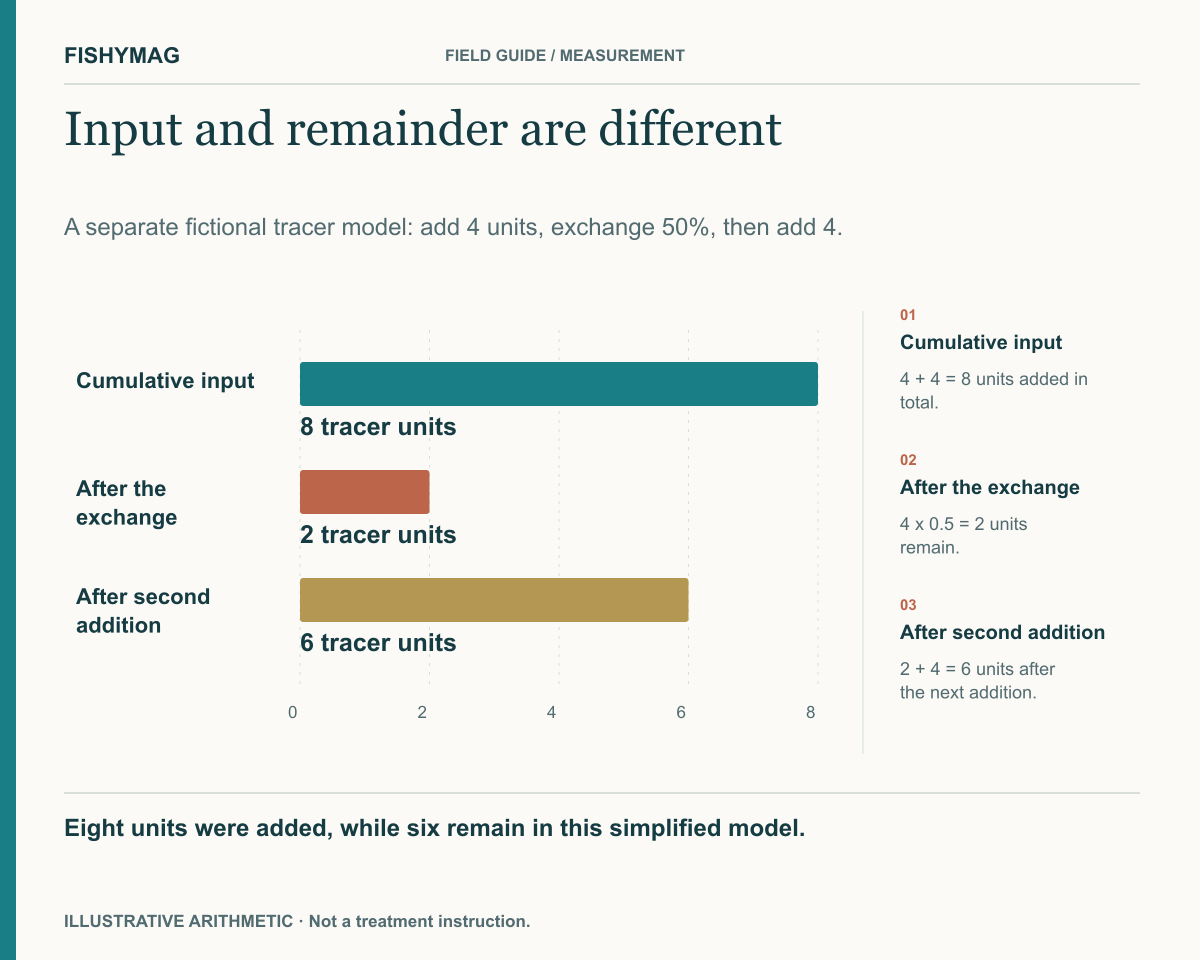
Figure data and explanation
A separate fictional tracer model: add 4 units, exchange 50%, then add 4.
- Cumulative input
- 8 tracer units. 4 + 4 = 8 units added in total.
- After the exchange
- 2 tracer units. 4 x 0.5 = 2 units remain.
- After second addition
- 6 tracer units. 2 + 4 = 6 units after the next addition.
Eight units were added, while six remain in this simplified model.
Name the quantity you are summing
Three recorded additions of 4 mL total 12 mL of bottle liquid. That sum describes recorded use over time. It does not say how much active ingredient remains in the water today. Keep the original addition times and product identity, because a total alone hides their sequence and conditions.
Use an ideal tracer to see the gap
For a separate fictional example, add four tracer units, then perform a perfectly mixed 50% water change and restore the original volume with tracer-free water. Two units remain in that ideal model. Add four more and the model contains six units, although cumulative additions total eight. This is a mass-balance illustration, not a medication estimate.
Do not divide the wrong numerator by today’s volume
Dividing cumulative bottle liquid by current tank litres yields a historical input-per-volume ratio. It does not measure current active concentration. You would need the appropriate substance quantity and a justified account of what remains. A change in bottle formulation would make a mixed historical total even less interpretable.
Keep separate fields for separate claims
Use one field for cumulative recorded bottle use, another for actual test results with their methods, and a third for any explicitly labelled model output. If an adviser asks what was added, supply the event list rather than replacing it with a single calculated concentration. The treatment log stores your entries; it does not establish chemical persistence.
Put it into practice
Your checklist
- Label totals as cumulative bottle use, with units.
- Keep chronological events and removals available.
- Separate model output from measured current concentration.
Sources and scope
This article distinguishes manufacturer statements from FishyMag’s own workflows and arithmetic examples. Linked formulation records retain their own evidence dates; publishing this article does not refresh those records.
- FishyMag evidence methodology and editorial scope ↗
- Aquarium calculator: ideal water-change limitations ↗
AI-assisted writing and development. Not hands-on product testing or veterinary review. How we publish →
FishyMag reports what manufacturers say, quoted and linked. It does not diagnose illness or recommend a treatment, and it never infers that a product is safe from the absence of a warning — where no statement exists, it says so.
Formulations change. Always read the label on the bottle in your hand, and contact the manufacturer if your tank contains anything valuable or unusual.