Measurement
Copper sulfate hydrates contain different copper fractions
Calculate copper’s nominal mass fraction in anhydrous copper sulfate and its pentahydrate, with the chemical form and formula-mass conventions kept visible.
By FishyMag · Published
Worked arithmetic example · Not a clinical review or treatment recommendation.
Quick answer
Using the stated nominal formula masses, copper is about 39.81% of anhydrous CuSO4 by mass and 25.45% of CuSO4·5H2O. The waters of crystallization enlarge the denominator. These formula fractions do not establish a bottle’s chemical form, purity or concentration.
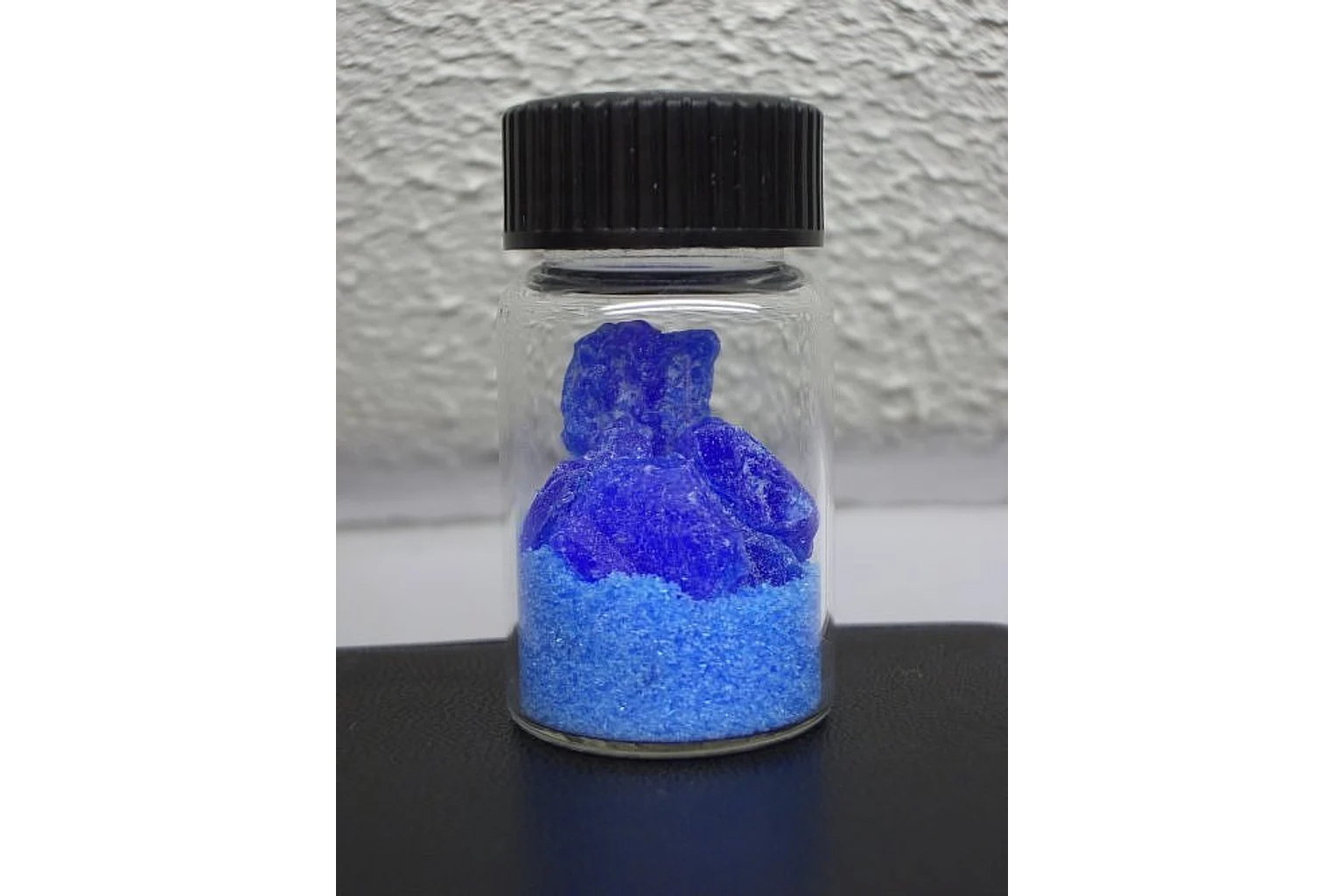
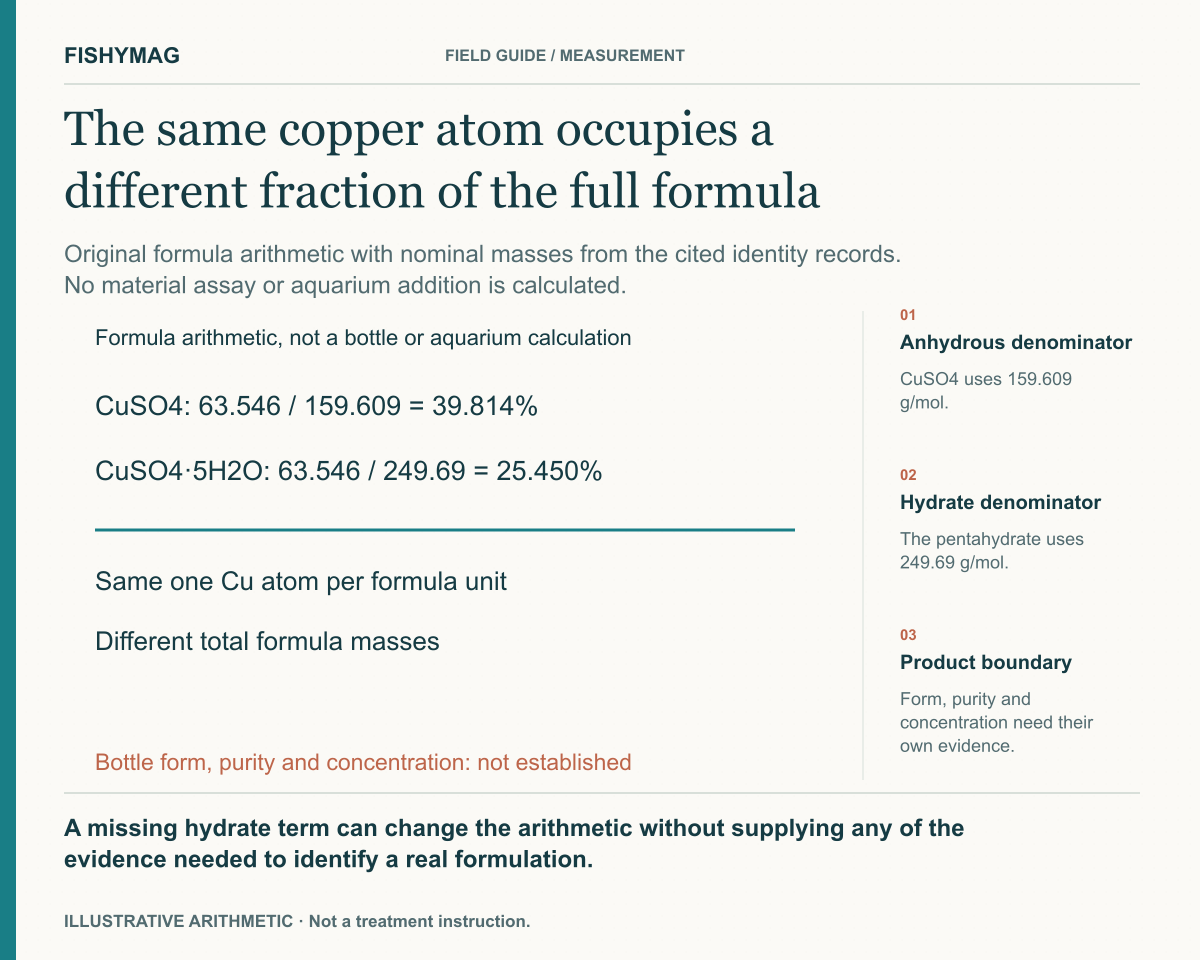
Figure data and explanation
Original formula arithmetic with nominal masses from the cited identity records. No material assay or aquarium addition is calculated.
- Anhydrous denominator
- CuSO4 uses 159.609 g/mol.
- Hydrate denominator
- The pentahydrate uses 249.69 g/mol.
- Product boundary
- Form, purity and concentration need their own evidence.
A missing hydrate term can change the arithmetic without supplying any of the evidence needed to identify a real formulation.
Read the full formula before taking the ratio
NIST lists CuSO4 with a formula mass of 159.609 g/mol; PubChem lists the pentahydrate at 249.69 g/mol. This worked example uses a nominal copper atomic mass of 63.546 g/mol. Both formulas contain one copper atom, but the pentahydrate includes five waters of crystallization. These rounded conventions explain the displayed fractions; they are not an assay of a purchased material.
Complete both fractions on the declared basis
The same copper numerator is divided by the complete mass of each formula unit. The arithmetic is independent of any aquarium volume, product direction or target concentration.
| Chemical form | Nominal formula mass | Copper mass fraction | Approximate percent |
|---|---|---|---|
| CuSO4 | 159.609 g/mol | 63.546 / 159.609 = 0.398135 | 39.81% |
| CuSO4·5H2O | 249.69 g/mol | 63.546 / 249.69 = 0.254500 | 25.45% |
| Unknown bottle form | Not established | No justified selection of either denominator | Unresolved |
| Named formula but unknown purity | Identity alone is not an assay | Theoretical fraction only | No bottle concentration established |
Stop before the unsupported product inference
A generic “copper sulfate” description may leave hydrate state or concentration basis unresolved. Even a correct formula does not establish the material’s assay, contaminants, fill concentration or behavior in aquarium water. Keep actual formulation and manufacturer evidence separate from this calculation. No aquarium addition, substitution between products or treatment compatibility follows from the theoretical percentages.
Use your own details
Copper sulfate hydrates contain different copper fractions worksheet
Download the editable text file, fill it in on your device and keep it with the relevant record. This blank worksheet records your information; it does not verify entries or approve treatment.
- Exact chemical formula and hydrate state
- Original identity authority and checked date
- Nominal atomic and formula masses used
- Copper atoms per formula unit
- Mass-fraction calculation and rounding
- Actual material purity or explicit missing evidence
- Bottle concentration basis if independently documented
- Claims that cannot follow from formula arithmetic
Put it into practice
Your checklist
- Retain the hydrate state in the formula.
- Use the full formula mass and declared precision.
- Do not turn a theoretical fraction into a bottle concentration.
Sources and scope
This article distinguishes manufacturer statements from FishyMag’s own workflows and arithmetic examples. Linked formulation records retain their own evidence dates; publishing this article does not refresh those records.
- NIST Chemistry WebBook: anhydrous copper sulfate; reviewed November 9, 2026 ↗
- PubChem: copper sulfate pentahydrate; reviewed November 9, 2026 ↗
AI-assisted writing and development. Not hands-on product testing or veterinary review. How we publish →
FishyMag reports what manufacturers say, quoted and linked. It does not diagnose illness or recommend a treatment, and it never infers that a product is safe from the absence of a warning — where no statement exists, it says so.
Formulations change. Always read the label on the bottle in your hand, and contact the manufacturer if your tank contains anything valuable or unusual.