Measurement
A cloudy aquarium sample needs the method’s own restriction
Apply HI713’s actual debris condition to an archived result without inventing a turbidity threshold or filtering the sample into a different fraction.
By FishyMag · Published
Manufacturer-source commentary · Not a clinical review or treatment recommendation.
Quick answer
Use the method’s documented condition rather than an invented cloudiness limit. HI713 says the sample should contain no debris. A record of particles in the cell fails that named check; an aquarium photograph does not establish the condition inside the measured cell. No universal NTU cutoff follows from that wording.
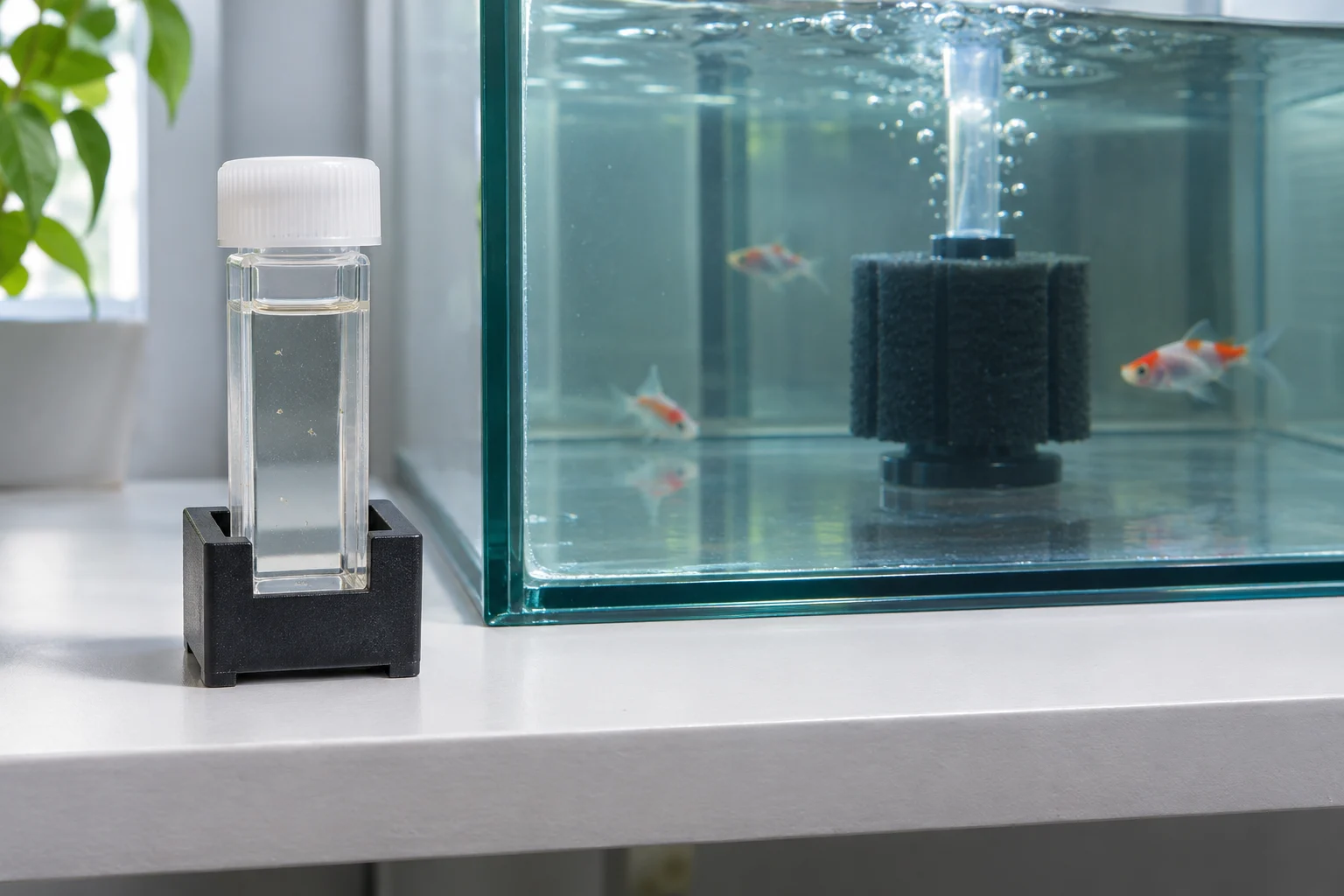
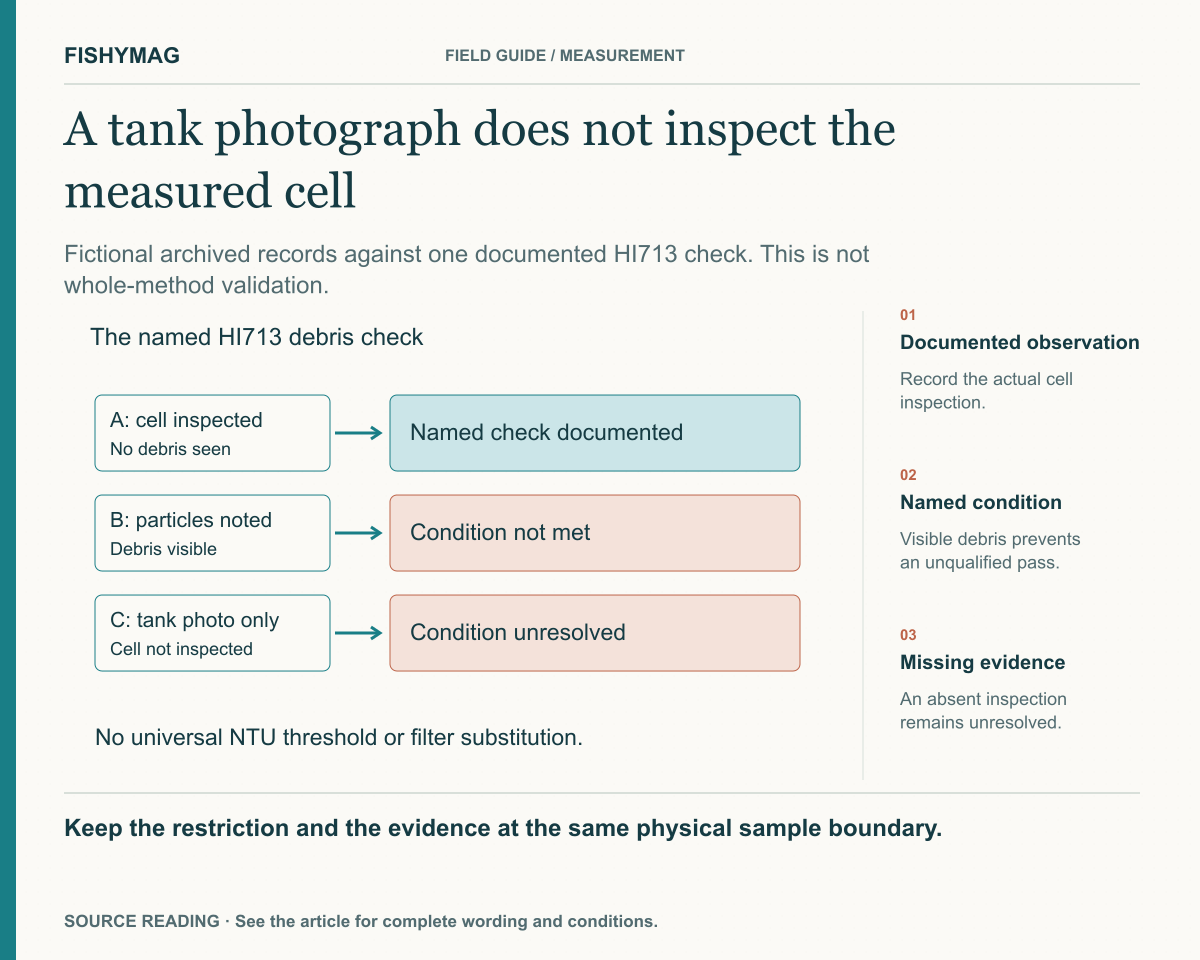
Figure data and explanation
Fictional archived records against one documented HI713 check. This is not whole-method validation.
- Documented observation
- Record the actual cell inspection.
- Named condition
- Visible debris prevents an unqualified pass.
- Missing evidence
- An absent inspection remains unresolved.
Keep the restriction and the evidence at the same physical sample boundary.
Do not turn a qualitative restriction into a numeric specification
Hanna’s HI713 manual explicitly addresses debris in the sample. It does not give a universal turbidity threshold for arbitrary aquarium water. Turbidity is an optical measurement with its own method and units; “looks cloudy” is an observation, not an NTU result. Conversely, a clear-looking photograph cannot establish every optical or chemical suitability requirement.
Complete three archived-cell branches
All cases below are invented. They differ in the evidence retained at the actual optical cell, rather than in aquarium appearance alone. A documented pass of this one check is not certification of the entire run.
| Case | Cell evidence | Disposition for the named condition |
|---|---|---|
| A | Contemporaneous inspection: no debris seen | Named visual check documented; retain with other QC |
| B | Particles recorded in measured cell | Condition not met; do not accept as an unqualified valid reading |
| C | Only a tank photograph retained | Measured-cell condition unresolved |
Keep any changed fraction explicit
The completed review preserves the original reading, its cell observations and the reason it is restricted. It does not invent a numeric debris correction or claim that averaging affected readings removes the problem. Nor does this review authorize a household filtration substitute. Filtering a sample can change what is included in the analytical fraction; whether it is permitted and what the result then means are method-specific questions. Ask for the appropriate documented route rather than silently relabelling a processed sample as the original whole-water result. If only case C is available, the useful answer is the precise inspection gap, without declaring the sample clean or contaminated.
Use your own details
A cloudy aquarium sample needs the method’s own restriction worksheet
Download the editable text file, fill it in on your device and keep it with the relevant record. This blank worksheet records your information; it does not verify entries or approve treatment.
- Aquarium and sample identity
- Instrument or laboratory method revision
- Original reading including flags
- Chemical basis and unit
- Sample preparation or blank identity recorded
- Quality-control evidence
- Supported finding and calculation
- Unresolved question and source
Put it into practice
Your checklist
- Use the exact debris or turbidity restriction in the method.
- Distinguish cell evidence from the appearance of the whole tank.
- Retain any changed analytical fraction explicitly.
Sources and scope
This article distinguishes manufacturer statements from FishyMag’s own workflows and arithmetic examples. Linked formulation records retain their own evidence dates; publishing this article does not refresh those records.
- Hanna HI713 manual IST71309/20; reviewed November 8, 2026 ↗
- USGS: turbidity and water; reviewed November 8, 2026 ↗
AI-assisted writing and development. Not hands-on product testing or veterinary review. How we publish →
FishyMag reports what manufacturers say, quoted and linked. It does not diagnose illness or recommend a treatment, and it never infers that a product is safe from the absence of a warning — where no statement exists, it says so.
Formulations change. Always read the label on the bottle in your hand, and contact the manufacturer if your tank contains anything valuable or unusual.