Measurement
Bubbles in the test cell: preserve the observation with the reading
Review bubble-affected HI713 records without estimating a correction from the difference between two readings.
By FishyMag · Published
Manufacturer-source commentary · Not a clinical review or treatment recommendation.
Quick answer
Hanna warns that bubbles can raise HI713 readings. A bubble observation belongs with the original reading and prevents an unqualified acceptance of that run. A later lower number does not quantify a bubble correction, and missing cell notes do not prove that the cell was bubble-free.
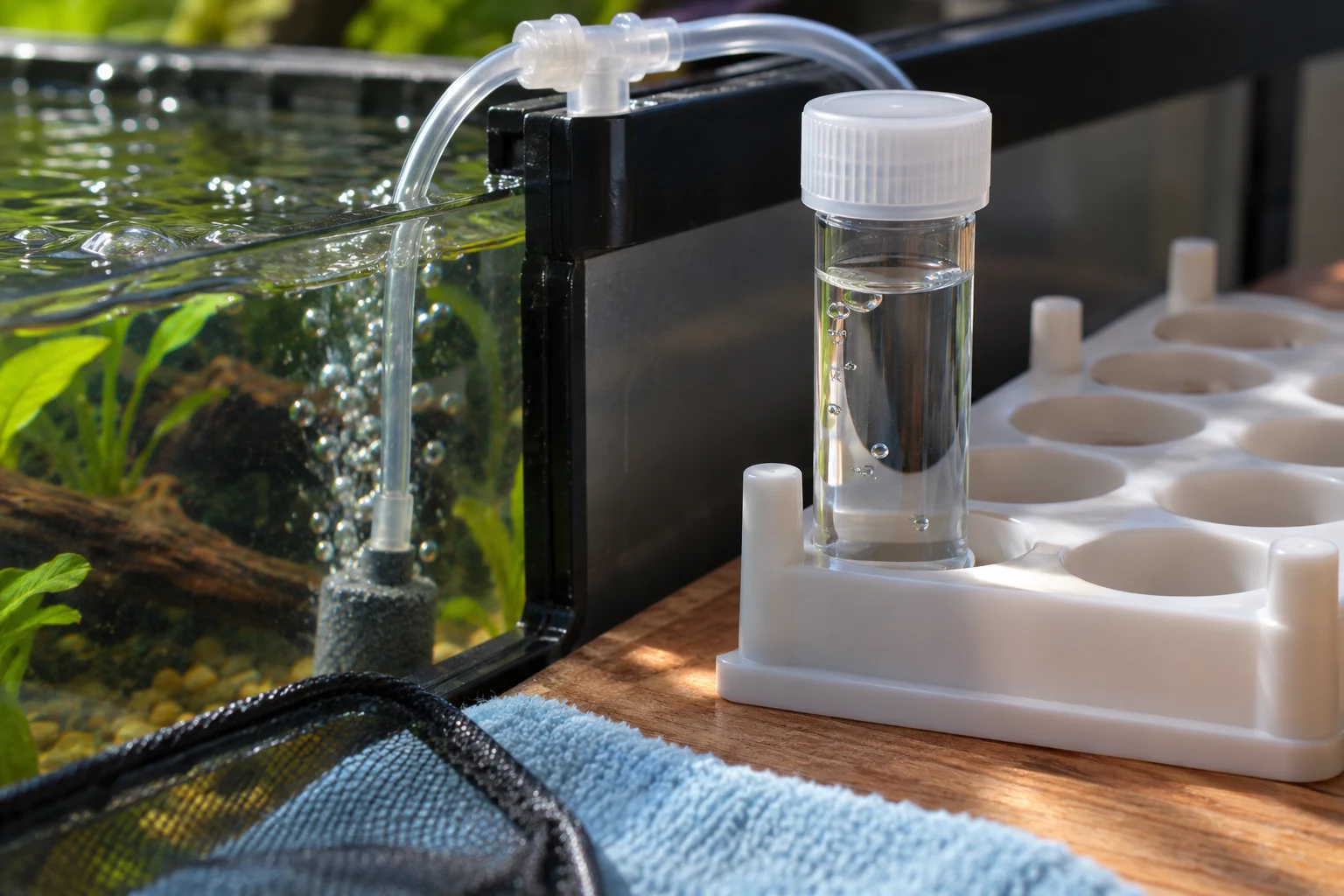
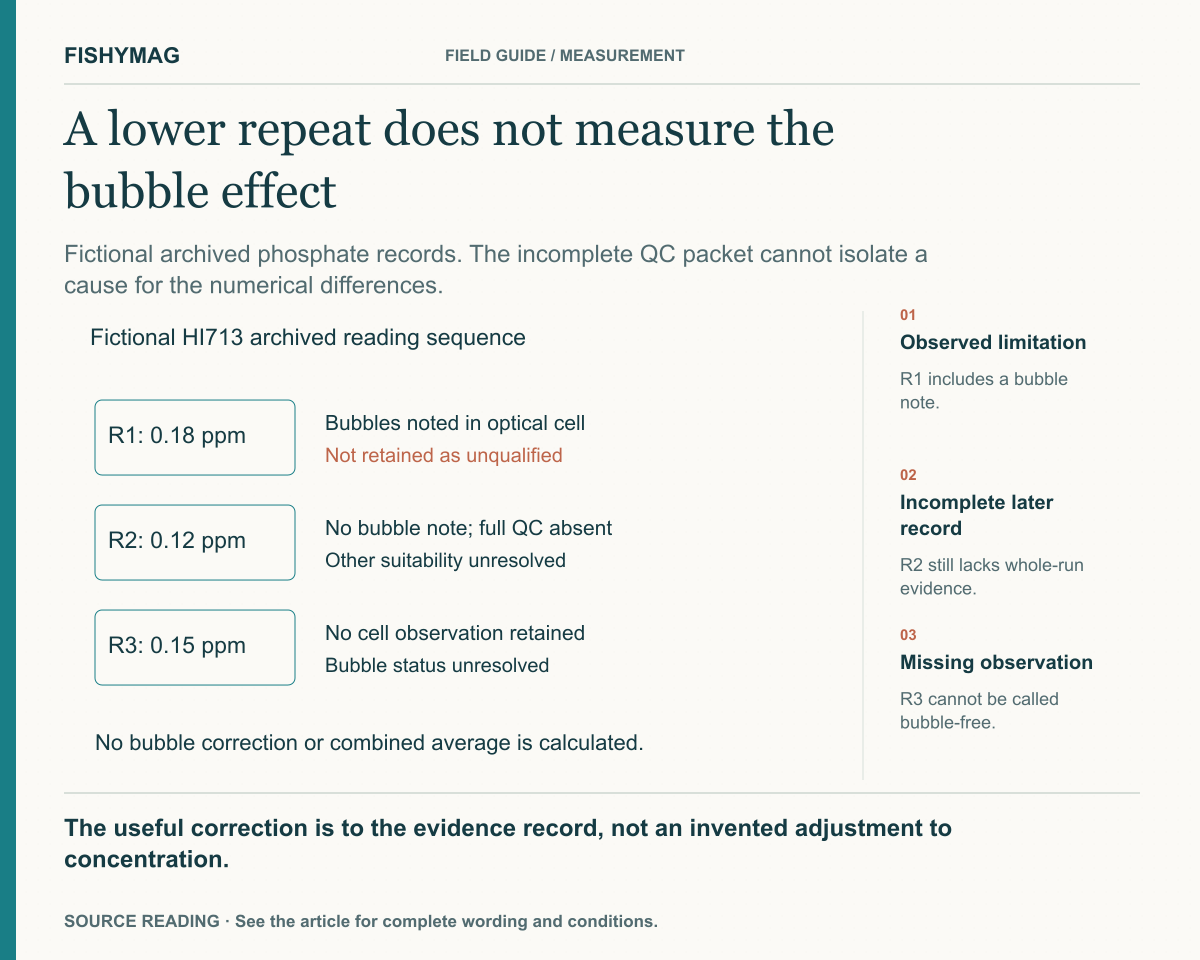
Figure data and explanation
Fictional archived phosphate records. The incomplete QC packet cannot isolate a cause for the numerical differences.
- Observed limitation
- R1 includes a bubble note.
- Incomplete later record
- R2 still lacks whole-run evidence.
- Missing observation
- R3 cannot be called bubble-free.
The useful correction is to the evidence record, not an invented adjustment to concentration.
Use the instrument’s actual optical warning
The linked HI713 manual identifies bubbles as a source of higher readings. It supplies instrument-specific handling directions; this article reviews records already created rather than replacing that procedure. The warning does not state a numerical correction per bubble, and bubble size or count in a photograph is not a concentration measurement.
Review three fictional readings
The invented packet contains three numbers and uneven observation records. It does not declare every other run condition equivalent. Therefore the numerical differences cannot isolate bubbles as the only changing factor.
| Record | Original response | Contemporaneous observation | Review status |
|---|---|---|---|
| R1 | 0.18 ppm phosphate | Bubbles in measured cell | Do not retain as an unqualified valid reading |
| R2 | 0.12 ppm phosphate | No bubbles noted; other QC not supplied | Bubble issue not documented; whole-run suitability unresolved |
| R3 | 0.15 ppm phosphate | No cell observation retained | Bubble status unresolved |
| Combined result | Not calculated | Records have different evidence limits | Do not average them into a repaired value |
Do not subtract the difference as a correction
R1 minus R2 is 0.06 ppm arithmetically. That does not establish that bubbles contributed exactly 0.06 ppm, because the packet does not isolate every other condition. Preserve the original response, observation and disposition together. A documented repeat following the actual method belongs in its own record, with its own sample and timing. Do not delete an excluded reading or choose a low number solely because it looks more plausible. The completed review states which limitation is observed, which is absent from the notes and which remains unknown.
Use your own details
Bubbles in the test cell: preserve the observation with the reading worksheet
Download the editable text file, fill it in on your device and keep it with the relevant record. This blank worksheet records your information; it does not verify entries or approve treatment.
- Method, instrument and document revision
- Aquarium and sample identity
- Original observation or display state
- Container, reagent or accessory identity
- Supported comparison evidence
- Conversion or decision actually authorized
- Unresolved finding and reason
- Original records retained
Put it into practice
Your checklist
- Keep cell observations attached to their original readings.
- Do not infer a numerical bubble correction.
- Retain restricted readings with the reason rather than silently averaging them.
Sources and scope
This article distinguishes manufacturer statements from FishyMag’s own workflows and arithmetic examples. Linked formulation records retain their own evidence dates; publishing this article does not refresh those records.
AI-assisted writing and development. Not hands-on product testing or veterinary review. How we publish →
FishyMag reports what manufacturers say, quoted and linked. It does not diagnose illness or recommend a treatment, and it never infers that a product is safe from the absence of a warning — where no statement exists, it says so.
Formulations change. Always read the label on the bottle in your hand, and contact the manufacturer if your tank contains anything valuable or unusual.