Measurement
Did that aquarium change last beyond one reading?
Distinguish a captured aquarium excursion from continuous persistence using an irregularly timed fictional observation record.
By FishyMag · Published
Worked arithmetic example · Not a clinical review or treatment recommendation.
Quick answer
An elevated reading at one retained time does not establish how long the condition lasted. In the fictional record, 520 µS/cm was observed at minute 5, with 500 at minute 0 and 501 at minute 10. Repeated later 520 readings would support a different claim, but still would not prove uninterrupted elevation between samples.
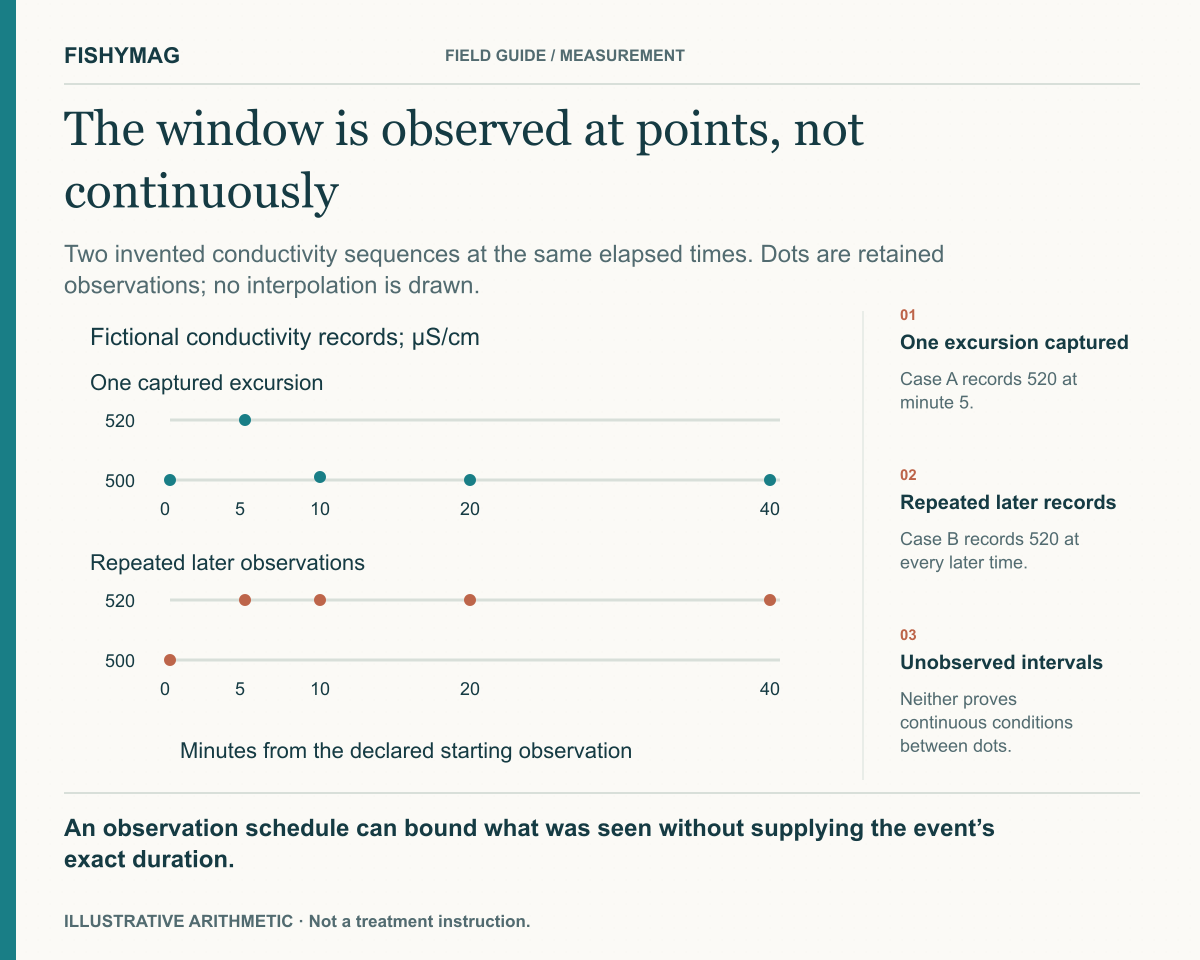
Figure data and explanation
Two invented conductivity sequences at the same elapsed times. Dots are retained observations; no interpolation is drawn.
- One excursion captured
- Case A records 520 at minute 5.
- Repeated later records
- Case B records 520 at every later time.
- Unobserved intervals
- Neither proves continuous conditions between dots.
An observation schedule can bound what was seen without supplying the event’s exact duration.
Keep the observation window distinct from event duration
The invented schedule uses offsets 0, 5, 10, 20 and 40 minutes after a declared starting observation. These are teaching times, not a recommended sampling cadence. The first case captures a larger conductivity excursion at minute 5. Its full 40-minute record must not be described as a 40-minute excursion. Method and compensation basis are declared consistent within the case.
Compare the complete retained sequences
The alternative sequence has the same initial value and observation times, but every later recorded value is 520. Plot the actual elapsed times, so the 20-minute gap between the final points is not shown as if it were five minutes.
| Offset, minutes | Case A, µS/cm | Case B, µS/cm |
|---|---|---|
| 0 | 500 | 500 |
| 5 | 520 | 520 |
| 10 | 501 | 520 |
| 20 | 500 | 520 |
| 40 | 500 | 520 |
Finish with the strongest observation claim
Case A supports a captured 520 reading at minute 5, with the flanking retained readings at 500 and 501. It does not establish exact onset, exact duration or the absence of another excursion between samples. Case B supports repeated 520 observations over the later window. It still does not establish uninterrupted persistence between them. Straight lines or a shaded continuous band would add an assumption the supplied data do not verify. Retain the gaps and choose further monitoring around the actual question and system access. Neither sequence identifies a chemical cause or a component that should be changed.
Use your own details
Did that aquarium change last beyond one reading? worksheet
Download the editable text file, fill it in on your device and keep it with the relevant record. This blank worksheet records your information; it does not verify entries or approve treatment.
- Declared comparison question
- Exact sites, parent samples or batch identity
- Method, units and reporting basis
- Observation times and pathway conditions
- Matched raw values with qualifiers
- Calculation and completed descriptive finding
- What the comparison does not resolve
- Specific next evidence or coverage gap
Put it into practice
Your checklist
- Report elapsed observation times as retained.
- Separate repeated observations from uninterrupted persistence.
- Keep unsampled intervals visible in the figure and conclusion.
Sources and scope
This article distinguishes manufacturer statements from FishyMag’s own workflows and arithmetic examples. Linked formulation records retain their own evidence dates; publishing this article does not refresh those records.
- Australian and New Zealand water-quality field sampling guidance; reviewed November 8, 2026 ↗
- Australian and New Zealand guidelines: water-quality data analysis; reviewed November 8, 2026 ↗
AI-assisted writing and development. Not hands-on product testing or veterinary review. How we publish →
FishyMag reports what manufacturers say, quoted and linked. It does not diagnose illness or recommend a treatment, and it never infers that a product is safe from the absence of a warning — where no statement exists, it says so.
Formulations change. Always read the label on the bottle in your hand, and contact the manufacturer if your tank contains anything valuable or unusual.