Measurement
Put aquarium source-water ions on a common charge basis
Convert two complete declared major-ion examples from elemental or ionic mass to mmol/L and meq/L, then calculate each cation’s share without ranking aquarium suitability.
By FishyMag · Published
Worked arithmetic example · Not a clinical review or treatment recommendation.
Quick answer
Convert the named constituent to mmol/L first, then multiply by the magnitude of its charge to obtain meq/L. In the fictional reports, both cation totals are 4.00 meq/L, but calcium supplies 50% in source A and 25% in source B. A larger mg/L entry alone would not establish that comparison.
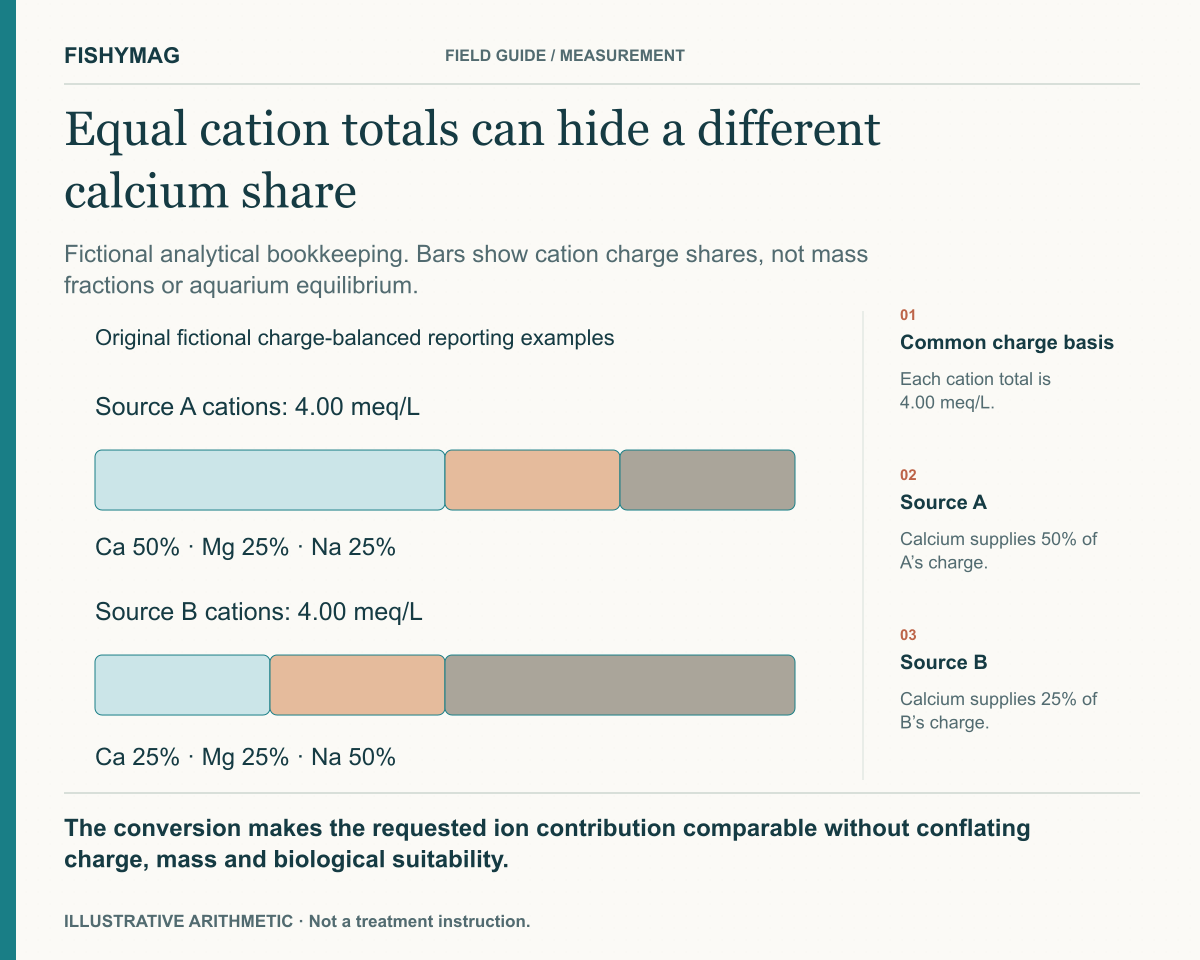
Figure data and explanation
Fictional analytical bookkeeping. Bars show cation charge shares, not mass fractions or aquarium equilibrium.
- Common charge basis
- Each cation total is 4.00 meq/L.
- Source A
- Calcium supplies 50% of A’s charge.
- Source B
- Calcium supplies 25% of B’s charge.
The conversion makes the requested ion contribution comparable without conflating charge, mass and biological suitability.
Declare the example’s completeness
These are nominal analytical bookkeeping examples, not full equilibrium speciations or actual source waters. The included species are Ca 2+, Mg 2+, Na+, Cl− and HCO3−, with all other charge terms stipulated negligible for this arithmetic. Real acidic, alkaline or complex waters need appropriate species treatment. The nominal molar masses used here are Ca 40.08, Mg 24.305, Na 22.98977, Cl 35.453 and HCO3 61.0168 mg/mmol; retaining them makes rounding reproducible.
Convert every included report row
For calcium, 40.08 mg Ca/L divided by 40.08 mg/mmol is 1.00 mmol/L; multiplying by two gives 2.00 meq/L. A result already reported as CaCO3 equivalent would require its own equivalent-basis interpretation rather than another elemental conversion.
| Constituent | A: mg/L | A: mmol/L → meq/L | B: mg/L | B: mmol/L → meq/L |
|---|---|---|---|---|
| Ca 2+ | 40.080 | 1.00 → 2.00 | 20.040 | 0.50 → 1.00 |
| Mg 2+ | 12.1525 | 0.50 → 1.00 | 12.1525 | 0.50 → 1.00 |
| Na+ | 22.98977 | 1.00 → 1.00 | 45.97954 | 2.00 → 2.00 |
| Cl− | 70.906 | 2.00 → 2.00 | 70.906 | 2.00 → 2.00 |
| HCO3− | 122.0336 | 2.00 → 2.00 | 122.0336 | 2.00 → 2.00 |
| Cations / anions | Not summed across unlike mass meanings | 4.00 / 4.00 | Same stated membership | 4.00 / 4.00 |
Finish the calcium-share comparison
Calcium supplies 2/4 = 50% of source A’s cation charge and 1/4 = 25% of source B’s. Magnesium contributes 25% in each; sodium supplies the remaining 25% and 50%. Both chloride and bicarbonate contribute half the anion total. The calculation answers a charge-contribution question, not which water is better for livestock. A real report still needs its species definitions, qualifiers and completeness assessment before these sums are meaningful.
Use your own details
Put aquarium source-water ions on a common charge basis worksheet
Download the editable text file, fill it in on your device and keep it with the relevant record. This blank worksheet records your information; it does not verify entries or approve treatment.
- Named ionic species and elemental or compound reporting basis
- Original mg/L result and qualifiers
- Declared nominal molar mass and ionic charge
- Calculated mmol/L
- Calculated meq/L
- Separate cation and anion totals
- Each ion share of its respective total
- Declared omitted species and limits of completeness
Put it into practice
Your checklist
- Preserve constituent and reporting basis before converting.
- Sum cations and anions separately on the charge basis.
- State each percentage denominator and avoid a suitability ranking.
Sources and scope
This article distinguishes manufacturer statements from FishyMag’s own workflows and arithmetic examples. Linked formulation records retain their own evidence dates; publishing this article does not refresh those records.
- USGS PHREEQC SOLUTION: units, calculated density, pH and alkalinity; reviewed November 9, 2026 ↗
- USGS PHREEQC Version 3 manual: capabilities and computational scope; reviewed November 9, 2026 ↗
- USGS SIR2013-5226: charge-balance convention; reviewed November 9, 2026 ↗
AI-assisted writing and development. Not hands-on product testing or veterinary review. How we publish →
FishyMag reports what manufacturers say, quoted and linked. It does not diagnose illness or recommend a treatment, and it never infers that a product is safe from the absence of a warning — where no statement exists, it says so.
Formulations change. Always read the label on the bottle in your hand, and contact the manufacturer if your tank contains anything valuable or unusual.