Measurement
Does an aquarium water report balance electrically?
Calculate two explicitly sourced charge-residual conventions and show how a report can balance despite equal omitted cation and anion charge.
By FishyMag · Published
Worked arithmetic example · Not a clinical review or treatment recommendation.
Quick answer
For cations 4.00 and anions 3.60 meq/L, 100 × difference/sum gives +5.2632%. A mean-denominator convention gives +10.5263% from the same totals. Neither a chosen percentage nor a small residual proves the report is complete; equal omitted charges can cancel.
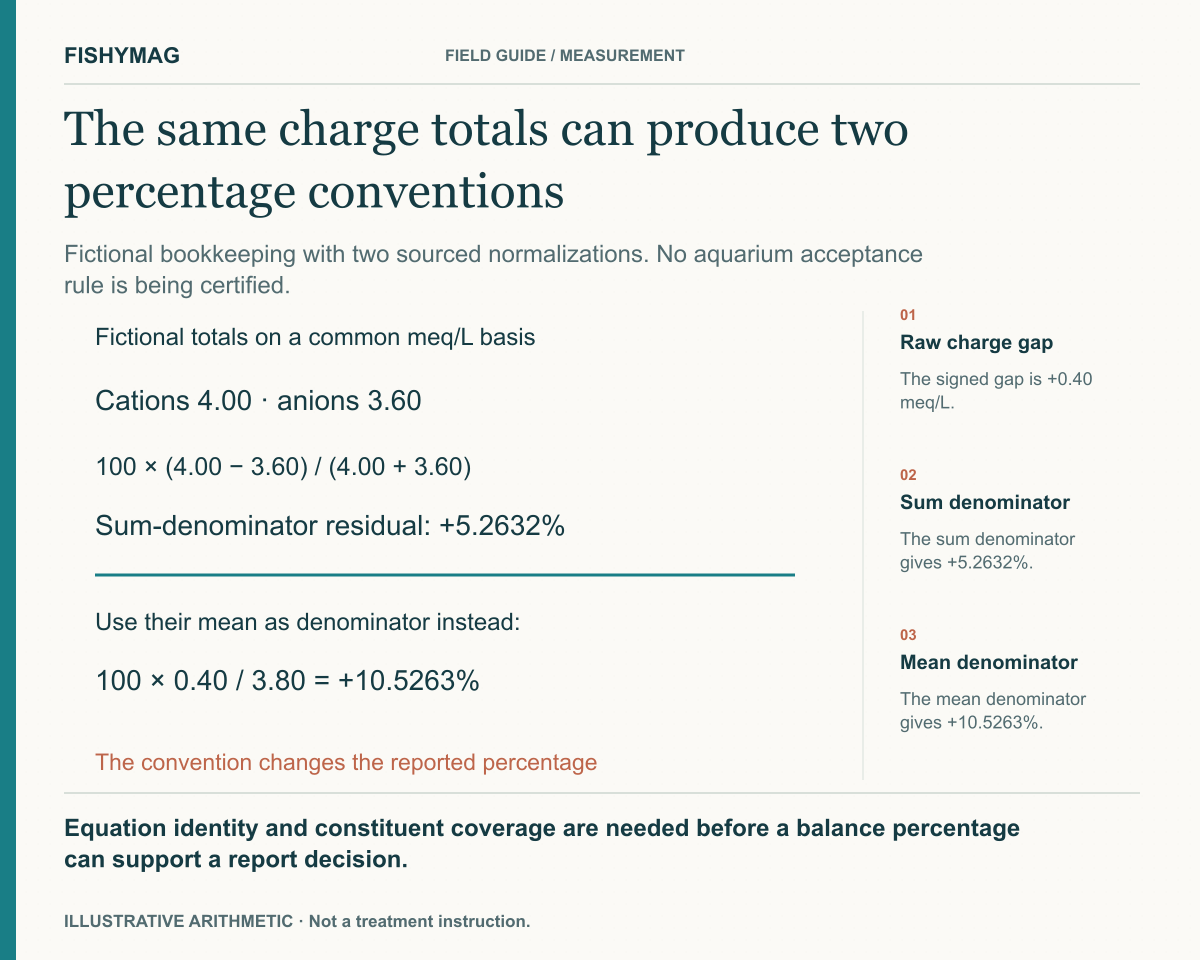
Figure data and explanation
Fictional bookkeeping with two sourced normalizations. No aquarium acceptance rule is being certified.
- Raw charge gap
- The signed gap is +0.40 meq/L.
- Sum denominator
- The sum denominator gives +5.2632%.
- Mean denominator
- The mean denominator gives +10.5263%.
Equation identity and constituent coverage are needed before a balance percentage can support a report decision.
State the equation before using a percentage
The cited USGS reports illustrate different normalizations. The fictional 4.00/3.60 pair gives a +0.40 meq/L cation-minus-anion difference. Dividing by the sum, 7.60, gives +5.2632%; dividing by the mean, 3.80, gives +10.5263%. A laboratory’s limit cannot be borrowed without knowing which convention, matrix and analytical or speciated calculation it addresses.
Work a balanced but incomplete counterexample
In the second constructed packet, the complete bookkeeping totals are 4.00 meq/L on each side. Omitting 1.00 meq/L from both lists leaves 3.00/3.00, so the calculated residual remains zero. This does not describe a chemically charged water sample: it describes missing entries in the reported account.
| Packet or convention | Cation / anion totals | Calculated finding | What remains unproved |
|---|---|---|---|
| First packet, difference/sum | 4.00 / 3.60 meq/L | +5.2632% | No cause or universal acceptance decision |
| Same packet, difference/mean | 4.00 / 3.60 meq/L | +10.5263% | Not twice the physical imbalance |
| Complete second packet | 4.00 / 4.00 meq/L | 0% | Completeness must still be documented |
| Second packet after equal omissions | 3.00 / 3.00 meq/L | 0% | Two missing charge contributions are concealed |
Send a report-specific clarification request
Ask the issuer for constituent membership, reporting bases, treatment of qualifiers, any alkalinity-derived entry and the residual equation. Keep a below-limit value distinct from zero rather than choosing a value that makes the sums close. In chemically complex waters, analytical totals and speciated ion charges can also differ. The useful conclusion is that a particular account is coherent or needs clarification on a defined basis, not that every relevant dissolved constituent was measured or that the aquarium is compatible with a treatment.
Use your own details
Does an aquarium water report balance electrically? worksheet
Download the editable text file, fill it in on your device and keep it with the relevant record. This blank worksheet records your information; it does not verify entries or approve treatment.
- Included ionic species and qualifiers
- Conversion to common meq/L basis
- Cation and anion totals with membership list
- Signed residual equation and denominator
- Analytical versus speciated calculation identity
- Unmeasured and omitted constituents retained as gaps
- Laboratory-specific acceptance criteria if applicable
- Completed coherence finding and limits
Put it into practice
Your checklist
- Retain the residual’s sign and denominator.
- Do not import an acceptance threshold from a different method or matrix.
- Check omissions independently of apparent electrical balance.
Sources and scope
This article distinguishes manufacturer statements from FishyMag’s own workflows and arithmetic examples. Linked formulation records retain their own evidence dates; publishing this article does not refresh those records.
- USGS SIR2013-5226: charge-balance convention; reviewed November 9, 2026 ↗
- USGS OFR2004-1341: alternative charge-imbalance denominator; reviewed November 9, 2026 ↗
- USGS PHREEQC Version 3 manual: capabilities and computational scope; reviewed November 9, 2026 ↗
AI-assisted writing and development. Not hands-on product testing or veterinary review. How we publish →
FishyMag reports what manufacturers say, quoted and linked. It does not diagnose illness or recommend a treatment, and it never infers that a product is safe from the absence of a warning — where no statement exists, it says so.
Formulations change. Always read the label on the bottle in your hand, and contact the manufacturer if your tank contains anything valuable or unusual.