Measurement
Work an ammonia-fraction calculation with its model attached
Reproduce the published freshwater ammonia relationship at pH 8.00 and 25 °C, with the temperature conversion, model scope and output kept visible.
By FishyMag · Published
Worked arithmetic example · Not a clinical review or treatment recommendation.
Quick answer
Using the conventional freshwater relationship reproduced by IPCS and the Australian water-quality guidance, pH 8.00 and 25.0 °C give an NH₃ fraction of about 0.05366, or 5.366%. This is a model result for invented inputs, not a test reading or a livestock safety limit. Do not transfer it unchanged to saline water.
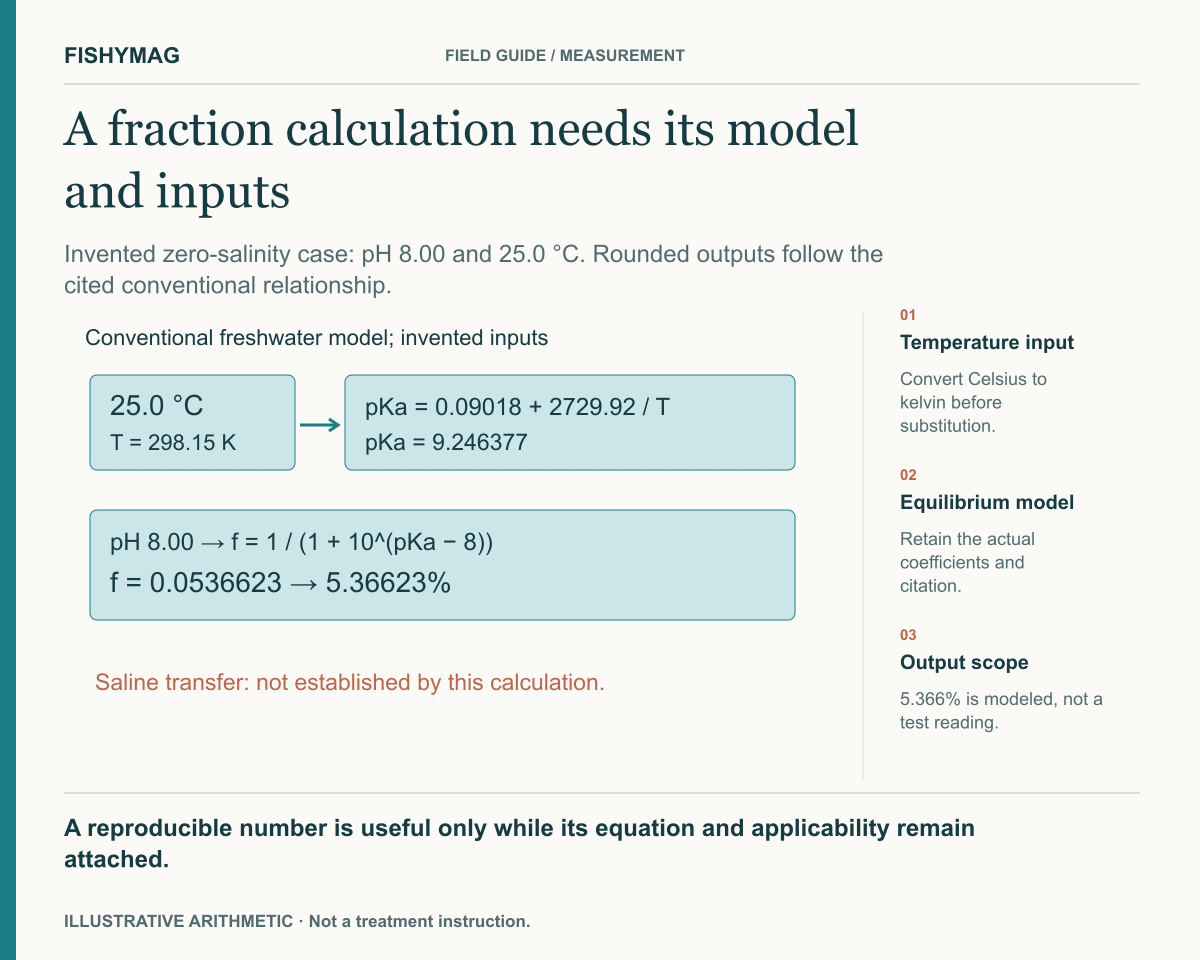
Figure data and explanation
Invented zero-salinity case: pH 8.00 and 25.0 °C. Rounded outputs follow the cited conventional relationship.
- Temperature input
- Convert Celsius to kelvin before substitution.
- Equilibrium model
- Retain the actual coefficients and citation.
- Output scope
- 5.366% is modeled, not a test reading.
A reproducible number is useful only while its equation and applicability remain attached.
Select the equation before entering a reading
The cited guidance reproduces pKa = 0.09018 + 2729.92/T, followed by f = 1/(1 + 10^(pKa − pH)). T is kelvin. IPCS describes the temperature relationship over 0 to 50 °C for most fresh waters and notes ionic-strength effects. Here the fictional case is explicitly the conventional freshwater model with zero salinity, pH 8.00 and 25.0 °C. It is not a validation for every freshwater formulation, unusually hard matrix or pH measurement convention.
Keep fraction and percentage separate
Use the 273.15 conversion printed in the Australian guidance: T = 25.0 + 273.15 = 298.15 K. Substitution gives pKa = 9.246376545. Then 10^(pKa − 8.00) is approximately 17.6350, and f = 0.0536623367. Multiplying the fraction by 100 gives 5.36623367%. The displayed result is rounded after the calculation.
| Step | Substitution | Result |
|---|---|---|
| Absolute temperature | 25.0 + 273.15 | 298.15 K |
| Model pKa | 0.09018 + 2729.92/298.15 | 9.246376545 |
| NH₃ fraction | 1/(1 + 10^(pKa − 8.00)) | 0.0536623367 |
| NH₃ percentage | Fraction × 100 | 5.366234% |
Retain the model boundary in a real record
A second record labelled marine water would fail this example’s zero-salinity assumption. Leave its result uncalculated until a matching model, salinity convention and input basis are established. For any real calculation, store the source equation, temperature convention, pH source, sample time and matrix alongside the result. A total-ammonia amount can be multiplied by the modeled fraction only on a compatible chemical reporting basis. No total-ammonia concentration is supplied here, so this page reports a fraction only. It provides no treatment action or waiting period.
Use your own details
Work an ammonia-fraction calculation with its model attached worksheet
Download the editable text file, fill it in on your device and keep it with the relevant record. This blank worksheet records your information; it does not verify entries or approve treatment.
- Aquarium and sample identity
- Exact analyte wording
- Reporting unit and chemical basis
- Sample fraction and method revision
- Original values and qualifiers
- Permitted comparison or calculation
- Remaining scope or evidence gap
- Completed interpretation and source
Put it into practice
Your checklist
- Copy the exact coefficients and kelvin convention.
- Check water matrix and measurement basis before calculation.
- Label fraction, percentage and any derived concentration separately.
Sources and scope
This article distinguishes manufacturer statements from FishyMag’s own workflows and arithmetic examples. Linked formulation records retain their own evidence dates; publishing this article does not refresh those records.
- IPCS Environmental Health Criteria 54, section 2.1.2; reviewed November 8, 2026 ↗
- Australian and New Zealand Guidelines, ammonia freshwater technical brief; reviewed November 8, 2026 ↗
AI-assisted writing and development. Not hands-on product testing or veterinary review. How we publish →
FishyMag reports what manufacturers say, quoted and linked. It does not diagnose illness or recommend a treatment, and it never infers that a product is safe from the absence of a warning — where no statement exists, it says so.
Formulations change. Always read the label on the bottle in your hand, and contact the manufacturer if your tank contains anything valuable or unusual.