Evidence decisions
“My shrimp were fine”: what a treatment anecdote leaves unanswered
An observation audit helps you use keeper reports as questions without turning them into a safety verdict.
By FishyMag · Published · Updated
FishyMag editorial workflow · Not a clinical review or treatment recommendation.
Quick answer
A keeper reporting no observed harm has described an experience, not established general compatibility. Product identity, actual exposure, livestock and observation limits still matter. Use the report to identify questions rather than overriding manufacturer restrictions.

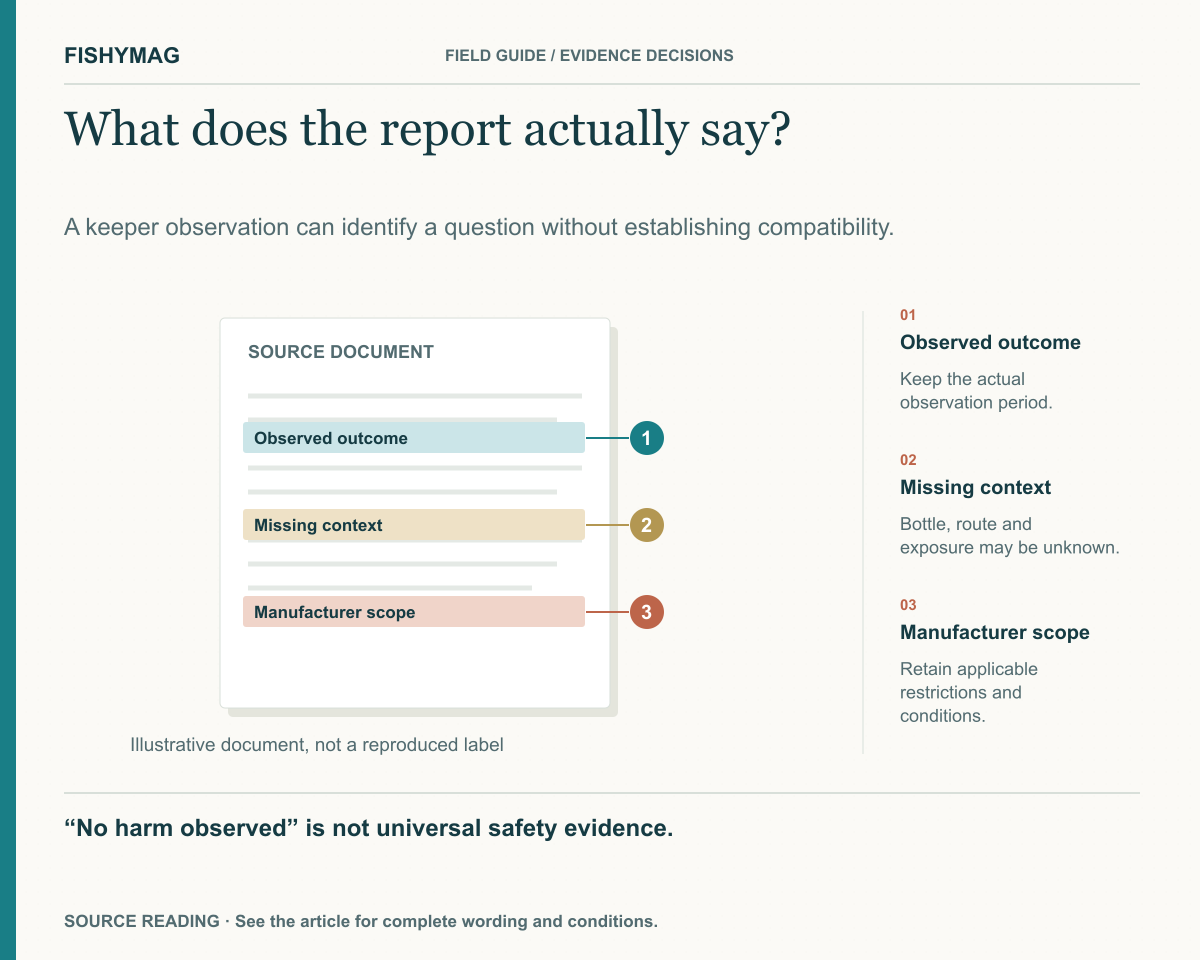
Figure data and explanation
A keeper observation can identify a question without establishing compatibility.
- Observed outcome
- Keep the actual observation period.
- Missing context
- Bottle, route and exposure may be unknown.
- Manufacturer scope
- Retain applicable restrictions and conditions.
“No harm observed” is not universal safety evidence.
Separate what was seen from what was concluded
Consider the fictional report “I used product X and my shrimp were fine”. The directly reported observation may be that visible shrimp were active during a particular period. The broader claim that the product is safe for all shrimp is a separate inference. Do not add missing survival counts, follow-up dates or measured exposure to make the report sound stronger.
Ask which details are actually available
Useful fields include exact bottle and market, route, recorded quantity, operating volume, other products, livestock present and observation period. Mark each field as reported, documented or unknown. These labels describe the record’s completeness; they are not a scientific quality score or a clinical risk estimate.
Keep alternative explanations open
A report might involve another formulation, less actual exposure than assumed, incomplete observations or several simultaneous changes. This article does not claim that any one explanation occurred. Its purpose is to prevent an unexplained outcome from becoming a universal causal claim. Equally, a reported loss alone does not prove which product or event caused it.
Use anecdotes to improve the evidence question
Ask the manufacturer whether the exact formulation and route are covered for the named group and what limitations apply. If a direct restriction exists, a favourable anecdote does not cancel it. FishyMag can use community reports to identify concerns, while affirmative compatibility still requires applicable manufacturer-grade evidence and human review.
Put it into practice
Your checklist
- Distinguish reported observations from a general safety conclusion.
- Mark missing identity, exposure and follow-up details explicitly.
- Use anecdotes to shape questions without overriding manufacturer evidence.
Sources and scope
This article distinguishes manufacturer statements from FishyMag’s own workflows and arithmetic examples. Linked formulation records retain their own evidence dates; publishing this article does not refresh those records.
AI-assisted writing and development. Not hands-on product testing or veterinary review. How we publish →
FishyMag reports what manufacturers say, quoted and linked. It does not diagnose illness or recommend a treatment, and it never infers that a product is safe from the absence of a warning — where no statement exists, it says so.
Formulations change. Always read the label on the bottle in your hand, and contact the manufacturer if your tank contains anything valuable or unusual.