Measurement
Endpoint or copied count? Audit the two KH mistakes separately
Use the actual API KH endpoint and chart to distinguish a count-transcription error from disagreement about which observation reached the endpoint.
By FishyMag · Published
Manufacturer-source commentary · Not a clinical review or treatment recommendation.
Quick answer
A count error and an endpoint disagreement need different evidence. In the fictional API KH record, both reviewers select cumulative count 8 but one copy says 7, so the transcription can be corrected. If reviewers select different endpoint events, the count record alone cannot resolve the interpretation.

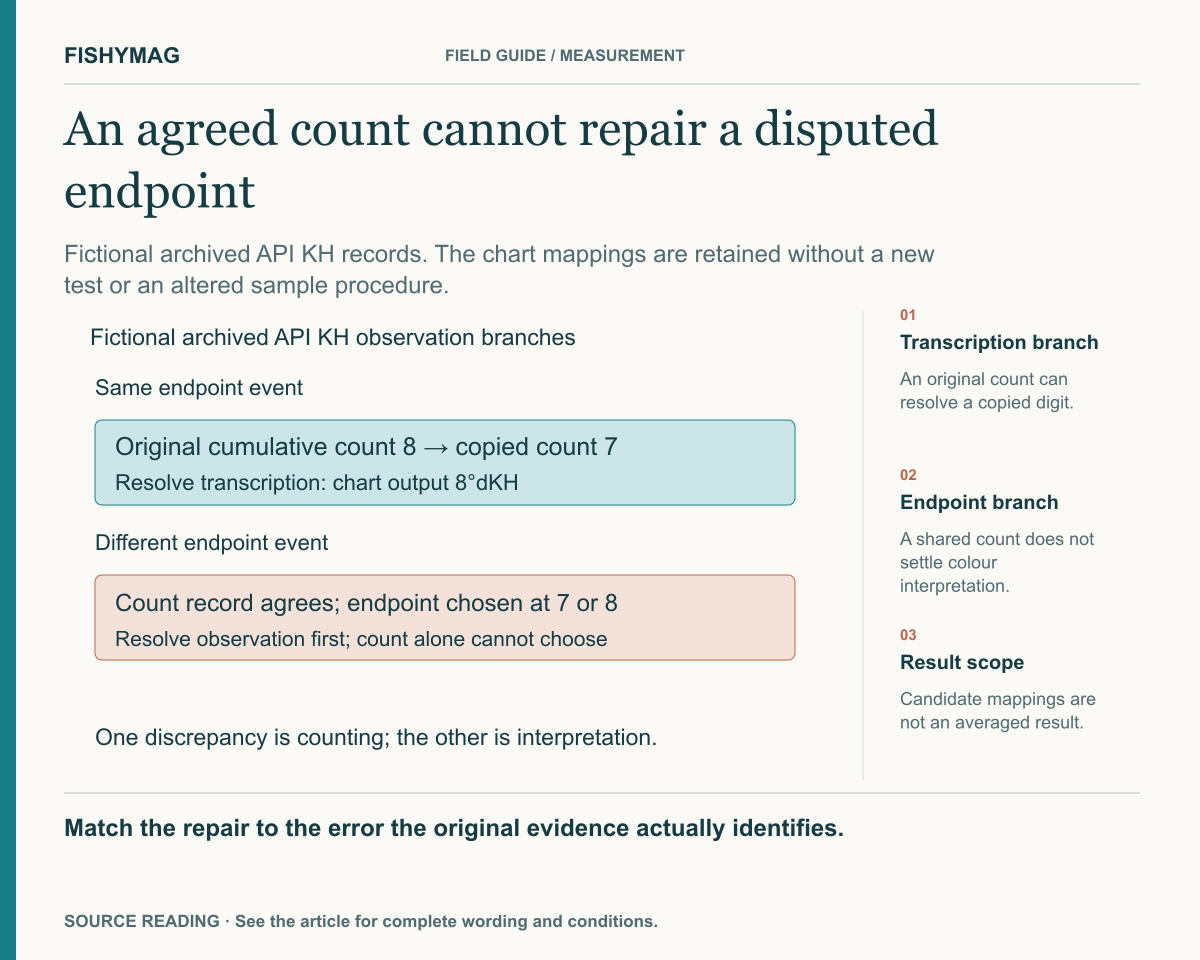
Figure data and explanation
Fictional archived API KH records. The chart mappings are retained without a new test or an altered sample procedure.
- Transcription branch
- An original count can resolve a copied digit.
- Endpoint branch
- A shared count does not settle colour interpretation.
- Result scope
- Candidate mappings are not an averaged result.
Match the repair to the error the original evidence actually identifies.
Keep the endpoint and conversion attached to the same kit
The manufacturer-linked API KH instructions identify the blue-to-yellow endpoint after mixing and provide a cumulative-drop conversion chart for the specified sample. The chart maps 7 drops to 7°dKH and 8 drops to 8°dKH. This page audits archived observations; it does not modify sample volume, define a new endpoint or recommend a hardness target.
Work the two fictional branches
In branch A, the retained observation sequence and both reviewers identify event E8 as the endpoint. Its original cumulative count is 8. A later spreadsheet contains 7. In branch B, the cumulative count record is shared but reviewers disagree whether E7 or E8 satisfies the documented endpoint.
| Branch | Agreed evidence | Disagreement | Completed finding |
|---|---|---|---|
| A: transcription | Endpoint E8; original count 8 | Copied count 7 | Correct copy to 8 with traceability; chart gives 8°dKH |
| B: endpoint | Original cumulative counts | Endpoint E7 versus E8 | Endpoint interpretation unresolved; do not choose a result from count alone |
| B candidate outputs | Chart maps 7 and 8 | No agreed endpoint event | 7°dKH and 8°dKH remain candidate mappings, not two measured final answers |
Correct only what the evidence resolves
For branch A, preserve the original copy, corrected entry and reason. The correction concerns transcription; it does not retroactively validate every test condition. For branch B, retain the original observations and ask the manufacturer about the disputed endpoint interpretation using the exact instructions and recorded conditions. A photograph’s colour depends on capture and viewing conditions, so avoid pretending that a compressed image is a calibrated colour decision. The completed review closes the count error while leaving the genuinely unresolved observation question visible. Averaging 7 and 8 into 7.5 would not apply the manufacturer’s chart to an observed endpoint.
Use your own details
Endpoint or copied count? Audit the two KH mistakes separately worksheet
Download the editable text file, fill it in on your device and keep it with the relevant record. This blank worksheet records your information; it does not verify entries or approve treatment.
- Method, instrument and document revision
- Aquarium and sample identity
- Original observation or display state
- Container, reagent or accessory identity
- Supported comparison evidence
- Conversion or decision actually authorized
- Unresolved finding and reason
- Original records retained
Put it into practice
Your checklist
- Identify the endpoint event separately from its copied count.
- Use the conversion chart for the actual kit and sample condition.
- Correct transcription without inventing an endpoint decision.
Sources and scope
This article distinguishes manufacturer statements from FishyMag’s own workflows and arithmetic examples. Linked formulation records retain their own evidence dates; publishing this article does not refresh those records.
AI-assisted writing and development. Not hands-on product testing or veterinary review. How we publish →
FishyMag reports what manufacturers say, quoted and linked. It does not diagnose illness or recommend a treatment, and it never infers that a product is safe from the absence of a warning — where no statement exists, it says so.
Formulations change. Always read the label on the bottle in your hand, and contact the manufacturer if your tank contains anything valuable or unusual.