Measurement
Test samples remove water too: keep a small-volume sampling ledger
A worked record distinguishes sample withdrawals from a true water change and avoids counting the same water twice.
By FishyMag · Published · Updated
Worked arithmetic example · Not a clinical review or treatment recommendation.
Quick answer
Water withdrawn for testing belongs in a volume record if it is not returned. Sum actual sample withdrawals, then record any replacement separately. A sample ledger does not determine how medication should be replaced.
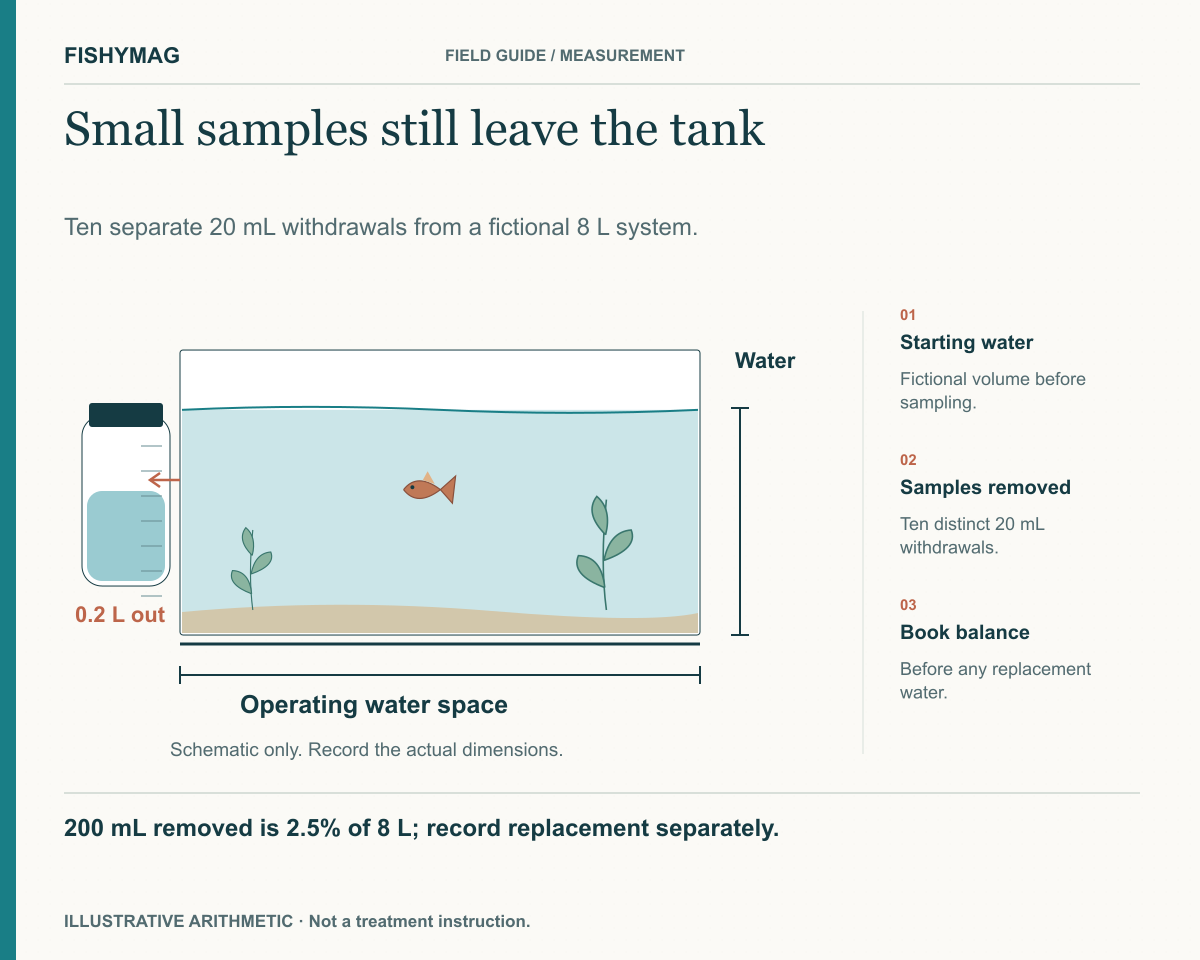
Figure data and explanation
Ten separate 20 mL withdrawals from a fictional 8 L system.
- Starting water
- 8 L. Fictional volume before sampling.
- Samples removed
- 0.2 L. Ten distinct 20 mL withdrawals.
- Book balance
- 7.8 L. Before any replacement water.
200 mL removed is 2.5% of 8 L; record replacement separately.
Count actual withdrawals rather than test names
Suppose a fictional session uses ten separate 20 mL withdrawals. The total is 200 mL, or 0.2 L. If the same one-time withdrawal was divided among several tests, count that original withdrawal once. Counting each test as a new withdrawal would overstate the water removed.
Show its share of the recorded volume
For an example system recorded at 8 L before sampling, 0.2 L is 2.5% of that volume. If no other event occurs and none of the sample water returns, the book balance becomes 7.8 L. These figures are arithmetic only; they do not establish the accuracy of the original 8 L estimate.
Keep replacement and sample handling separate
A later 0.2 L replacement restores the book volume to 8 L in the example. It does not undo the history of the withdrawn water or guarantee an unchanged substance concentration. Follow test instructions for sample handling and disposal; this ledger is not permission to return reacted samples to an aquarium.
Record a change without inventing a correction dose
Use sample identifier, actual withdrawn volume, unit, whether it was a new withdrawal, and any later replacement event. Keep product additions in their own rows. If the sampling history matters to a treatment question, share the event list with the relevant adviser rather than treating the removed percentage as a redosing rule.
Put it into practice
Your checklist
- Count each actual water withdrawal once.
- Convert sample millilitres to litres before updating the volume balance.
- Keep replacement events and treatment decisions separate.
Sources and scope
This article distinguishes manufacturer statements from FishyMag’s own workflows and arithmetic examples. Linked formulation records retain their own evidence dates; publishing this article does not refresh those records.
AI-assisted writing and development. Not hands-on product testing or veterinary review. How we publish →
FishyMag reports what manufacturers say, quoted and linked. It does not diagnose illness or recommend a treatment, and it never infers that a product is safe from the absence of a warning — where no statement exists, it says so.
Formulations change. Always read the label on the bottle in your hand, and contact the manufacturer if your tank contains anything valuable or unusual.