Measurement
A test’s viewing window is not its optical path length
Use an ideal Beer-Lambert example while avoiding a false path-length inference from an aquarium comparator’s viewing-window dimension.
By FishyMag · Published
Worked arithmetic example · Not a clinical review or treatment recommendation.
Quick answer
Optical path length is part of the measurement geometry. In an ideal same-solution Beer-Lambert example, doubling the path doubles absorbance. That does not let you transfer a calibration between an aquarium photometer and a visual comparator. A viewing-window dimension is not automatically the distance light travels through the sample.
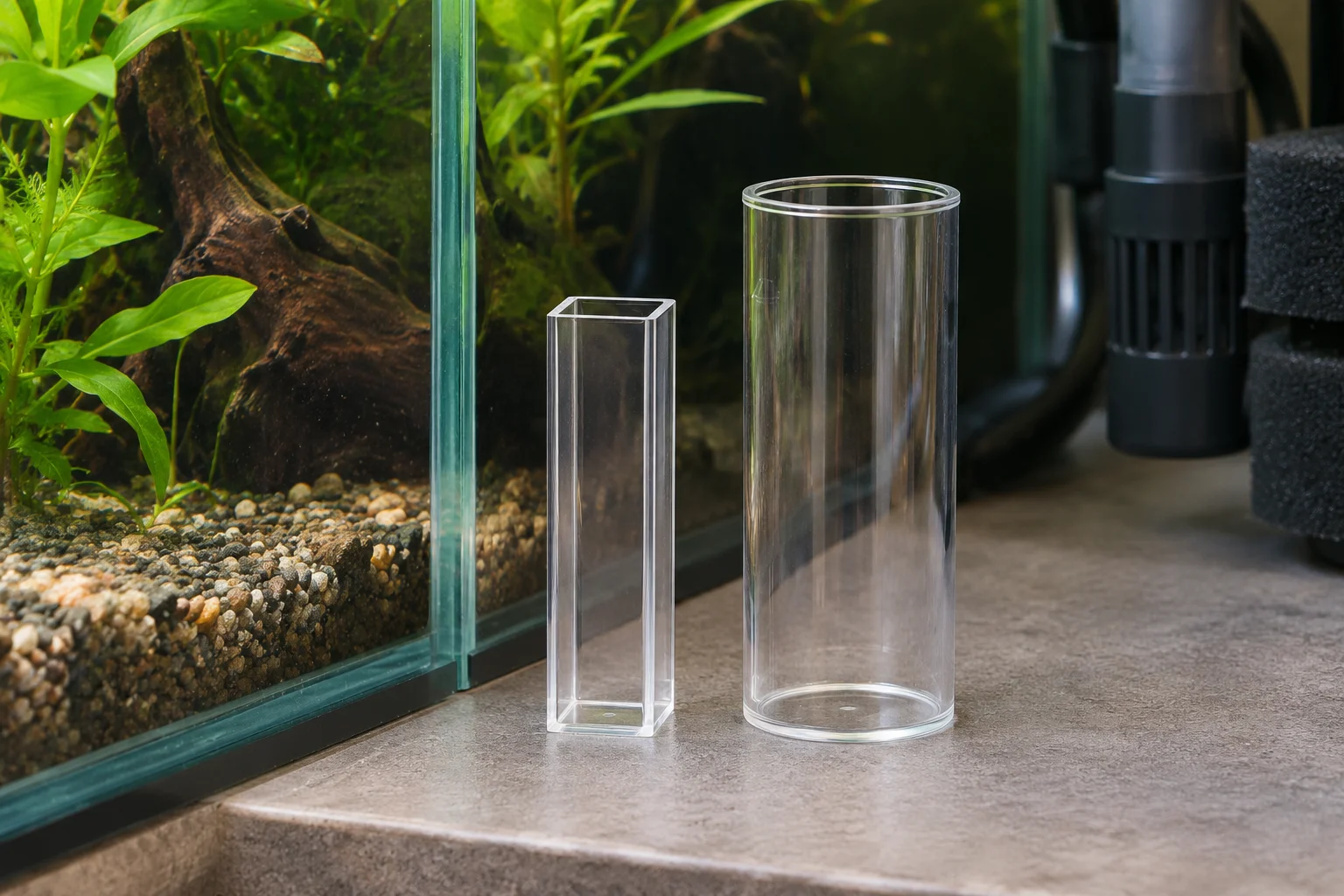
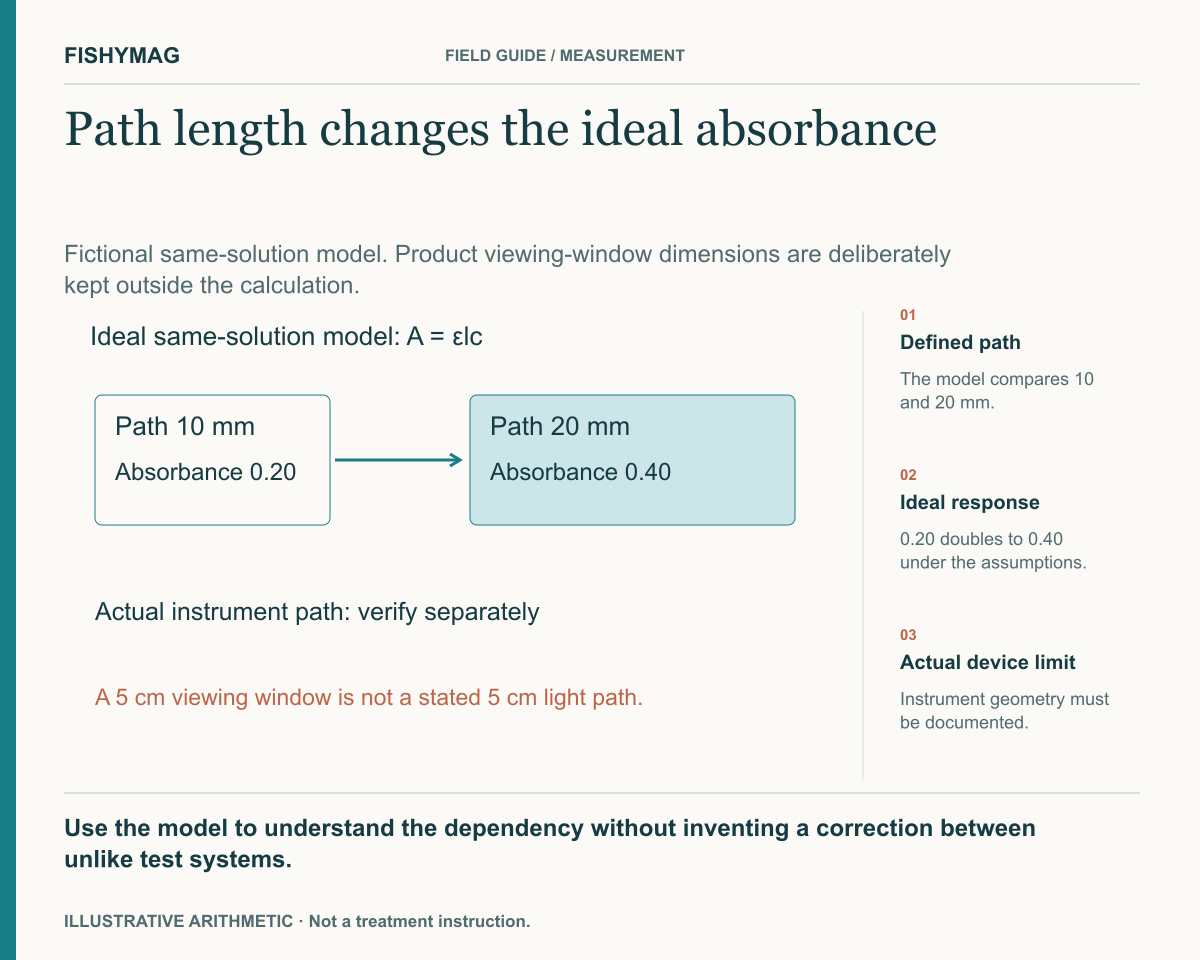
Figure data and explanation
Fictional same-solution model. Product viewing-window dimensions are deliberately kept outside the calculation.
- Defined path
- The model compares 10 and 20 mm.
- Ideal response
- 0.20 doubles to 0.40 under the assumptions.
- Actual device limit
- Instrument geometry must be documented.
Use the model to understand the dependency without inventing a correction between unlike test systems.
Keep model geometry separate from product dimensions
The Beer-Lambert relationship A = εlc connects absorbance with path length under its stated optical and chemical assumptions. Hanna identifies HI713’s optical wavelength; Seachem describes a 5 cm viewing window for isolating a visual colour comparison. Neither statement by itself supplies a matching sample path for a cross-device conversion. Do not substitute a window width for the liquid path.
Complete the ideal calculation
This invented model keeps the same homogeneous solution, concentration, absorptivity and suitable narrow-band optical conditions. Only the defined path length changes. The calculation is a model illustration, without an actual kit comparison or validated sample.
| Model case | Defined liquid path | Absorbance | Supported model comparison |
|---|---|---|---|
| A | 10 mm | 0.20 | Reference model case |
| B | 20 mm | 0.40 | 0.20 × 20/10 |
| Seachem window statement | 5 cm viewing window | Not supplied | Window dimension does not establish sample path |
| Real cross-device conversion | Actual optical geometries needed | Not calculated | No calibration transfer established |
Do not use the model ratio as an instrument correction
A real comparison also needs compatible analyte response, wavelength or viewing conditions, cell properties, colour processing and calibration. A visual comparator and a photometer can differ in several of those at once. The completed finding here is that the ideal 2:1 absorbance ratio is reproducible, while the proposed product-to-product concentration conversion is unsupported. Ask for the actual measurement geometry and applicable method validation rather than doubling a displayed concentration or scaling a colour chart from its printed dimensions.
Use your own details
A test’s viewing window is not its optical path length worksheet
Download the editable text file, fill it in on your device and keep it with the relevant record. This blank worksheet records your information; it does not verify entries or approve treatment.
- Aquarium or sample identity
- Method, study and revision
- Original response and reporting basis
- Applicable measurement conditions
- Comparison data and calculation
- Scope or selectivity evidence
- Completed conclusion
- Unresolved transfer or mechanism question
Put it into practice
Your checklist
- Identify the actual liquid optical path.
- Keep model assumptions attached to the absorbance calculation.
- Do not turn a window dimension into a calibration transfer.
Sources and scope
This article distinguishes manufacturer statements from FishyMag’s own workflows and arithmetic examples. Linked formulation records retain their own evidence dates; publishing this article does not refresh those records.
- IUPAC Gold Book: Beer-Lambert law; reviewed November 8, 2026 ↗
- Hanna HI713 phosphate low-range specifications; reviewed November 8, 2026 ↗
- Seachem MultiTest Ammonia manufacturer page; reviewed November 8, 2026 ↗
AI-assisted writing and development. Not hands-on product testing or veterinary review. How we publish →
FishyMag reports what manufacturers say, quoted and linked. It does not diagnose illness or recommend a treatment, and it never infers that a product is safe from the absence of a warning — where no statement exists, it says so.
Formulations change. Always read the label on the bottle in your hand, and contact the manufacturer if your tank contains anything valuable or unusual.