Measurement
Does an aquarium test agree across approved dilutions?
Calculate back-corrected nitrate-plus-nitrite results from supplied dilution records and identify a disagreement without assigning a cause.
By FishyMag · Published
Worked arithmetic example · Not a clinical review or treatment recommendation.
Quick answer
Multiply each permitted measured result by its documented dilution factor, then compare the corrected values. In this fictional report, factors 1, 2 and 4 give 8.0, 7.0 and 6.0 mg/L as N. That trend needs review; it does not validate a correction curve, identify an interferent or supply a pass threshold.
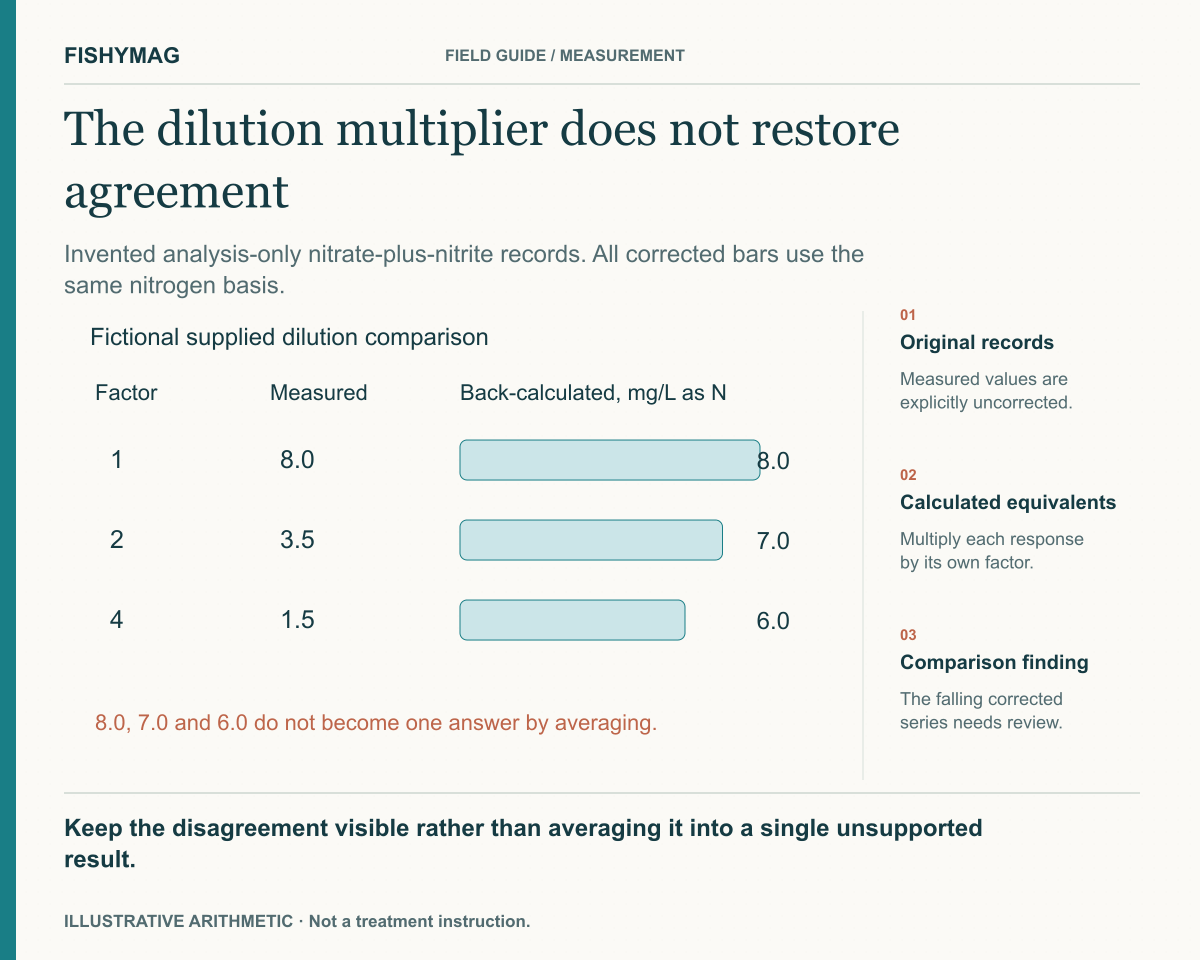
Figure data and explanation
Invented analysis-only nitrate-plus-nitrite records. All corrected bars use the same nitrogen basis.
- Original records
- Measured values are explicitly uncorrected.
- Calculated equivalents
- Multiply each response by its own factor.
- Comparison finding
- The falling corrected series needs review.
Keep the disagreement visible rather than averaging it into a single unsupported result.
Review existing analytical records
EPA 353.2 calls for the appropriate dilution multiplier and reports only responses between the calibration standards. The dataset here is invented and analysis-only. It assumes the laboratory confirms measured responses are inside its actual calibration range. Preparation authorization, matrix preservation and diluent identity remain part of the laboratory’s method record, not household instructions supplied on this page.
Back-calculate before comparing
A factor of 2 belongs to the method’s measured value, not to a value already multiplied by the laboratory. In this example the report explicitly identifies the three values as uncorrected aliquot concentrations on the same nitrogen basis.
| Factor | Measured aliquot, mg/L as N | Calculation | Original-sample equivalent, mg/L as N |
|---|---|---|---|
| 1 | 8.0 | 8.0 × 1 | 8.0 |
| 2 | 3.5 | 3.5 × 2 | 7.0 |
| 4 | 1.5 | 1.5 × 4 | 6.0 |
Report the disagreement without choosing an explanation
The corrected series spans 6.0 to 8.0 mg/L as N and declines with factor in this constructed dataset. Potential explanations require evidence: dilution records, matrix effects, calibration behavior and uncertainty should be reviewed. The trend alone does not identify which explanation is correct. Do not extrapolate toward an infinitely diluted value, pick the most reassuring number or average all three into a supposedly improved result. Ask the laboratory for its applicable comparison criterion and final interpretation. The completed finding retains the three calculations and marks the comparison unresolved; it does not certify any point as the true aquarium concentration.
Use your own details
Does an aquarium test agree across approved dilutions? worksheet
Download the editable text file, fill it in on your device and keep it with the relevant record. This blank worksheet records your information; it does not verify entries or approve treatment.
- Aquarium and sample identity
- Instrument or laboratory method revision
- Original reading including flags
- Chemical basis and unit
- Sample preparation or blank identity recorded
- Quality-control evidence
- Supported finding and calculation
- Unresolved question and source
Put it into practice
Your checklist
- Confirm whether the laboratory already applied the multiplier.
- Keep measured range checks distinct from back-corrected results.
- Review disagreement before combining or correcting the series.
Sources and scope
This article distinguishes manufacturer statements from FishyMag’s own workflows and arithmetic examples. Linked formulation records retain their own evidence dates; publishing this article does not refresh those records.
- EPA Method 353.2, Revision 2.0; reviewed November 8, 2026 ↗
- Australian and New Zealand guidelines: water-quality data analysis; reviewed November 8, 2026 ↗
AI-assisted writing and development. Not hands-on product testing or veterinary review. How we publish →
FishyMag reports what manufacturers say, quoted and linked. It does not diagnose illness or recommend a treatment, and it never infers that a product is safe from the absence of a warning — where no statement exists, it says so.
Formulations change. Always read the label on the bottle in your hand, and contact the manufacturer if your tank contains anything valuable or unusual.