Measurement
Reconstruct aquarium meter TDS before comparing it with a lab result
Calculate two TDS displays from the documented HI98194/95 equation, preserve settings that can change saved logs and compare the estimate with a separate gravimetric result.
By FishyMag · Published
Worked arithmetic example · Not a clinical review or treatment recommendation.
Quick answer
A meter’s TDS display can be a conductivity-based calculation. The HI98194/95 manual states TDS = factor × EC25. In the fictional case, 500 µS/cm gives 250 mg/L at factor 0.50 and 350 mg/L at 0.70. Neither factor independently measures the sample’s true dissolved-solids mass or replaces a gravimetric determination.
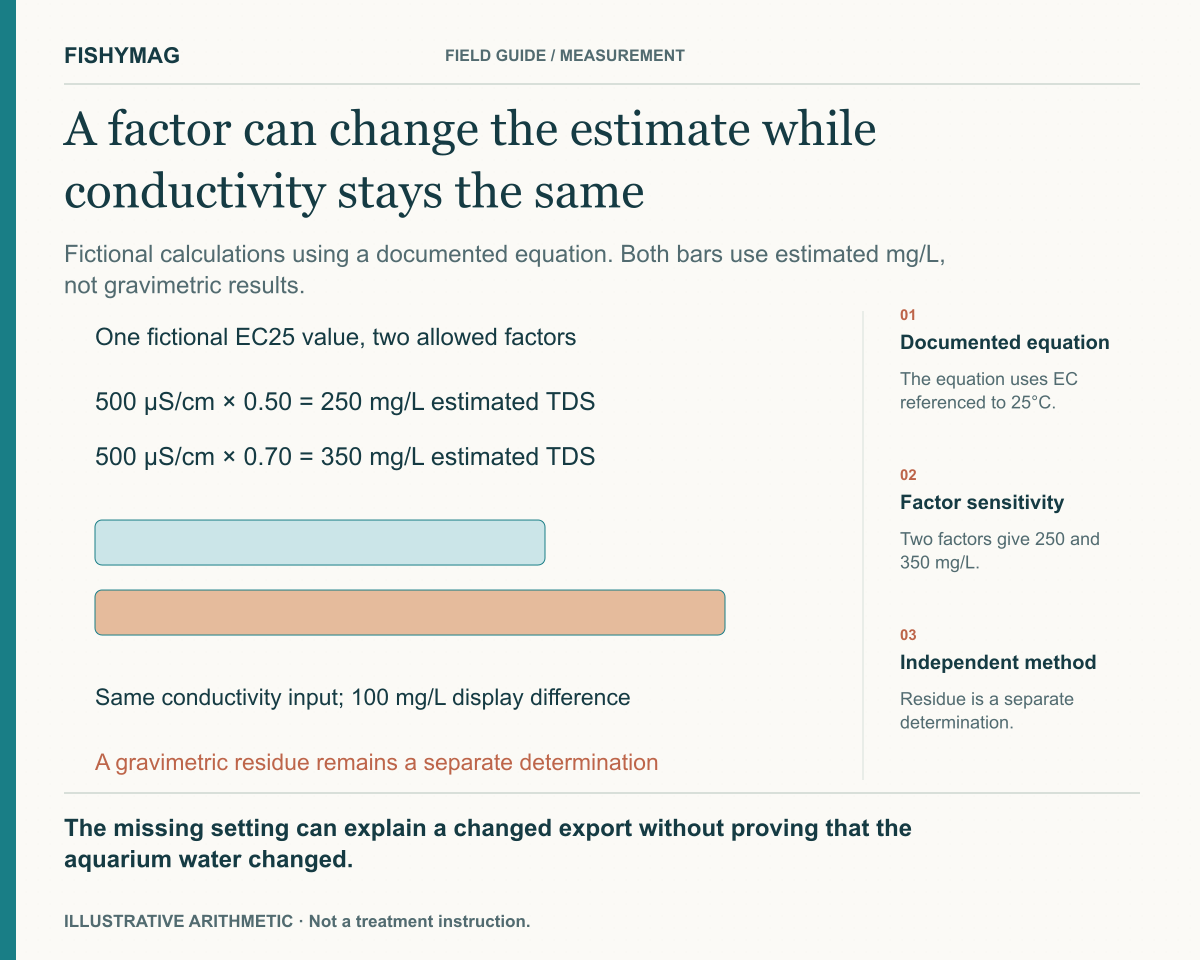
Figure data and explanation
Fictional calculations using a documented equation. Both bars use estimated mg/L, not gravimetric results.
- Documented equation
- The equation uses EC referenced to 25°C.
- Factor sensitivity
- Two factors give 250 and 350 mg/L.
- Independent method
- Residue is a separate determination.
The missing setting can explain a changed export without proving that the aquarium water changed.
Trace the displayed quantity to its input
The cited manual identifies the equation and a selectable factor from 0.00 to 1.00, with default 0.50. This constructed example uses EC25 of 500 µS/cm; the two factors are sensitivity cases, not recommendations for aquarium water. A recorded 500 µS/cm without its reference-temperature and compensation information would not establish that same input.
Complete the display calculation and preserve the original settings
Multiplication gives 250 and 350 mg/L, a difference of 100 mg/L from the same conductivity input. The manual also warns that changes to units or coefficients alter displayed stored logs and advises saving them before changes. A later export therefore needs its settings history, rather than being treated as an untouched copy of the original display.
| Fictional record | Input and transformation | Completed result |
|---|---|---|
| Display A | 500 µS/cm EC25 × 0.50 | 250 mg/L estimated TDS |
| Display B | 500 µS/cm EC25 × 0.70 | 350 mg/L estimated TDS |
| Factor sensitivity | 350 − 250 | 100 mg/L, not a real change in the source water |
| Separate paired-method case | Gravimetric 180 mg/L; meter estimate 140 mg/L | 40 mg/L difference |
| Relative paired-method difference | 40 ÷ 180 × 100 | 22.22% relative to the gravimetric result |
Compare a residue measurement on its own analytical basis
The last two rows form a separate fictional sample pair, not the 500 µS/cm case. EPA 160.1 defines filterable residue using the stated glass-fiber filtration and 180 °C drying method. The 140 mg/L meter estimate instead follows a recorded EC25 of 280 µS/cm and factor 0.50. Their 40 mg/L difference does not by itself identify instrument error, the correct factor or a particular missing constituent. Retain common sample identity, method, timing, conversion settings and uncertainties before investigating the difference. No household residue-analysis procedure or aquarium purity conclusion follows.
Use your own details
Reconstruct aquarium meter TDS before comparing it with a lab result worksheet
Download the editable text file, fill it in on your device and keep it with the relevant record. This blank worksheet records your information; it does not verify entries or approve treatment.
- Meter model, firmware and original export
- Conductivity quantity and reference temperature
- TDS equation and recorded factor
- Display units and resolution
- Settings at collection and at later export
- Laboratory residue method, fraction and date
- Difference with its explicit denominator
- Uncertainty, sample identity and unresolved explanation
Put it into practice
Your checklist
- Preserve conductivity basis and factor with every TDS export.
- Keep original logs before a settings change can reinterpret them.
- Compare laboratory residue and meter estimates as different determinations.
Sources and scope
This article distinguishes manufacturer statements from FishyMag’s own workflows and arithmetic examples. Linked formulation records retain their own evidence dates; publishing this article does not refresh those records.
- Hanna HI98194/HI98195/HI98196 instruction manual; reviewed November 9, 2026 ↗
- EPA 160.1 official NEMI method record: filterable residue; reviewed November 9, 2026 ↗
- NIST TN1297 Appendix D1: measurement terminology; reviewed November 8, 2026 ↗
AI-assisted writing and development. Not hands-on product testing or veterinary review. How we publish →
FishyMag reports what manufacturers say, quoted and linked. It does not diagnose illness or recommend a treatment, and it never infers that a product is safe from the absence of a warning — where no statement exists, it says so.
Formulations change. Always read the label on the bottle in your hand, and contact the manufacturer if your tank contains anything valuable or unusual.