Measurement
Could the aquarium sampling tool add contamination?
Compare untouched, container and equipment-contact blanks without turning censored values into zero or subtracting a suspected contamination contribution.
By FishyMag · Published
Worked arithmetic example · Not a clinical review or treatment recommendation.
Quick answer
Different blank pathways answer different contamination questions. In the fictional packet, untouched and direct-container blanks are both below 1 µg/L, while the equipment-contact blank is 6 and the equipment-collected aquarium sample is 7. Equipment contact is a specific unresolved route to review. Subtracting 6 from 7 does not produce an authorized aquarium result.
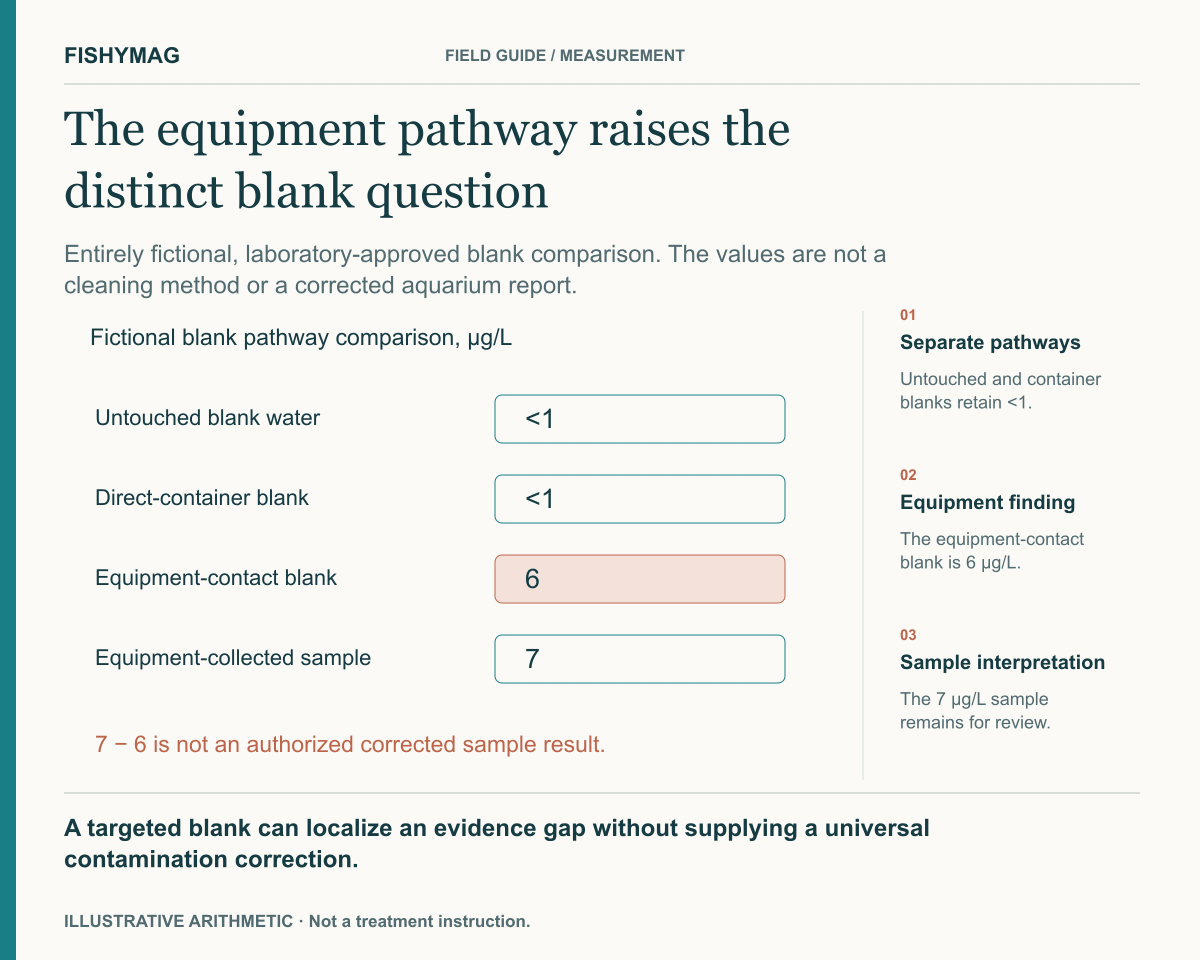
Figure data and explanation
Entirely fictional, laboratory-approved blank comparison. The values are not a cleaning method or a corrected aquarium report.
- Separate pathways
- Untouched and container blanks retain <1.
- Equipment finding
- The equipment-contact blank is 6 µg/L.
- Sample interpretation
- The 7 µg/L sample remains for review.
A targeted blank can localize an evidence gap without supplying a universal contamination correction.
Keep the blank pathway in its name
The invented laboratory-approved blank set separates untouched blank water, direct-container contact and sampling-equipment contact. Those conditions are declared in the example; this page does not prescribe blank water, equipment cleaning or a preparation protocol. Blanks can reveal a contamination question, but they do not automatically quantify an additive correction for a particular environmental sample.
Compare the supplied findings
The “less than” qualifiers remain part of the first two results. Neither is an exact zero. The aquarium result came through the equipment pathway, making that blank relevant without proving a constant contribution.
| Record | Result, µg/L | Completed finding |
|---|---|---|
| Untouched blank | <1 | No quantified result at or above the stated reporting limit |
| Direct-container blank | <1 | Does not identify a quantified container contribution |
| Equipment-contact blank | 6 | Equipment pathway raises a specific contamination question |
| Aquarium sample through equipment | 7 | Requires laboratory review with the blank findings |
| Proposed 7 − 6 correction | Not issued | Constant sample contribution not established |
Resolve the pathway before interpreting the aquarium concentration
The completed review asks the laboratory whether the equipment blank is applicable to this sample and what a documented repeat or qualification should involve. Contact duration, sample chemistry, blank composition and handling can affect comparability. The blank findings alone do not identify which component of the equipment contributed, or prove that the aquarium contained only 1 µg/L before collection. Preserve all original results, including the censored qualifiers, and keep the equipment identity and sample path. The useful output is a targeted contamination-route question, without a guessed corrected result or a household cleaning recipe.
Use your own details
Could the aquarium sampling tool add contamination? worksheet
Download the editable text file, fill it in on your device and keep it with the relevant record. This blank worksheet records your information; it does not verify entries or approve treatment.
- Question and intended sampled population
- Exact parent samples and pathway identities
- Laboratory-approved method and fraction
- Raw values, units and qualifiers
- Weighting or replication assumptions
- Completed descriptive calculation
- What remains unidentifiable
- Laboratory review and next evidence
Put it into practice
Your checklist
- Name the contact pathway for every blank.
- Preserve less-than qualifiers rather than replacing them with zero.
- Ask for laboratory disposition instead of subtracting the blank yourself.
Sources and scope
This article distinguishes manufacturer statements from FishyMag’s own workflows and arithmetic examples. Linked formulation records retain their own evidence dates; publishing this article does not refresh those records.
- Australian and New Zealand water-quality field sampling guidance; reviewed November 8, 2026 ↗
- Australian and New Zealand water-quality guidelines: laboratory analysis; reviewed November 8, 2026 ↗
AI-assisted writing and development. Not hands-on product testing or veterinary review. How we publish →
FishyMag reports what manufacturers say, quoted and linked. It does not diagnose illness or recommend a treatment, and it never infers that a product is safe from the absence of a warning — where no statement exists, it says so.
Formulations change. Always read the label on the bottle in your hand, and contact the manufacturer if your tank contains anything valuable or unusual.