Measurement
Does the journey change an aquarium sample?
Compare a sample’s transport pathway with a matched approved pathway while keeping time, container and analytical differences visible.
By FishyMag · Published
Worked arithmetic example · Not a clinical review or treatment recommendation.
Quick answer
In the fictional paired records, transported minus comparison is +0.8 and +0.7 mg/L, with mean +0.75. That is a repeated pathway-associated contrast. It does not prove that shipping alone caused it, or authorize a universal transport correction.
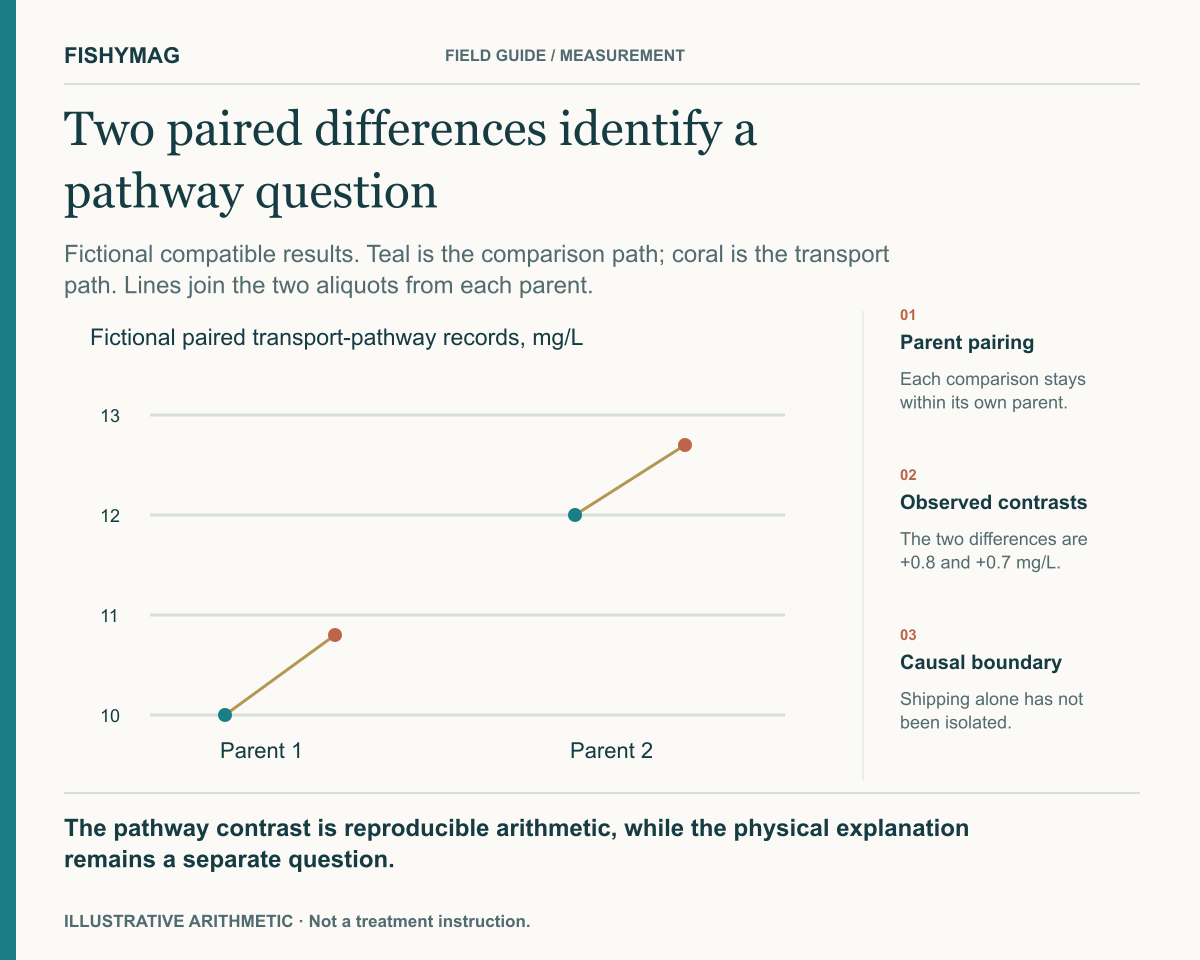
Figure data and explanation
Fictional compatible results. Teal is the comparison path; coral is the transport path. Lines join the two aliquots from each parent.
- Parent pairing
- Each comparison stays within its own parent.
- Observed contrasts
- The two differences are +0.8 and +0.7 mg/L.
- Causal boundary
- Shipping alone has not been isolated.
The pathway contrast is reproducible arithmetic, while the physical explanation remains a separate question.
Define what differs between the pathways
The invented investigation begins with two independently collected parent samples. Each is divided through laboratory-authorized pathways: an approved comparison path and the transport path under review. The split and handling applicability are supplied conditions of this teaching packet. No storage temperature, holding time, transport stress or sample-preservation procedure is recommended here.
Calculate the paired contrast first
Comparisons remain within parent sample. A transported value from parent 2 must not be compared with the lower starting concentration of parent 1. All supplied results share the same declared analyte basis and mg/L unit.
| Parent | Comparison pathway, mg/L | Transport pathway, mg/L | Transport minus comparison |
|---|---|---|---|
| 1 | 10.0 | 10.8 | +0.8 mg/L |
| 2 | 12.0 | 12.7 | +0.7 mg/L |
| Mean paired difference | Not a pooled parent concentration | Not a pooled parent concentration | +0.75 mg/L |
Retain the whole pathway in the conclusion
Both pairs show a positive descriptive contrast. That finding makes the transport pathway worth reviewing, but the pathway may also differ in container, elapsed time, sample splitting or analysis sequence. Any of those could contribute to the comparison. Preserve collection times, parent-to-aliquot links, container identities and analytical batch information. The completed finding is “pathway-associated contrast observed in both supplied pairs,” without a shipping-only causal claim. A laboratory’s qualified review should decide whether the original sample report remains usable and what a better matched investigation would require. Subtracting 0.75 from every future transported result would extend this tiny fictional packet beyond its evidence.
Use your own details
Does the journey change an aquarium sample? worksheet
Download the editable text file, fill it in on your device and keep it with the relevant record. This blank worksheet records your information; it does not verify entries or approve treatment.
- Declared comparison or event question
- Parent sample or system identity
- Pathway and observation method
- Exact times or matched block conditions
- Original values and qualifiers
- Completed calculation or coverage finding
- Unresolved mechanism or unobserved interval
- Next evidence and responsible reviewer
Put it into practice
Your checklist
- Keep transported and comparison results paired by parent.
- Retain time, container and analytical-pathway differences.
- Report the contrast without creating a universal correction.
Sources and scope
This article distinguishes manufacturer statements from FishyMag’s own workflows and arithmetic examples. Linked formulation records retain their own evidence dates; publishing this article does not refresh those records.
- Australian and New Zealand water-quality field sampling guidance; reviewed November 8, 2026 ↗
- Australian and New Zealand guidelines: water-quality data analysis; reviewed November 8, 2026 ↗
AI-assisted writing and development. Not hands-on product testing or veterinary review. How we publish →
FishyMag reports what manufacturers say, quoted and linked. It does not diagnose illness or recommend a treatment, and it never infers that a product is safe from the absence of a warning — where no statement exists, it says so.
Formulations change. Always read the label on the bottle in your hand, and contact the manufacturer if your tank contains anything valuable or unusual.