Measurement
Why aquarium sample exposure can matter to a pH record
Compare checked gas-equilibrated model states with conserved alkalinity inventory, then separate that mechanism example from an undocumented sample-exposure history.
By FishyMag · Published
Worked arithmetic example · Not a clinical review or treatment recommendation.
Quick answer
A changed pH does not by itself prove that alkalinity was consumed. The two computed gas-equilibrated states below have different pH and DIC while conserving alkalinity inventory. A sample-handling deviation can make that mechanism worth investigating, but it does not establish how much CO2 a real sample gained or lost.
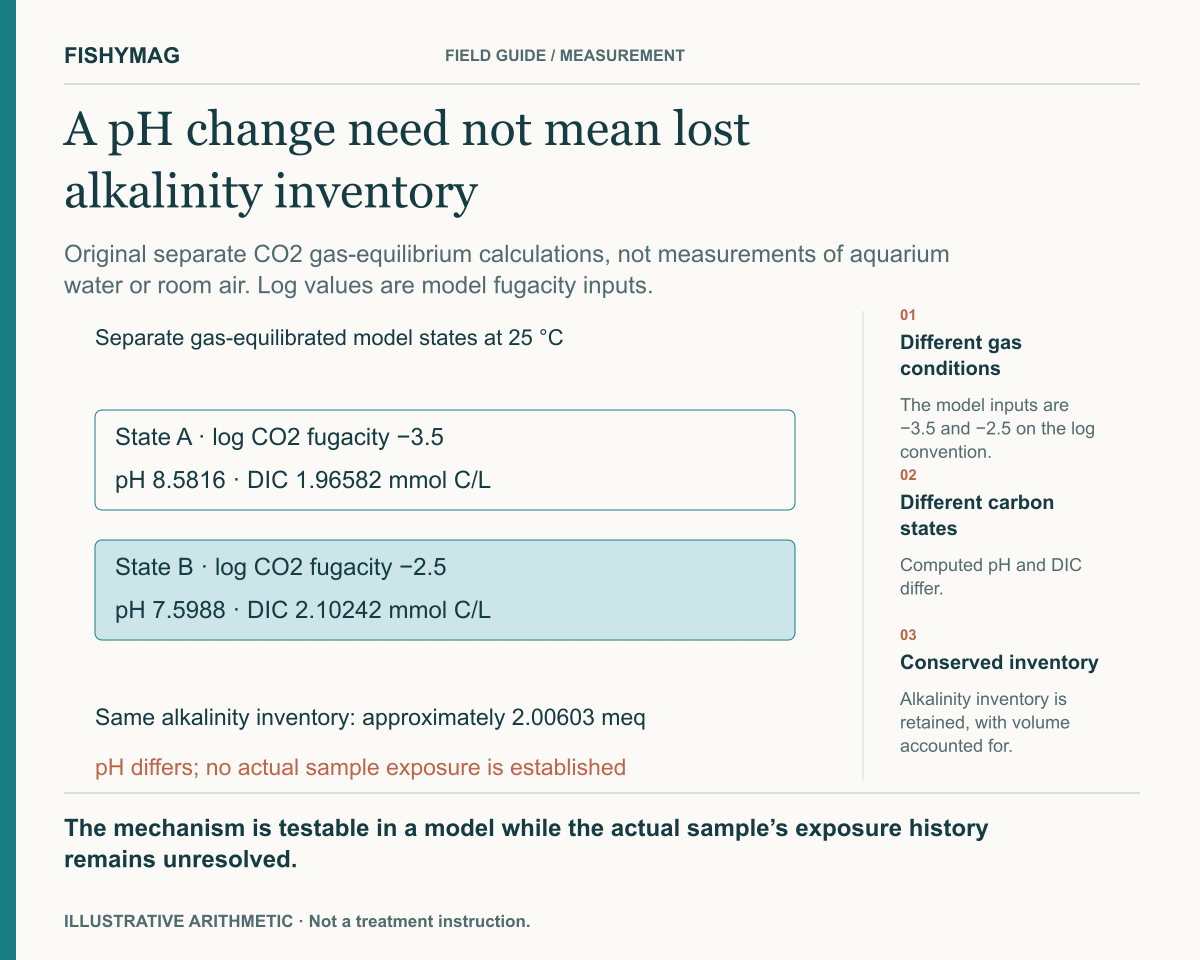
Figure data and explanation
Original separate CO2 gas-equilibrium calculations, not measurements of aquarium water or room air. Log values are model fugacity inputs.
- Different gas conditions
- The model inputs are −3.5 and −2.5 on the log convention.
- Different carbon states
- Computed pH and DIC differ.
- Conserved inventory
- Alkalinity inventory is retained, with volume accounted for.
The mechanism is testable in a model while the actual sample’s exposure history remains unresolved.
Keep the fictional handling packet separate from the calculation
A constructed handover packet says sample A remained in its specified closed container while sample B was found with an undocumented closure deviation. It supplies no measured headspace composition, exposure duration or gas-transfer rate. That is enough to flag a handling difference, not enough to compute a corrected pH. The following independent model example explains a possible mechanism without claiming that it occurred in either sample.
Work two fully declared gas-equilibrium states
Both local calculations start from the same declared sodium-carbonate-water solution at pH 7.50 and 2.000 meq/L alkalinity, 25 °C and 1 atm. Each is separately equilibrated with a computational CO2 gas reservoir at the stated log fugacity. These are neither measured room-air concentrations nor instructions for exposing water. No mineral reaction is imposed.
| Model quantity | State A | State B |
|---|---|---|
| Specified log CO2 fugacity on engine convention | −3.5 | −2.5 |
| Computed pH | 8.5816 | 7.5988 |
| DIC, mmol C/L | 1.96582 | 2.10242 |
| Alkalinity concentration, meq/L | 2.0000115 | 2.0000020 |
| Computed solution volume, L | 1.0030110 | 1.0030158 |
| Alkalinity inventory, meq | 2.0060336 | 2.0060336 |
Report the conserved quantity precisely
The independent inventory check multiplies concentration by computed solution volume. It confirms conservation to within 0.00000001 meq; the tiny concentration difference reflects the different calculated volumes. Calling the concentrations exactly identical would hide that basis. These states demonstrate that gas exchange can alter a carbonate-system pH without consuming its alkalinity inventory under the declared conditions. They do not supply an exposure correction, establish a real sample’s composition or distinguish handling effects from instrument and collection differences. Keep those questions open in the original packet.
Use your own details
Why aquarium sample exposure can matter to a pH record worksheet
Download the editable text file, fill it in on your device and keep it with the relevant record. This blank worksheet records your information; it does not verify entries or approve treatment.
- Sample identifier and collection time
- Original closure, headspace and exposure record
- pH measurement time, temperature and method
- Alkalinity result and sample-fraction basis
- Actual composition and gas-contact evidence
- Model gas condition and its distinction from measured air
- Alkalinity inventory versus concentration
- Supported comparison and unresolved cause
Worked example files
These files contain the article’s worked example. Read its source and scope notes, and keep your own current records before opening an example in a tool.
Put it into practice
Your checklist
- Record closure and exposure without inventing their duration.
- Distinguish a mechanism example from a correction for a real sample.
- State inventory conservation separately from concentration rounding.
Sources and scope
This article distinguishes manufacturer statements from FishyMag’s own workflows and arithmetic examples. Linked formulation records retain their own evidence dates; publishing this article does not refresh those records.
- USGS PHREEQC Version 3 manual: capabilities and computational scope; reviewed November 9, 2026 ↗
- USGS PHREEQC SOLUTION: units, calculated density, pH and alkalinity; reviewed November 9, 2026 ↗
- Vitens PhreeqPython primary repository and local version 1.6.2; reviewed November 9, 2026 ↗
AI-assisted writing and development. Not hands-on product testing or veterinary review. How we publish →
FishyMag reports what manufacturers say, quoted and linked. It does not diagnose illness or recommend a treatment, and it never infers that a product is safe from the absence of a warning — where no statement exists, it says so.
Formulations change. Always read the label on the bottle in your hand, and contact the manufacturer if your tank contains anything valuable or unusual.