Measurement
Read the quantity behind an aquarium salinity number
Resolve practical salinity, mass-fraction and specific-gravity conventions with a reproducible reference-composition example and two explicitly hypothetical density ratios.
By FishyMag · Published
Worked arithmetic example · Not a clinical review or treatment recommendation.
Quick answer
Practical Salinity 35 and salt mass fraction 35 g/kg are different reports, despite their matching numerals. The TEOS-10 reference-composition bridge gives Reference Salinity 35.16504 g/kg from Practical Salinity 35. It does not automatically establish an aquarium sample’s actual salt mass fraction. Specific gravity also needs its temperature convention.

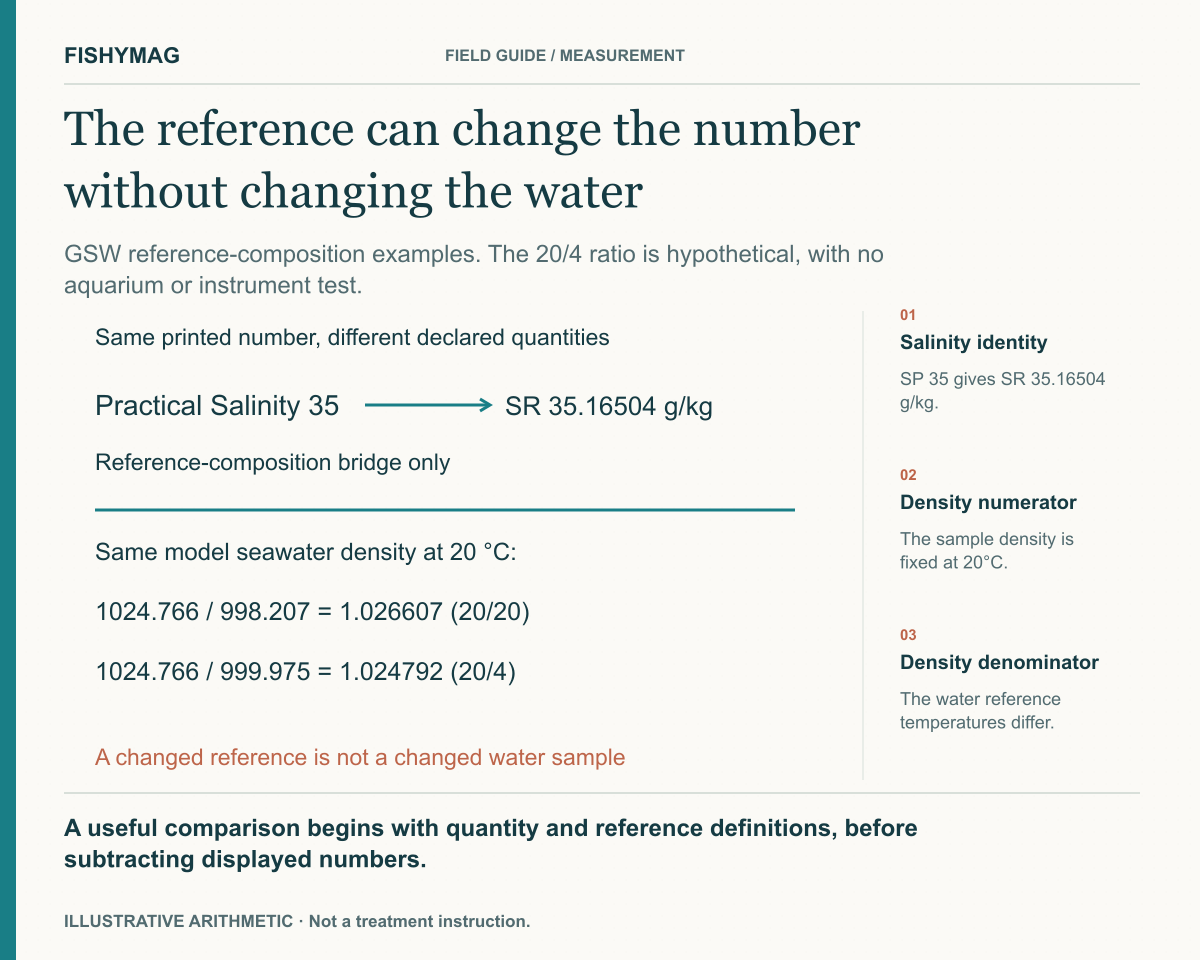
Figure data and explanation
GSW reference-composition examples. The 20/4 ratio is hypothetical, with no aquarium or instrument test.
- Salinity identity
- SP 35 gives SR 35.16504 g/kg.
- Density numerator
- The sample density is fixed at 20°C.
- Density denominator
- The water reference temperatures differ.
A useful comparison begins with quantity and reference definitions, before subtracting displayed numbers.
Separate the two reports before comparing their numbers
The fictional packet contains report A, Practical Salinity 35, and report B, salt mass fraction 35 g/kg. PSS-78 Practical Salinity is dimensionless. Reference Salinity is a defined g/kg quantity obtained through the stated reference-composition relationship. Absolute Salinity and an independently determined salt mass fraction need their own definitions and composition evidence. A display suffix such as PSU or ppt does not replace that information.
Work the applicable reference example
Using GSW 3.6.23 locally, SR_from_SP(35) returns 35.16504 g/kg. The factor is 35.16504/35, about 1.0047154. That establishes the defined Reference Salinity conversion, rather than proving report B is wrong by 0.16504 g/kg. Its actual sample composition and method have not been supplied. Preserve both original quantities until that bridge is established.
| Record | What is supported | What is not established |
|---|---|---|
| A: Practical Salinity 35 | A value on the named conductivity-related scale | Actual aquarium salt mass fraction |
| Reference-composition calculation | SR = 35.16504 g/kg | Unrestricted conversion for an unusual ionic mixture |
| B: mass fraction 35 g/kg | A stated mass-per-mass result | Equivalence to A without composition and method evidence |
Specific gravity adds a second reference question
Hanna HI96822 identifies its specific-gravity output as 20/20. To show why the denominator matters, the downloadable model holds one reference-composition sample density at 20 °C fixed at 1024.7660 kg/m 3. Dividing by modeled pure-water density at 20 °C, 998.2071, gives 1.0266066. Dividing the same numerator by the 4 °C value, 999.9749, gives 1.0247917. The second ratio is an explicitly hypothetical 20/4 convention, not a claimed setting on that instrument. Their difference, about 0.0018148, comes from the reference alone.
Close the original comparison without filling missing conventions
A bare specific-gravity entry of 1.026 is therefore incomplete for a precision comparison. Ask which sample and reference-water temperatures the issuer used, and retain pressure and density-model assumptions. The example assumes reference-composition seawater and sea pressure zero. It neither estimates a particular aquarium’s composition nor supplies a salinity target. The finished packet distinguishes a defined conversion, a conditional density calculation and the original comparisons that remain unresolved.
Use your own details
Read the quantity behind an aquarium salinity number worksheet
Download the editable text file, fill it in on your device and keep it with the relevant record. This blank worksheet records your information; it does not verify entries or approve treatment.
- Original number and exact quantity name
- Unit, scale and instrument reporting convention
- Conductivity or optical derivation if applicable
- Composition basis behind any conversion
- Sample temperature, pressure and density source
- Reference-water temperature for a density ratio
- Completed comparison and conversion assumptions
- Missing evidence needed for the actual sample
Worked example files
These files contain the article’s worked example. Read its source and scope notes, and keep your own current records before opening an example in a tool.
Put it into practice
Your checklist
- Retain the salinity quantity and scale beside the number.
- Apply a reference-composition bridge only within its stated scope.
- Keep both temperature references when interpreting specific gravity.
Sources and scope
This article distinguishes manufacturer statements from FishyMag’s own workflows and arithmetic examples. Linked formulation records retain their own evidence dates; publishing this article does not refresh those records.
- TEOS-10 GSW: Reference Salinity from Practical Salinity; reviewed November 9, 2026 ↗
- TEOS-10 GSW: density from Absolute Salinity, temperature and sea pressure; reviewed November 9, 2026 ↗
- Hanna HI96822 seawater refractometer specification; reviewed November 9, 2026 ↗
AI-assisted writing and development. Not hands-on product testing or veterinary review. How we publish →
FishyMag reports what manufacturers say, quoted and linked. It does not diagnose illness or recommend a treatment, and it never infers that a product is safe from the absence of a warning — where no statement exists, it says so.
Formulations change. Always read the label on the bottle in your hand, and contact the manufacturer if your tank contains anything valuable or unusual.