Measurement
Match the refractometer scale and reference to aquarium water
Compare real sodium-chloride and seawater scale specifications, interpret the manufacturer’s check table and keep a reference material’s assigned property separate from its name.
By FishyMag · Published
Worked arithmetic example · Not a clinical review or treatment recommendation.
Quick answer
A refractometer’s optical reading and its concentration scale are separate parts of the result. Hanna HI96821 uses sodium-chloride conversions for food samples; HI96822 uses seawater properties. The HI96822 manufacturer table associates 3.5% NaCl by mass with an expected seawater display of 34 ppt, so an assumed one-to-one percentage conversion would be wrong for that check.
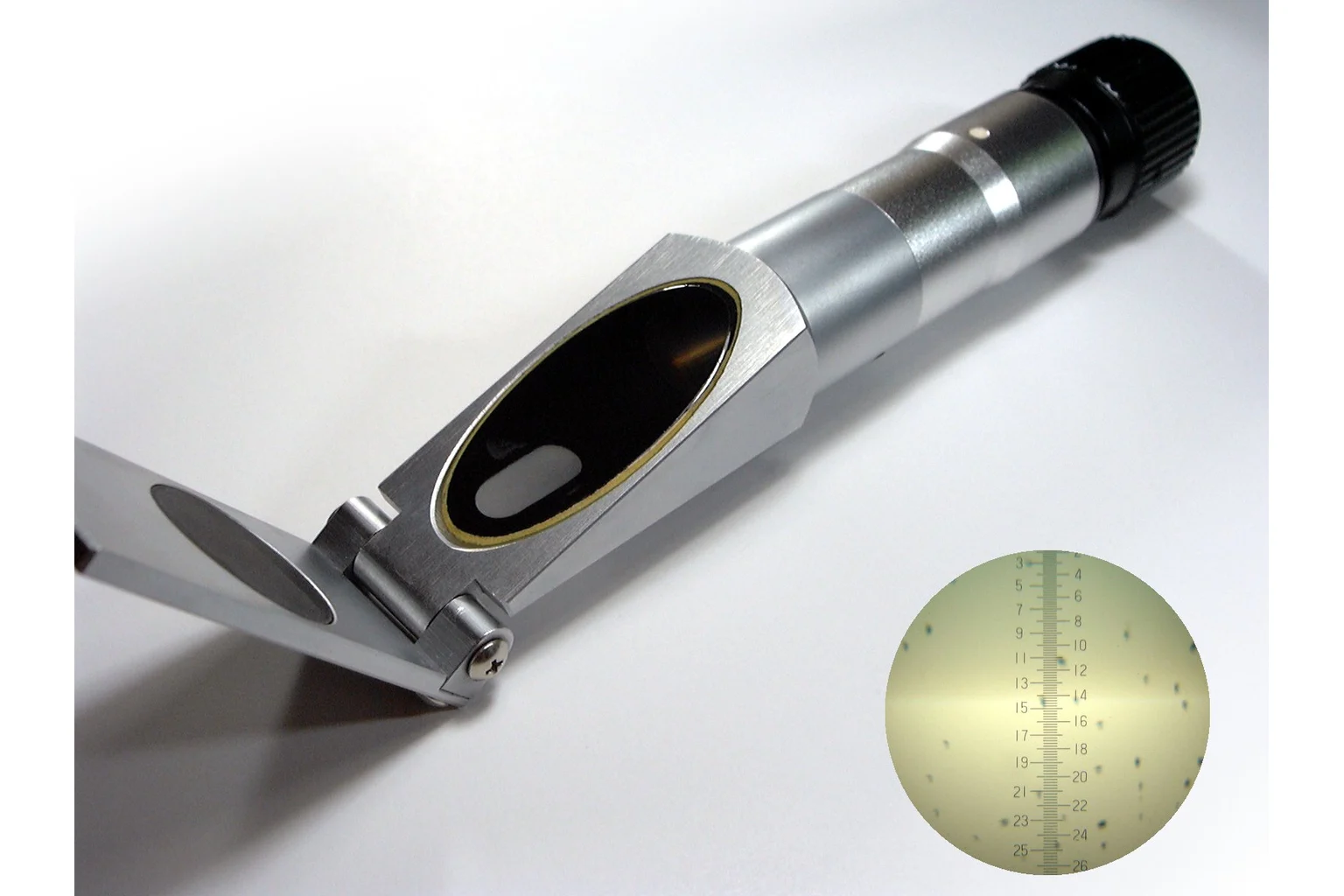
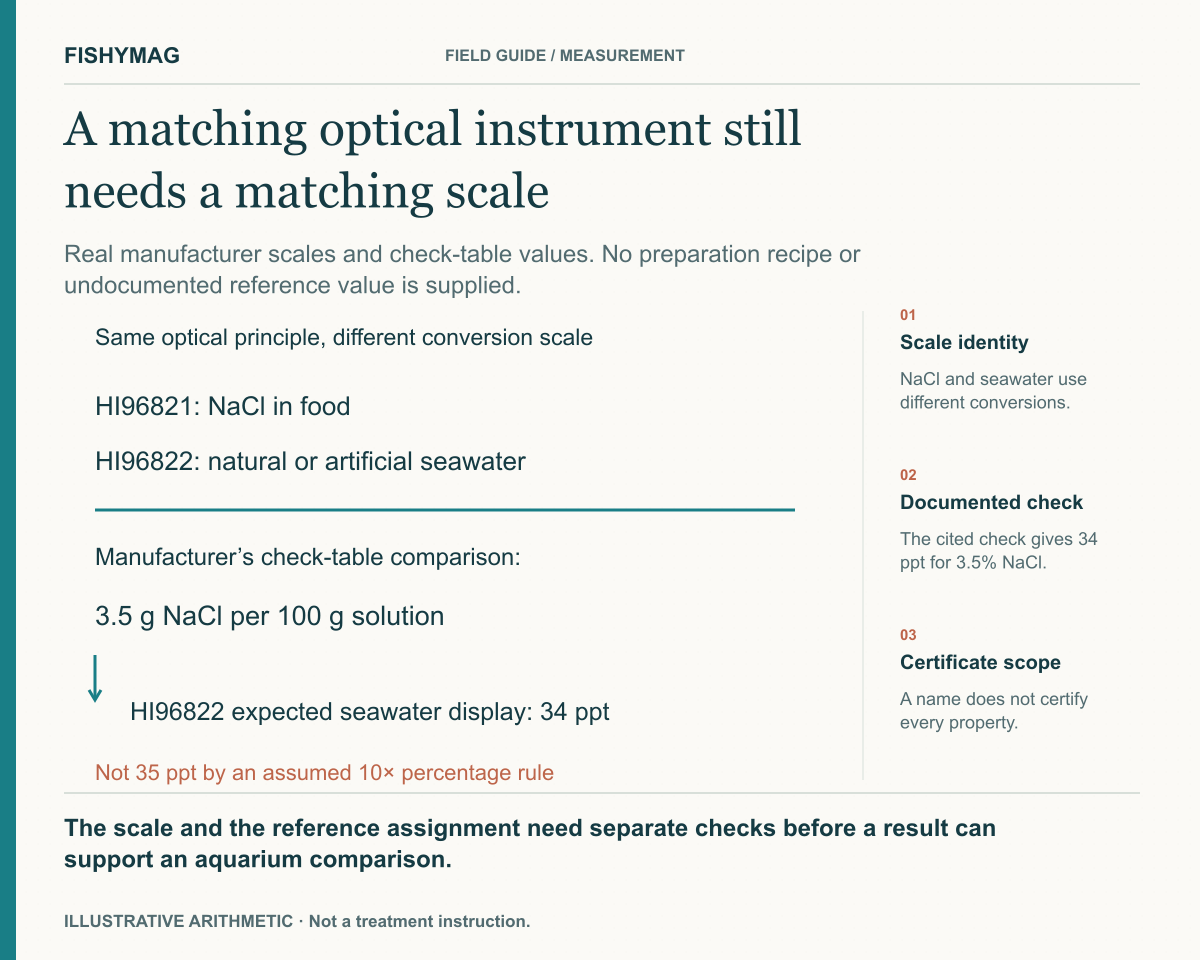
Figure data and explanation
Real manufacturer scales and check-table values. No preparation recipe or undocumented reference value is supplied.
- Scale identity
- NaCl and seawater use different conversions.
- Documented check
- The cited check gives 34 ppt for 3.5% NaCl.
- Certificate scope
- A name does not certify every property.
The scale and the reference assignment need separate checks before a result can support an aquarium comparison.
Inspect the scale, not just the shape of the instrument
The HI96821 manufacturer describes NaCl conversions in g/100 g and g/100 mL, among other outputs. HI96822 instead derives its outputs from seawater properties and identifies a 20/20 specific-gravity convention. Both list automatic temperature compensation from 10 to 40 °C, but that common range does not make their concentration scales equivalent. The accompanying licensed close-up is a sugar-scale refractometer, explicitly a different application rather than a photograph of either Hanna model.
Complete a real document-based pairing comparison
The manufacturer’s HI96822 check table provides a useful numerical distinction without inventing a universal offset. Its 3.5% NaCl entry has an expected seawater value of 34 ppt. This is the source’s check-table relationship, not an aquarium sample result, a household preparation recipe or proof of a reference bottle’s current value.
| Pairing or claim | Documentation available | Decision |
|---|---|---|
| HI96822 with its documented NaCl check-table configuration | Manufacturer supplies the relationship and expected display | Documented optical check pairing within the stated procedure |
| HI96821 food-NaCl scale used as the same seawater scale | Different declared conversion basis | Transfer is unsupported by the matching appearance or ATC range |
| Bottle called “35 ppt seawater reference” | No lot certificate or assigned measurement property in the fictional packet | Reference fitness unresolved |
| Conductivity-assigned value used to certify refractive output | No applicable property bridge supplied | Do not transfer the assigned value automatically |
A reference name is not a certificate crosswalk
For the fictional 35 ppt bottle, request the actual lot document and determine whether the assigned property concerns conductivity, refractive index, a particular scale or another quantity. Retain uncertainty, temperature, validity and use conditions. No current reference certificate has been invented for this example, and no undocumented reading-minus-reference tolerance is applied. A satisfactory check of one property also does not identify an aquarium’s complete ionic composition. The useful purchasing decision is to match the documented scale and check configuration, then keep any unassigned reference properties unresolved.
Use your own details
Match the refractometer scale and reference to aquarium water worksheet
Download the editable text file, fill it in on your device and keep it with the relevant record. This blank worksheet records your information; it does not verify entries or approve treatment.
- Instrument model and exact conversion scale
- Sample matrix and original evidence
- Reference identity, lot and actual documentation
- Assigned property, unit and reference temperature
- Uncertainty and coverage information if supplied
- Manufacturer’s documented check configuration
- Supported pairing versus unsupported transfer
- Missing certificate or applicability facts
Put it into practice
Your checklist
- Identify the conversion scale before comparing refractometers.
- Use only the documented reference-to-output relationship.
- Keep lot assignment, uncertainty and property scope with a reference check.
Sources and scope
This article distinguishes manufacturer statements from FishyMag’s own workflows and arithmetic examples. Linked formulation records retain their own evidence dates; publishing this article does not refresh those records.
- Hanna HI96821 sodium-chloride refractometer specification; reviewed November 9, 2026 ↗
- Hanna HI96822 seawater refractometer specification; reviewed November 9, 2026 ↗
- NIST TN1297 Appendix D1: measurement terminology; reviewed November 8, 2026 ↗
AI-assisted writing and development. Not hands-on product testing or veterinary review. How we publish →
FishyMag reports what manufacturers say, quoted and linked. It does not diagnose illness or recommend a treatment, and it never infers that a product is safe from the absence of a warning — where no statement exists, it says so.
Formulations change. Always read the label on the bottle in your hand, and contact the manufacturer if your tank contains anything valuable or unusual.