Measurement
Does the reference uncertainty fit your aquarium measurement budget?
A worked conductivity example and reusable worksheet for comparing reference uncertainty with a declared checking objective, without treating the reference as exact.
By FishyMag · Published
Worked arithmetic example · Not a clinical review or treatment recommendation.
Quick answer
Convert the reference’s expanded uncertainty to standard uncertainty, then include it in a justified uncertainty model for the comparison. In the fictional example below, candidate A gives a combined standard uncertainty of 2.83 µS/cm against a declared limit of 3.0 µS/cm; candidate B gives 5.39 µS/cm. A meets that uncertainty-only objective and B does not. Overall suitability remains Unknown because range, matrix, stability and intended-use evidence have not been established.

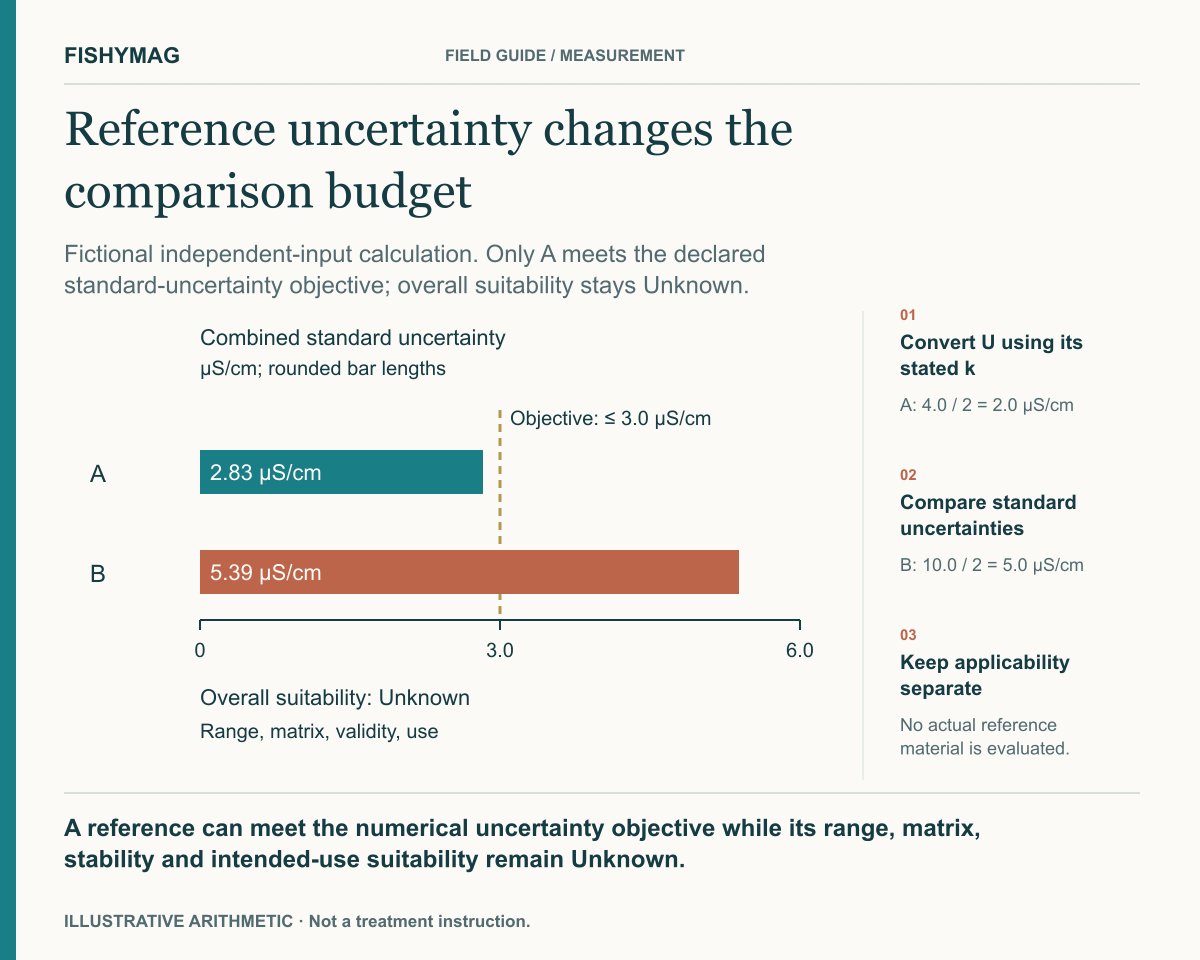
Figure data and explanation
Fictional independent-input calculation. Only A meets the declared standard-uncertainty objective; overall suitability stays Unknown.
- Convert U using its stated k
- A: 4.0 / 2 = 2.0 µS/cm
- Compare standard uncertainties
- B: 10.0 / 2 = 5.0 µS/cm
- Keep applicability separate
- No actual reference material is evaluated.
A reference can meet the numerical uncertainty objective while its range, matrix, stability and intended-use suitability remain Unknown.
Start with the comparison you need to make
A reference value is not an exact number against which every instrument reading can be judged without qualification. Its uncertainty belongs in the comparison. The useful question is whether that contribution leaves the comparison within a justified uncertainty objective. Define the measurand, measurement configuration and intended decision before choosing the reference. Record whether the objective concerns standard uncertainty or expanded uncertainty. Those are not interchangeable quantities. NIST’s uncertainty guidance relates expanded uncertainty U to standard uncertainty u through U = k × u, where k is the stated coverage factor. The example here is entirely fictional: an aquarium conductivity commissioning record declares that the comparison’s combined standard uncertainty must not exceed 3.0 µS/cm. This is an invented arithmetic objective, not an aquarium standard, a device specification or a livestock requirement. A real record needs a justification for its own objective. There is no universal reference-to-instrument accuracy ratio being applied here.
A completed uncertainty-only comparison
For this fictional calculation, the measurement side contributes a standard uncertainty of 2.0 µS/cm. This represents the complete measurement-side contribution within the declared example, not a value inferred from display resolution or repeated readings. The comparison quantity is the measurement result minus the reference value. Its sensitivity coefficients are therefore +1 for the measurement result and −1 for the reference value. The fictional case explicitly declares the two contributions independent. Under that model, their variances add: u(comparison) = [u(measurement)² + u(reference)²] raised to the power 0.5. Candidate A’s fictional uncertainty statement is U = 4.0 µS/cm with k = 2. Dividing gives u(reference) = 2.0 µS/cm. Candidate B states U = 10.0 µS/cm with k = 2, giving u(reference) = 5.0 µS/cm. Both candidates are fictional records, not actual materials or certificates. Their assigned conductivity values are not supplied, so this example evaluates only their uncertainty contributions.
| Fictional candidate | Expanded uncertainty U (µS/cm) | Coverage factor k (dimensionless) | Reference standard uncertainty U/k (µS/cm) | Measurement standard uncertainty (µS/cm) | Combined standard uncertainty (µS/cm) | Objective (µS/cm, standard uncertainty) | Uncertainty-only result | Overall suitability |
|---|---|---|---|---|---|---|---|---|
| A | 4.0 | 2 | 2.0 | 2.0 | 2.83 | ≤ 3.0 | Meets declared objective | Unknown |
| B | 10.0 | 2 | 5.0 | 2.0 | 5.39 | ≤ 3.0 | Does not meet declared objective | Unknown |
Keep the arithmetic and its limits together
For A, the calculation is (2.0² + 2.0²)^0.5 = 2.828427… µS/cm, reported here as 2.83 µS/cm. For B, it is (2.0² + 5.0²)^0.5 = 5.385165… µS/cm, reported as 5.39 µS/cm. The comparisons with the objective use the unrounded results. The same decisions can be checked in squared units: the objective squared is 9.0 (µS/cm)². A contributes a combined variance of 8.0 (µS/cm)², which is below that limit; B contributes 29.0 (µS/cm)², which is above it. This result does not show instrument error because no instrument reading or assigned reference value has been supplied. It does not show that A is suitable overall. It shows only that A’s stated uncertainty contribution fits this particular fictional budget. Do not carry the independent-input calculation into a real record merely because it is convenient. NIST’s propagation guidance requires attention to covariance when inputs share error sources. Repeated readings do not establish independence or eliminate shared error. Likewise, a stated k = 2 is not an unconditional coverage guarantee.
Separate numerical adequacy from applicability
Use separate entries for the uncertainty decision and the applicability evidence. A small uncertainty cannot fill in a missing value range, matrix match or validity condition. Equally, a material described for a relevant use does not automatically meet your numerical uncertainty objective. For the fictional candidates, the completed evidence status is shown below. Unknown is a finished record status, not a request to invent missing values. No real reference material is approved by this article.
| Evidence item | Candidate A | Candidate B | Record needed for an actual decision |
|---|---|---|---|
| Uncertainty-only objective | Meets fictional objective | Does not meet fictional objective | Justified objective and applicable uncertainty budget |
| Assigned conductivity value and measurement-range suitability | Unknown | Unknown | Applicable certificate and instrument documentation |
| Sample-matrix suitability | Unknown | Unknown | Documentation covering the intended matrix |
| Stability and validity conditions | Unknown | Unknown | Applicable validity and handling documentation |
| Traceability and intended use | Unknown | Unknown | Certificate statements and intended-use documentation |
| Independence of uncertainty contributions | Declared only within fictional calculation | Declared only within fictional calculation | Evidence addressing shared uncertainty sources |
| Actual comparison calculation | Not applicable: no actual comparison supplied | Not applicable: no actual comparison supplied | Actual input uncertainties and supported dependence model |
Turn the example into a usable decision record
FishyMag’s editorial workflow is to keep the original uncertainty statement, its conversion and the decision on the same record. Attach the identifiable certificate or report rather than retaining only a copied uncertainty number. Preserve the measurand, unit, coverage factor, validity conditions and the measurement configuration to which the evidence applies. Before calculating, check that every component is expressed as a standard uncertainty for the same comparison quantity. Record the sensitivity coefficients and why independence is justified, or retain the supported covariance terms in the model. Do not silently assign a missing coverage factor or treat an unspecified bound as a standard deviation. For a real evaluation lacking these inputs, use an explicit stop entry: reason for stopping: Actual reference uncertainty, its stated multiplier, the applicable measurement-side uncertainty budget or the dependence model is missing; combined standard uncertainty cannot be established. If the arithmetic can be completed but applicability evidence is absent, record the numerical result separately and leave overall suitability Unknown. The worksheet below supports this separation. It is a record template, not instructions for preparing a reference, adjusting an instrument or exposing aquarium animals.
Use your own details
Reference uncertainty fit record
Download the editable text file, fill it in on your device and keep it with the relevant record. This blank worksheet records your information; it does not verify entries or approve treatment.
- Measurand, unit and intended comparison: __________
- Instrument identity and measurement configuration: __________
- Uncertainty objective, standard or expanded basis, and justification: __________
- Reference identity, certificate identifier and evidence location: __________
- Assigned value, applicable range and matrix evidence: __________
- Stated reference uncertainty U, unit, coverage factor k and converted u: __________
- Measurement-side standard uncertainty and budget evidence: __________
- Sensitivity coefficients, dependence evidence and calculation model: __________
- Validity conditions, stability, traceability and intended-use evidence: __________
- Calculated uncertainty, objective decision, overall status and reason for stopping if needed: __________
Put it into practice
Your checklist
- Copy the reference uncertainty and its stated multiplier together; convert to standard uncertainty before combining contributions.
- Document the measurement-side budget and dependence model; stop with a reason for stopping if a required numerical or physical input is missing.
- Record uncertainty-only adequacy separately from range, matrix, stability and intended-use evidence; retain Unknown wherever applicability is unresolved.
Sources and scope
This article distinguishes manufacturer statements from FishyMag’s own workflows and arithmetic examples. Linked formulation records retain their own evidence dates; publishing this article does not refresh those records.
- NIST: evaluating Type B uncertainty components; reviewed November 8, 2026 ↗
- NIST/SEMATECH: propagation of measurement uncertainty; reviewed November 8, 2026 ↗
- NIST/SEMATECH handbook: uncertainty approach; reviewed November 8, 2026 ↗
AI-assisted writing and development. Not hands-on product testing or veterinary review. How we publish →
FishyMag reports what manufacturers say, quoted and linked. It does not diagnose illness or recommend a treatment, and it never infers that a product is safe from the absence of a warning — where no statement exists, it says so.
Formulations change. Always read the label on the bottle in your hand, and contact the manufacturer if your tank contains anything valuable or unusual.