Measurement
An over-range aquarium reading is not a concentration
Distinguish an HI713 steady boundary reading from its blinking over-range response and preserve the original display flag.
By FishyMag · Published
Manufacturer-source commentary · Not a clinical review or treatment recommendation.
Quick answer
A blinking maximum display is an over-range indication, not a measured concentration equal to that maximum. HI713’s stated range ends at 2.50 ppm phosphate. Preserve whether the display was steady or blinking; copying only “2.50” can erase the difference.
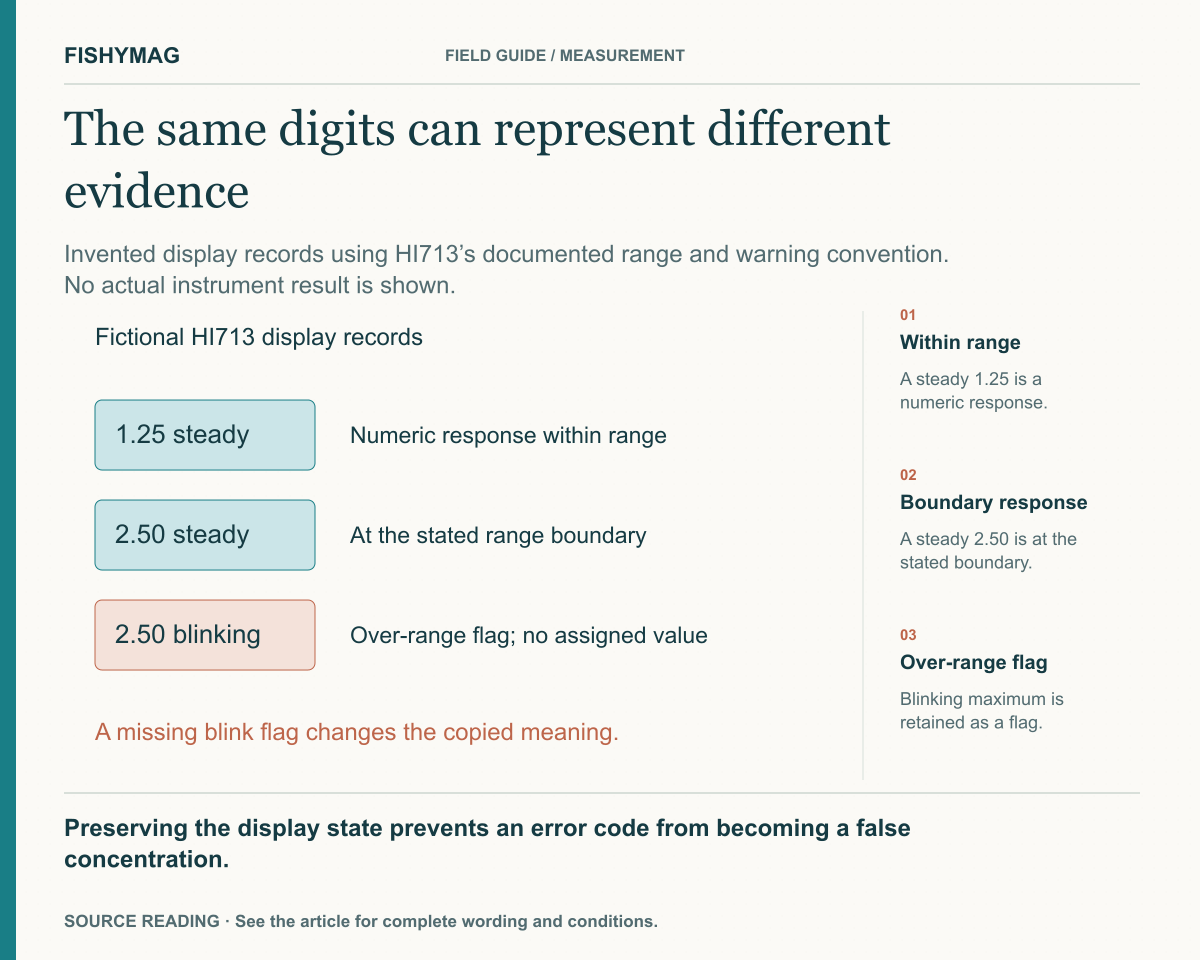
Figure data and explanation
Invented display records using HI713’s documented range and warning convention. No actual instrument result is shown.
- Within range
- A steady 1.25 is a numeric response.
- Boundary response
- A steady 2.50 is at the stated boundary.
- Over-range flag
- Blinking maximum is retained as a flag.
Preserving the display state prevents an error code from becoming a false concentration.
Read the number and the flag together
The HI713 manual identifies a blinking maximum display as over range. Its stated range is 0.00 to 2.50 ppm as phosphate. Those facts do not provide a way to estimate a concentration from the brightness, colour intensity or number of flashes. A maximum display value is not an extrapolated measurement.
Keep the original response in the report
The invented run notes below separate display state from copied number. A steady numeric response still needs all other method and sample checks; the range classification alone does not validate it.
| Archived response | Range interpretation | Appropriate copied record |
|---|---|---|
| 1.25, steady | Numeric response inside stated range | 1.25 ppm phosphate; other QC retained |
| 2.50, steady | Numeric response at stated boundary | 2.50 ppm phosphate; boundary noted |
| 2.50, blinking | Documented over-range indication | Over-range flag retained; no numerical result assigned |
| “2.50” without state | Display state missing | Original response unresolved; do not assume steady |
Use the documented next route without inventing a dilution
The manual directs checking for debris and a repeat through its specified route when over range. It does not make a guessed concentration from the error display reportable. Retain the method instructions and seek the manufacturer’s applicable dilution details and matrix requirements before creating any derived result. This article supplies no dilution recipe. If a laboratory or authorized method later produces a quantified value, keep its new method record and multiplier separate from the original flagged response. Do not replace the earlier flag as though the concentration had been known at that time.
Use your own details
An over-range aquarium reading is not a concentration worksheet
Download the editable text file, fill it in on your device and keep it with the relevant record. This blank worksheet records your information; it does not verify entries or approve treatment.
- Aquarium and sample identity
- Instrument or laboratory method revision
- Original reading including flags
- Chemical basis and unit
- Sample preparation or blank identity recorded
- Quality-control evidence
- Supported finding and calculation
- Unresolved question and source
Put it into practice
Your checklist
- Copy display flags with the numerical characters.
- Do not report a blinking maximum as a measured maximum.
- Retain any later quantified result as a separate method record.
Sources and scope
This article distinguishes manufacturer statements from FishyMag’s own workflows and arithmetic examples. Linked formulation records retain their own evidence dates; publishing this article does not refresh those records.
- Hanna HI713 phosphate low-range specifications; reviewed November 8, 2026 ↗
- Hanna HI713 manual IST71309/20; reviewed November 8, 2026 ↗
AI-assisted writing and development. Not hands-on product testing or veterinary review. How we publish →
FishyMag reports what manufacturers say, quoted and linked. It does not diagnose illness or recommend a treatment, and it never infers that a product is safe from the absence of a warning — where no statement exists, it says so.
Formulations change. Always read the label on the bottle in your hand, and contact the manufacturer if your tank contains anything valuable or unusual.