Measurement
Read the phosphorus form before comparing aquarium results
Separate orthophosphate, dissolved phosphorus and total phosphorus using the analytical operations recorded on the report.
By FishyMag · Published
Worked arithmetic example · Not a clinical review or treatment recommendation.
Quick answer
“Phosphorus” is not a complete result definition. Under EPA 365.1, filtration and pretreatment distinguish the reported forms. Compare the fraction and analytical operation before comparing values. A reactive or orthophosphate result is not automatically a total-phosphorus result.

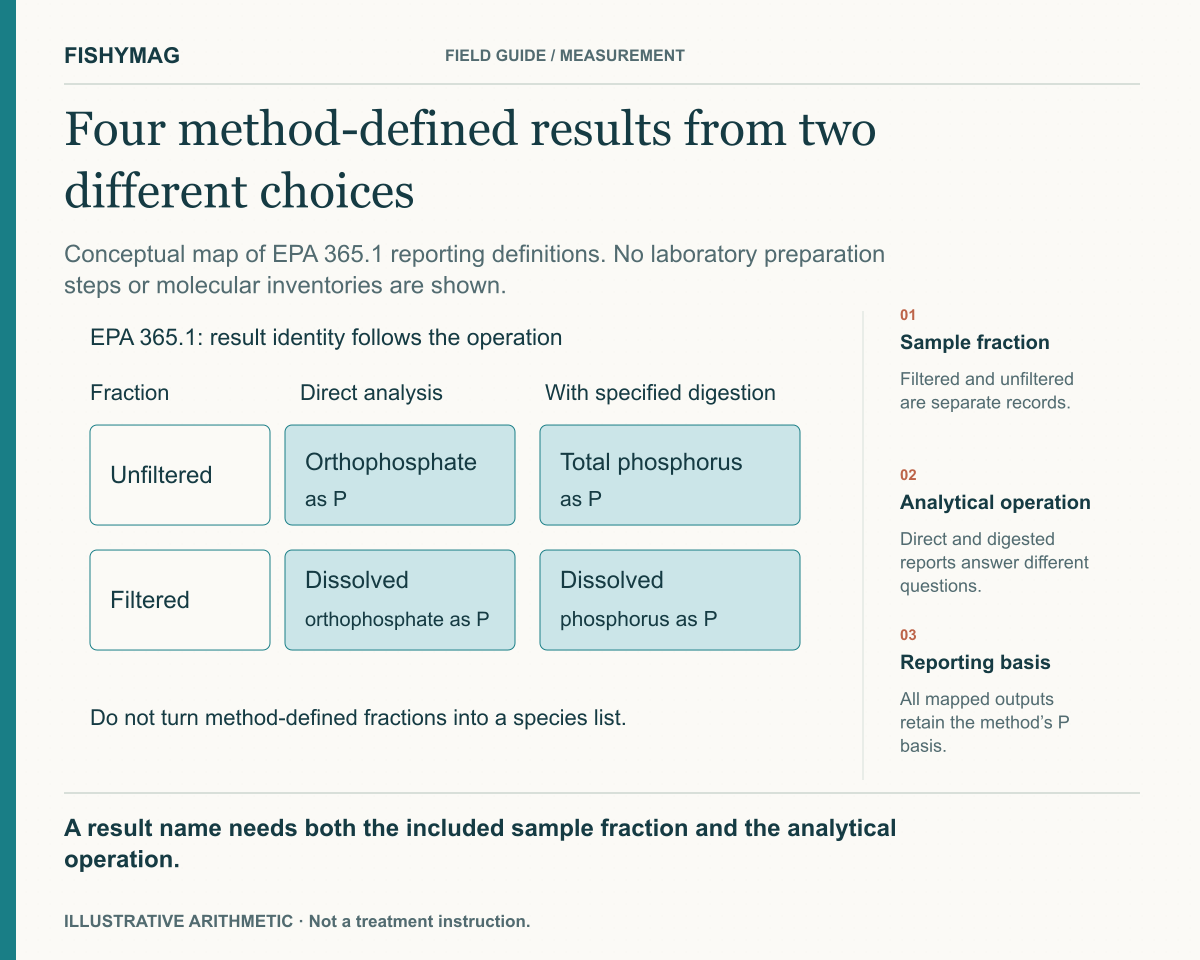
Figure data and explanation
Conceptual map of EPA 365.1 reporting definitions. No laboratory preparation steps or molecular inventories are shown.
- Sample fraction
- Filtered and unfiltered are separate records.
- Analytical operation
- Direct and digested reports answer different questions.
- Reporting basis
- All mapped outputs retain the method’s P basis.
A result name needs both the included sample fraction and the analytical operation.
Use the method’s definitions
EPA 365.1 defines phosphorus forms through sample fraction and pretreatment, with results reported as P. A laboratory’s shorthand “reactive” should be traced to its exact method, not assumed to mean every dissolved phosphorus form. The diagram maps this method’s reporting structure; it is not a claim that a test photographs or identifies every molecule.
Reconcile a fictional three-report packet
In the invented sample P8, all values below are on a phosphorus mass basis and the laboratory confirms matched sampling. They are not replicate answers to one identical question. The complete finding retains three method-defined quantities rather than choosing the largest as the most correct result.
| Report wording | Recorded fraction and operation | Fictional result, mg/L as P | Comparison meaning |
|---|---|---|---|
| Orthophosphate | Unfiltered; direct method analysis | 0.040 | Directly responding method-defined form |
| Dissolved phosphorus | Documented filtrate; specified digestion | 0.080 | Filtered fraction with different processing |
| Total phosphorus | Unfiltered; specified digestion | 0.130 | Different included sample material |
| “Reactive phosphorus” alone | Method and fraction missing | 0.050 | Definition unresolved; do not place in hierarchy |
Ask a narrower comparison question
The useful next question is whether two reports measured the same named quantity from compatible sample material. If one did not, changing mg/L to µg/L will not remove that difference. Request the actual fraction, digestion status, chemical basis and method revision. Keep any results derived by subtraction separate from measured results and retain their uncertainty. A numerical ordering in this invented table does not prove those orderings for every real dataset. Analytical variation, qualifiers and mismatched fractions can prevent a meaningful subtraction. The worksheet is complete when it either identifies a valid like-for-like comparison or names the exact missing definition.
Use your own details
Read the phosphorus form before comparing aquarium results worksheet
Download the editable text file, fill it in on your device and keep it with the relevant record. This blank worksheet records your information; it does not verify entries or approve treatment.
- Aquarium and matched sample identity
- Analyte and chemical reporting basis
- Filtered or unfiltered fraction
- Method and pretreatment recorded by laboratory
- Original values and qualifiers
- Permitted derivation and units
- Uncertainty or applicability limits
- Completed interpretation and unresolved questions
Put it into practice
Your checklist
- Retain sample fraction and analytical pretreatment.
- Confirm what a laboratory means by reactive.
- Resolve the quantity before converting or comparing it.
Sources and scope
This article distinguishes manufacturer statements from FishyMag’s own workflows and arithmetic examples. Linked formulation records retain their own evidence dates; publishing this article does not refresh those records.
AI-assisted writing and development. Not hands-on product testing or veterinary review. How we publish →
FishyMag reports what manufacturers say, quoted and linked. It does not diagnose illness or recommend a treatment, and it never infers that a product is safe from the absence of a warning — where no statement exists, it says so.
Formulations change. Always read the label on the bottle in your hand, and contact the manufacturer if your tank contains anything valuable or unusual.