Measurement
What pH temperature compensation actually changes
Interpret two aquarium pH records marked ATC without assuming their sample chemistry was normalized to 25 °C.
By FishyMag · Published
Worked arithmetic example · Not a clinical review or treatment recommendation.
Quick answer
For the Hanna edge measurement described in its manual, the compensated result is the sample pH at its measurement temperature. ATC does not establish a common-temperature chemical pH. In this fictional record, 7.20 at 22 °C and 7.12 at 26 °C differ by −0.08 pH unit; the two observations alone do not establish why.
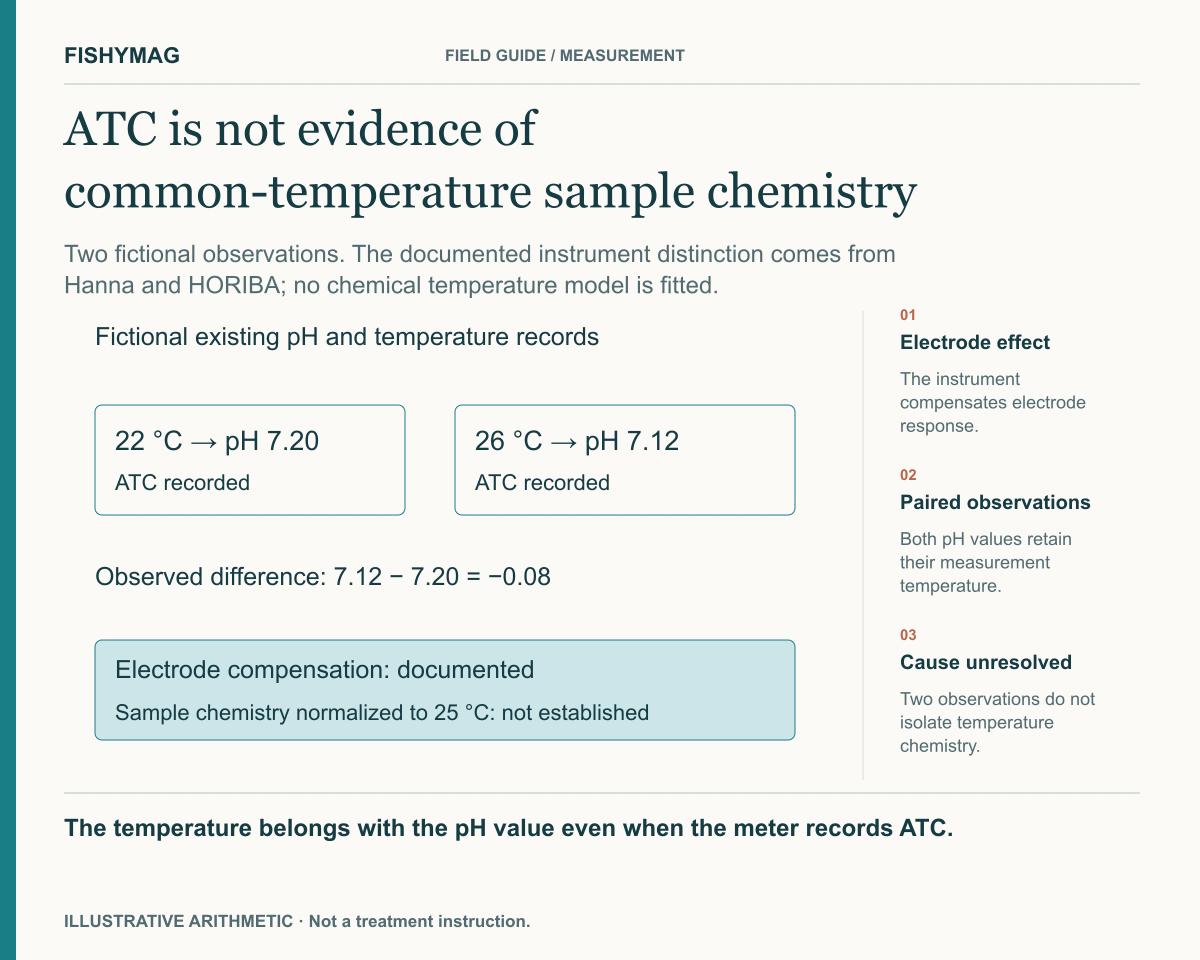
Figure data and explanation
Two fictional observations. The documented instrument distinction comes from Hanna and HORIBA; no chemical temperature model is fitted.
- Electrode effect
- The instrument compensates electrode response.
- Paired observations
- Both pH values retain their measurement temperature.
- Cause unresolved
- Two observations do not isolate temperature chemistry.
The temperature belongs with the pH value even when the meter records ATC.
Find out which temperature effect the meter addresses
Electrode response changes with temperature. HORIBA’s explanation distinguishes that instrument effect from temperature-dependent chemistry in the sample. The edge manual identifies the reported pH as applying at the measurement temperature. A temperature-conversion feature, if a particular instrument provides one, needs its own documented model and sample coefficient. It cannot be assumed from the letters ATC.
Finish the comparison before assigning a cause
The invented record below contains two observations, not a controlled experiment. No samples were heated, cooled or tested by FishyMag. The “ATC” field is preserved because it describes meter configuration, not because it proves chemical normalization.
| Record | Temperature | pH | ATC field | Supported interpretation |
|---|---|---|---|---|
| Earlier observation | 22 °C | 7.20 | On | pH at the recorded measurement condition |
| Later observation | 26 °C | 7.12 | On | pH at a different recorded temperature |
| Later minus earlier | +4 °C | −0.08 pH unit | Both marked on | Observed contrast; cause unresolved |
Ask a follow-up question the records can answer
The completed conclusion is a −0.08 observed contrast with different recorded temperatures. It is not proof that the water changed by exactly that amount because of temperature, nor evidence that ATC failed. Recover sample identity, exposure, elapsed time, calibration and temperature-input records. If the actual question is the sample’s temperature dependence, commission an appropriate controlled analytical comparison that addresses equilibration and gas exchange. Do not derive a universal aquarium correction coefficient from these two observations or alter livestock conditions to reproduce them. Keep the pH-temperature pair together in the treatment evidence packet.
Use your own details
What pH temperature compensation actually changes worksheet
Download the editable text file, fill it in on your device and keep it with the relevant record. This blank worksheet records your information; it does not verify entries or approve treatment.
- Aquarium or parent-sample identity
- Complete meter and electrode model
- Manual revision and applicable mode
- Original readings, units and temperatures
- Calibration or compensation record
- Completed comparison and calculation
- Supported conclusion and unresolved claim
- Evidence required before transferring the result
Put it into practice
Your checklist
- Read the exact model’s compensation definition.
- Retain temperature with every pH observation.
- Do not turn two different-temperature observations into a chemical correction rule.
Sources and scope
This article distinguishes manufacturer statements from FishyMag’s own workflows and arithmetic examples. Linked formulation records retain their own evidence dates; publishing this article does not refresh those records.
- Hanna edge pH/EC/DO manual, document380; reviewed November 8, 2026 ↗
- HORIBA: pH automatic temperature compensation; reviewed November 8, 2026 ↗
AI-assisted writing and development. Not hands-on product testing or veterinary review. How we publish →
FishyMag reports what manufacturers say, quoted and linked. It does not diagnose illness or recommend a treatment, and it never infers that a product is safe from the absence of a warning — where no statement exists, it says so.
Formulations change. Always read the label on the bottle in your hand, and contact the manufacturer if your tank contains anything valuable or unusual.