Measurement
Read pH slope and offset as a pair
Use an actual transmitter manual to distinguish slope and offset rejection rules from a complete calibration or aquarium-applicability verdict.
By FishyMag · Published
Worked arithmetic example · Not a clinical review or treatment recommendation.
Quick answer
An acceptable-looking slope cannot clear an excessive offset, and the reverse is also true. The Omega PHTX-45 manual rejects calibrations below 80% slope or beyond ±90 mV offset. Those are that model’s rejection boundaries, not universal aquarium-meter criteria or a complete definition of a good measurement.
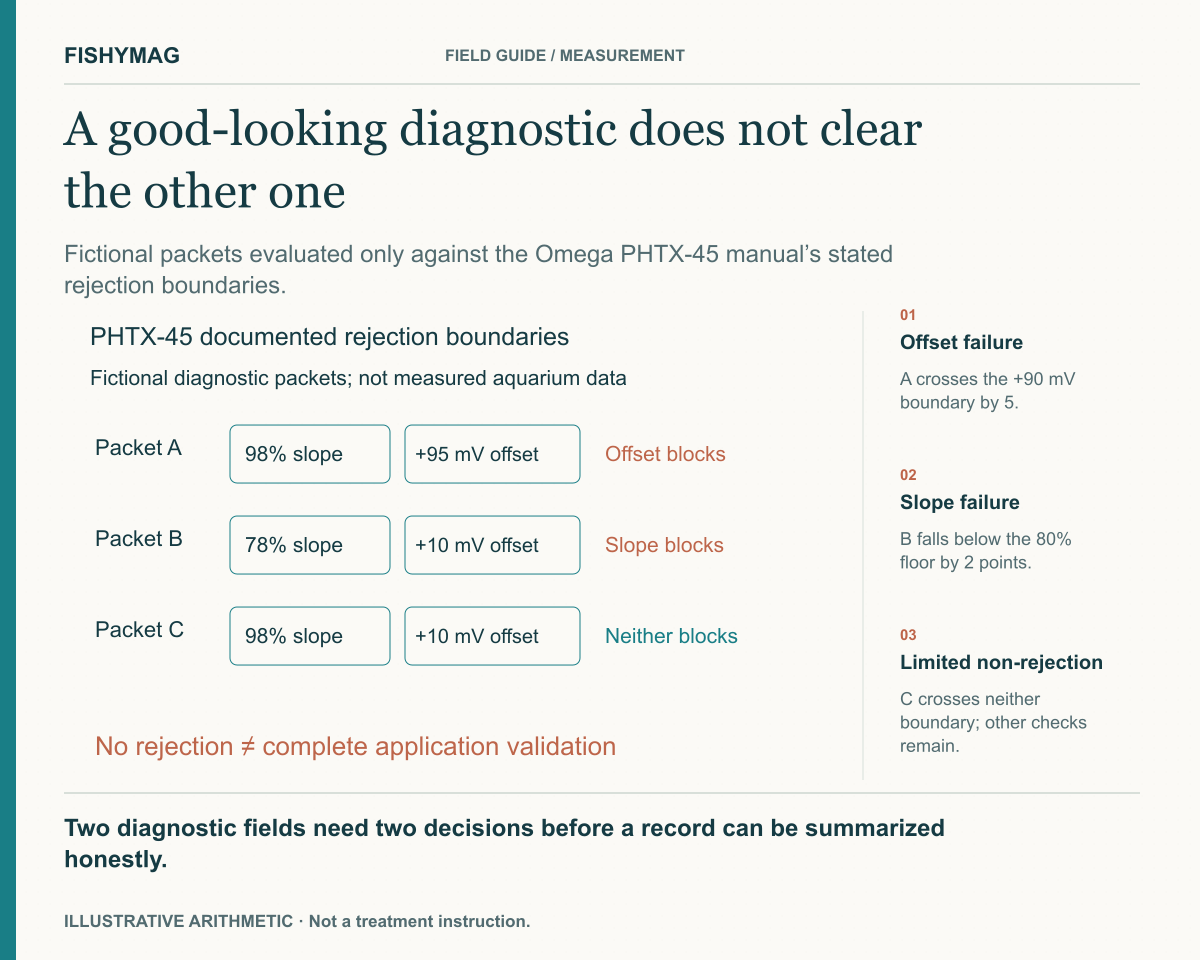
Figure data and explanation
Fictional packets evaluated only against the Omega PHTX-45 manual’s stated rejection boundaries.
- Offset failure
- A crosses the +90 mV boundary by 5.
- Slope failure
- B falls below the 80% floor by 2 points.
- Limited non-rejection
- C crosses neither boundary; other checks remain.
Two diagnostic fields need two decisions before a record can be summarized honestly.
Separate a rejection boundary from a preferred condition
Sections 6.11 and 6.12 of the PHTX-45 manual, Rev. B 04/02, provide a useful worked example of paired diagnostics. The manual gives 95% to 105% as a new-sensor slope expectation, while the transmitter’s lower rejection boundary is 80%. It defines offset using pH 7.00 buffer at 25 °C. These statements have different roles. Copying the 80% floor into a checklist as “ideal slope” would misread the source.
Complete three diagnostic decisions
All three packets are fictional and refer to this one transmitter’s stated conditions. “Neither blocks” below means only that these two rejection tests do not block the packet. Other calibration requirements and sample suitability have not been assessed.
| Packet | Slope | Offset | Completed finding |
|---|---|---|---|
| A | 98% | +95 mV | Offset is 5 mV beyond +90; blocked by offset |
| B | 78% | +10 mV | Slope is 2 percentage points below 80; blocked by slope |
| C | 98% | +10 mV | Neither stated rejection boundary is crossed; not full approval |
Carry both diagnostics into the actual aquarium record
For a different meter, replace the criteria with its exact manual and software revision before deciding anything. Do not modify diagnostic values or subtract the offset from an aquarium result to make the record pass. Save the original calibration points, temperature, slope, offset and warnings together. A packet that passes these two checks still needs an appropriate measurement method, compatible probe, calibration coverage and sample conditions. This article interprets a historical instrument source; it does not recommend buying that transmitter or provide installation, maintenance or calibration instructions.
Use your own details
Read pH slope and offset as a pair worksheet
Download the editable text file, fill it in on your device and keep it with the relevant record. This blank worksheet records your information; it does not verify entries or approve treatment.
- Aquarium or parent-sample identity
- Complete meter and electrode model
- Manual revision and applicable mode
- Original readings, units and temperatures
- Calibration or compensation record
- Completed comparison and calculation
- Supported conclusion and unresolved claim
- Evidence required before transferring the result
Put it into practice
Your checklist
- Keep slope and offset together.
- Distinguish preferred conditions from rejection boundaries.
- Use the actual model’s criteria before reaching a decision.
Sources and scope
This article distinguishes manufacturer statements from FishyMag’s own workflows and arithmetic examples. Linked formulation records retain their own evidence dates; publishing this article does not refresh those records.
AI-assisted writing and development. Not hands-on product testing or veterinary review. How we publish →
FishyMag reports what manufacturers say, quoted and linked. It does not diagnose illness or recommend a treatment, and it never infers that a product is safe from the absence of a warning — where no statement exists, it says so.
Formulations change. Always read the label on the bottle in your hand, and contact the manufacturer if your tank contains anything valuable or unusual.