Measurement
Does your pH calibration bracket the aquarium reading?
Plot temperature-specific pH calibration points and complete an inside-or-outside coverage check for an aquarium reading.
By FishyMag · Published
Worked arithmetic example · Not a clinical review or treatment recommendation.
Quick answer
Compare the aquarium reading with the actual calibration points at their recorded temperatures. In this fictional 25 °C record, pH 8.20 lies between 7.01 and 10.01; pH 10.40 is above the upper point by 0.39. This establishes geometric coverage, not overall measurement accuracy.
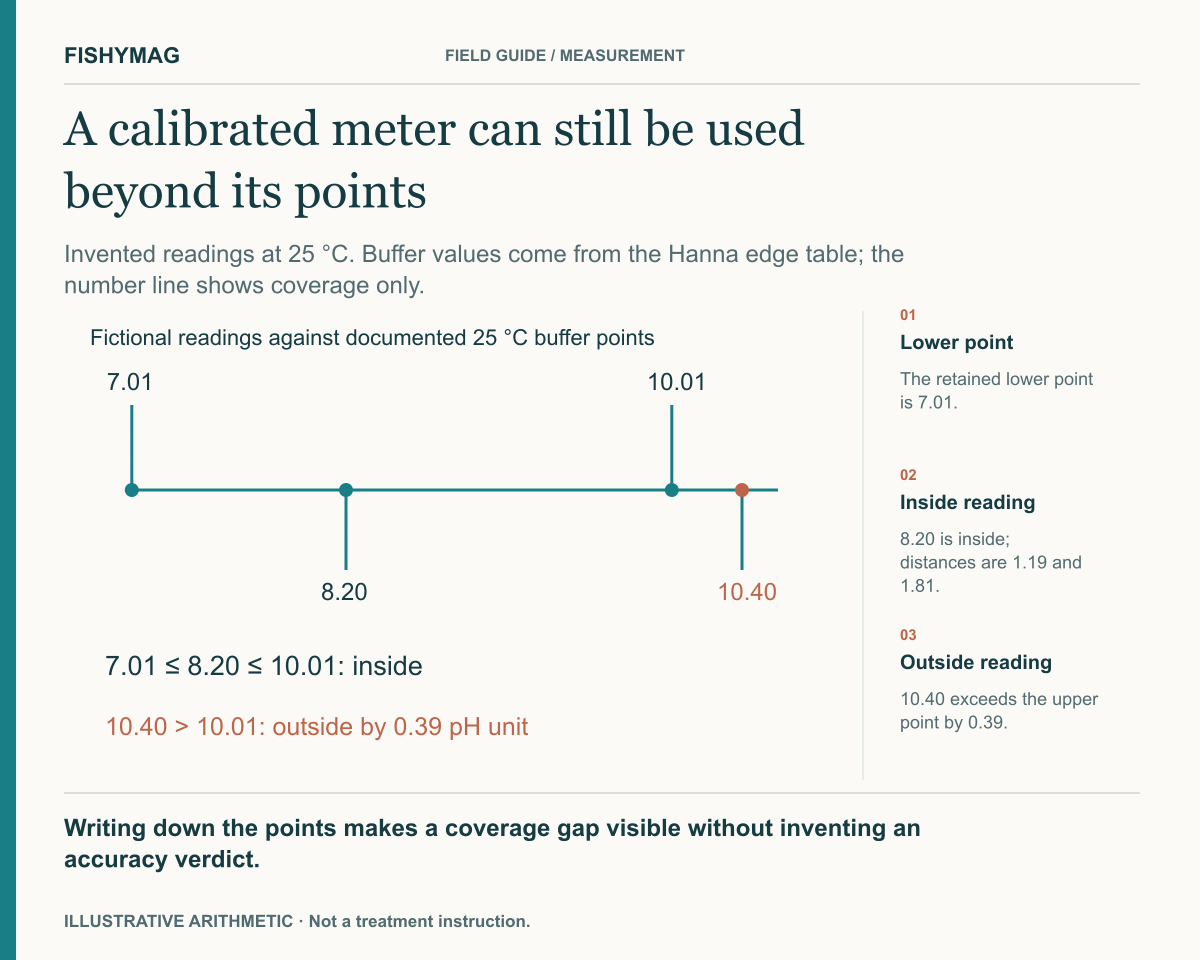
Figure data and explanation
Invented readings at 25 °C. Buffer values come from the Hanna edge table; the number line shows coverage only.
- Lower point
- The retained lower point is 7.01.
- Inside reading
- 8.20 is inside; distances are 1.19 and 1.81.
- Outside reading
- 10.40 exceeds the upper point by 0.39.
Writing down the points makes a coverage gap visible without inventing an accuracy verdict.
Recover the points that were actually used
The Hanna edge manual gives temperature-dependent buffer values and distinguishes calibration modes. Its 25 °C table lists 7.010 and 10.010 for the two buffer families used in this example. A bottle’s nominal room-temperature label is not enough to reconstruct a calibration at another temperature. Retain the buffer family, calibration temperature, points, date, probe and mode. HORIBA’s ATC explanation separately describes the principle of bracketing sample pH.
Complete the coverage calculation
The invented record uses those two points at 25 °C. Both sample readings below are fictional. Distances are differences in pH units; they are not uncertainty estimates or chemical concentration ratios.
| Sample reading | Reading minus lower point | Upper point minus reading | Coverage finding |
|---|---|---|---|
| 8.20 | 8.20 − 7.01 = 1.19 | 10.01 − 8.20 = 1.81 | Inside the two-point interval |
| 10.40 | 10.40 − 7.01 = 3.39 | 10.01 − 10.40 = −0.39 | Outside; 0.39 above upper point |
Keep coverage separate from calibration quality
The completed review flags the second reading as outside the supplied interval. It does not declare the first reading accurate merely because it is inside. The edge manual discusses additional points, diagnostics and mode-specific behavior; this diagram is not a complete calibration procedure. Check the actual instrument’s required calibration, condition messages, sample applicability and temperature record. A missing range warning is not proof of coverage, particularly when warning behavior depends on mode or configuration. In a handover, preserve the actual point list instead of replacing it with a single “calibrated” checkbox.
Use your own details
Does your pH calibration bracket the aquarium reading? worksheet
Download the editable text file, fill it in on your device and keep it with the relevant record. This blank worksheet records your information; it does not verify entries or approve treatment.
- Aquarium or parent-sample identity
- Complete meter and electrode model
- Manual revision and applicable mode
- Original readings, units and temperatures
- Calibration or compensation record
- Completed comparison and calculation
- Supported conclusion and unresolved claim
- Evidence required before transferring the result
Put it into practice
Your checklist
- Use temperature-specific points from the actual calibration record.
- Calculate coverage before interpreting a reading beyond the points.
- Retain diagnostics and mode alongside the coverage finding.
Sources and scope
This article distinguishes manufacturer statements from FishyMag’s own workflows and arithmetic examples. Linked formulation records retain their own evidence dates; publishing this article does not refresh those records.
- Hanna edge pH/EC/DO manual, document380; reviewed November 8, 2026 ↗
- HORIBA: pH automatic temperature compensation; reviewed November 8, 2026 ↗
AI-assisted writing and development. Not hands-on product testing or veterinary review. How we publish →
FishyMag reports what manufacturers say, quoted and linked. It does not diagnose illness or recommend a treatment, and it never infers that a product is safe from the absence of a warning — where no statement exists, it says so.
Formulations change. Always read the label on the bottle in your hand, and contact the manufacturer if your tank contains anything valuable or unusual.