Measurement
When pH and alkalinity do not determine aquarium CO2
Work a fully declared carbonate-system estimate and show why its CO2 value cannot be copied into a dossier with unknown non-carbonate contributions.
By FishyMag · Published
Worked arithmetic example · Not a clinical review or treatment recommendation.
Quick answer
A CO2 estimate needs an applicable chemical model, not only two numbers. In the declared 25 °C carbonate-system example, pH 7.00 and alkalinity 2.00 meq/L give modeled aqueous CO2 of 0.42721 mmol/L, about 18.80 mg/L. The same estimate is unsupported when the relevant non-carbonate composition or model applicability is unknown.
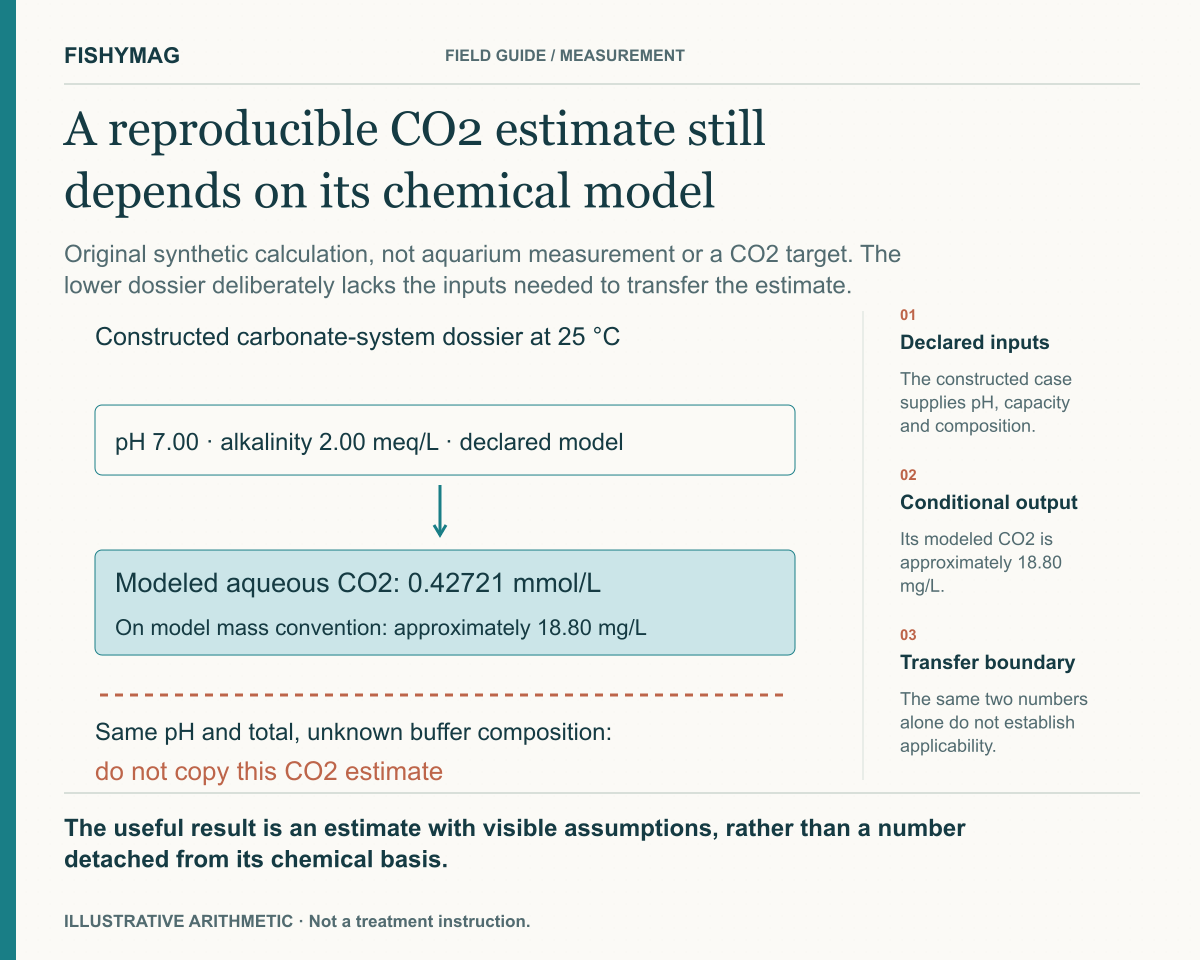
Figure data and explanation
Original synthetic calculation, not aquarium measurement or a CO2 target. The lower dossier deliberately lacks the inputs needed to transfer the estimate.
- Declared inputs
- The constructed case supplies pH, capacity and composition.
- Conditional output
- Its modeled CO2 is approximately 18.80 mg/L.
- Transfer boundary
- The same two numbers alone do not establish applicability.
The useful result is an estimate with visible assumptions, rather than a number detached from its chemical basis.
A complete constructed case makes the assumptions visible
The original local calculation specifies pH 7.00, alkalinity 2.00 meq/L, 25 °C and 1 atm. Sodium supplies the countercharge; calcium, magnesium, boron, phosphate and organic buffers are absent from the declared model. No mineral or gas equilibrium is imposed. PhreeqPython 1.6.2 uses its explicitly selected phreeqc.dat database. These are synthetic states, not a measured aquarium, a recommended CO2 level or an injection experiment.
Complete the model result and unit conversion
The calculation derives the inorganic-carbon inventory from the supplied conditions and retains carbonate complexes and the net water term. Molarity is obtained from solvent mass and computed solution volume. Independent species accounting and mass-action checks were retained with the output.
| Quantity | Checked model value | Scope |
|---|---|---|
| pH | 7.0000 | Hydrogen-ion activity convention |
| Total alkalinity | 2.0000 meq/L | Declared model capacity |
| DIC | 2.42610 mmol C/L | Derived total inorganic carbon |
| Aqueous CO2 species | 0.427208 mmol/L | Specified database species, not all carbon |
| CO2 mass conversion | 0.427208 × 44.0111 = 18.8019 mg/L | Approximately 18.80 on the stated molecular-mass convention |
The second dossier does not inherit the answer
A second packet reports pH 7.00 and total alkalinity 2.00 meq/L but lacks relevant composition and non-carbonate information. Its total remains a reported capacity; it does not establish the carbonate contribution or the ionic model needed to reproduce the first calculation. Do not paste 18.80 into that packet or use a familiar chart as independent proof that the missing assumptions hold. The first dossier supplies a conditional estimate. The second supplies an unanswered model-applicability question. Neither result diagnoses an animal problem or establishes a treatment’s compatibility.
Use your own details
When pH and alkalinity do not determine aquarium CO2 worksheet
Download the editable text file, fill it in on your device and keep it with the relevant record. This blank worksheet records your information; it does not verify entries or approve treatment.
- Original pH with temperature and electrode record
- Total alkalinity, fraction and reporting basis
- Known non-carbonate components or explicit gaps
- Declared complete composition and ionic model
- Calculated aqueous CO2 and its species definition
- Molar-to-mass convention, if converted
- Mass, charge and equilibrium checks retained
- Boundary beyond which the estimate must not be transferred
Worked example files
These files contain the article’s worked example. Read its source and scope notes, and keep your own current records before opening an example in a tool.
Put it into practice
Your checklist
- State the model and the non-carbonate assumptions.
- Keep aqueous CO2 separate from total inorganic carbon.
- Do not transfer the estimate when its input scope is unknown.
Sources and scope
This article distinguishes manufacturer statements from FishyMag’s own workflows and arithmetic examples. Linked formulation records retain their own evidence dates; publishing this article does not refresh those records.
- USGS PHREEQC Version 3 manual: capabilities and computational scope; reviewed November 9, 2026 ↗
- USGS PHREEQC SOLUTION: units, calculated density, pH and alkalinity; reviewed November 9, 2026 ↗
- USGS PHREEQC SELECTED_OUTPUT: alkalinity and concentration output bases; reviewed November 9, 2026 ↗
- Vitens PhreeqPython primary repository and local version 1.6.2; reviewed November 9, 2026 ↗
AI-assisted writing and development. Not hands-on product testing or veterinary review. How we publish →
FishyMag reports what manufacturers say, quoted and linked. It does not diagnose illness or recommend a treatment, and it never infers that a product is safe from the absence of a warning — where no statement exists, it says so.
Formulations change. Always read the label on the bottle in your hand, and contact the manufacturer if your tank contains anything valuable or unusual.