Measurement
Oxygen probes and aquarium flow requirements
Compare two actual oxygen-probe designs against retained local-flow evidence without converting a pump rating into sensor-face velocity.
By FishyMag · Published
Worked evidence example · Not a clinical review or treatment recommendation.
Quick answer
Read the selected probe’s manual. The edge HI764080 guidance suggests 0.3 m/s water movement because measurement consumes oxygen at the membrane. The ProODO manual says continuous sample movement is not required for its optical measurement. Neither statement lets a pump’s liters-per-hour rating prove velocity at a probe.
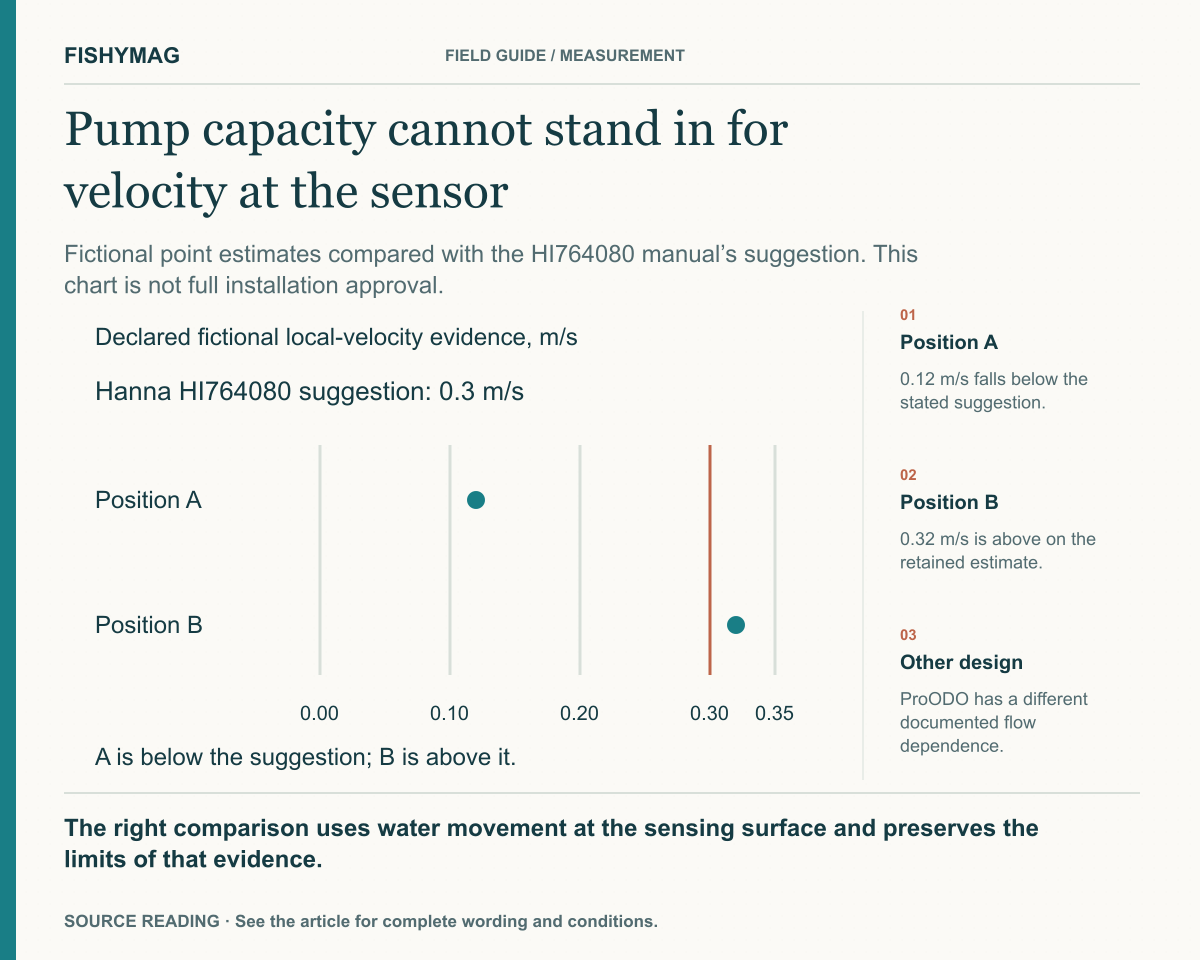
Figure data and explanation
Fictional point estimates compared with the HI764080 manual’s suggestion. This chart is not full installation approval.
- Position A
- 0.12 m/s falls below the stated suggestion.
- Position B
- 0.32 m/s is above on the retained estimate.
- Other design
- ProODO has a different documented flow dependence.
The right comparison uses water movement at the sensing surface and preserves the limits of that evidence.
Flow requirements belong to a particular sensor and geometry
The cited manuals describe different measurement designs and conditions. Hanna’s edge discussion links movement to replenishing the oxygen-consuming membrane surface. YSI distinguishes its optical measurement from continuous stirring, while still discussing temperature stabilization, bubbles and sample mixing in particular vessels. That is a bounded comparison of two documented designs, not a ranking of every optical and electrochemical sensor.
Complete the two-location assessment
The fictional commissioning file includes independent local-velocity records for two accessible measurement positions, A at 0.12 m/s and B at 0.32 m/s. Their method and geometry are declared part of the packet. The pump’s separate nominal rating of 1,000 L/h is not used to calculate either local velocity. No household flow test or equipment change is proposed.
| Case evidence | HI764080 membrane guidance | ProODO optical guidance |
|---|---|---|
| Position A: 0.12 m/s | Below the manual’s 0.3 m/s suggestion | No continuous-flow requirement established by cited guidance |
| Position B: 0.32 m/s | Above the stated suggestion on the retained point estimate | Same limited no-continuous-movement finding |
| Pump label: 1,000 L/h | Does not establish local velocity | Does not establish sample representativeness |
| Remaining review | Actual uncertainty, orientation, temperature and sample conditions | Temperature, bubbles, vessel mixing and sample conditions |
Resolve the mismatch at the evidence boundary
For the membrane-design question, B is the documented alternative that clears the simple point-estimate comparison with 0.3 m/s; A does not. This is not a full installation approval or a claim that B’s true velocity is guaranteed above a threshold. The measurement uncertainty and actual manual conditions still matter. For the optical design, lack of a continuous-flow requirement does not prove stagnant water represents the whole aquarium. Keep local velocity and sample representativeness as separate questions. The useful output is a location-by-sensor evidence table, without changing live circulation to make a test pass.
Use your own details
Oxygen probes and aquarium flow requirements worksheet
Download the editable text file, fill it in on your device and keep it with the relevant record. This blank worksheet records your information; it does not verify entries or approve treatment.
- Aquarium and measurement location
- Exact oxygen meter, probe and sensor cap
- Manufacturer document and revision
- Original reading and compensation configuration
- Temperature, pressure and salinity bases
- Local conditions with evidence provenance
- Completed comparison and answerable claim
- Unresolved application or response limit
Put it into practice
Your checklist
- Use the exact sensor’s flow statement.
- Retain measured local velocity separately from pump capacity.
- Treat flow compliance as one part of measurement applicability.
Sources and scope
This article distinguishes manufacturer statements from FishyMag’s own workflows and arithmetic examples. Linked formulation records retain their own evidence dates; publishing this article does not refresh those records.
- Hanna edge pH/EC/DO manual, document380; reviewed November 8, 2026 ↗
- YSI ProODO manufacturer user manual, Rev. C, pages 15 to 25 and Appendices A and B; reviewed November 8, 2026 ↗
AI-assisted writing and development. Not hands-on product testing or veterinary review. How we publish →
FishyMag reports what manufacturers say, quoted and linked. It does not diagnose illness or recommend a treatment, and it never infers that a product is safe from the absence of a warning — where no statement exists, it says so.
Formulations change. Always read the label on the bottle in your hand, and contact the manufacturer if your tank contains anything valuable or unusual.