Measurement
Does the oxygen meter account for aquarium salinity?
Audit the manual salinity setting behind a ProODO concentration result using a manufacturer example and a completed fictional record review.
By FishyMag · Published
Worked evidence example · Not a clinical review or treatment recommendation.
Quick answer
The ProODO relies on a manually supplied salinity value for its mg/L calculation. A zero setting does not establish freshwater. Its manual’s full-saturation example at 20 °C and sea level is 9.092 mg/L at 0 ppt and 8.621 mg/L at 9 ppt, a difference of 0.471 mg/L. This is a source example, not a correction to every aquarium reading.
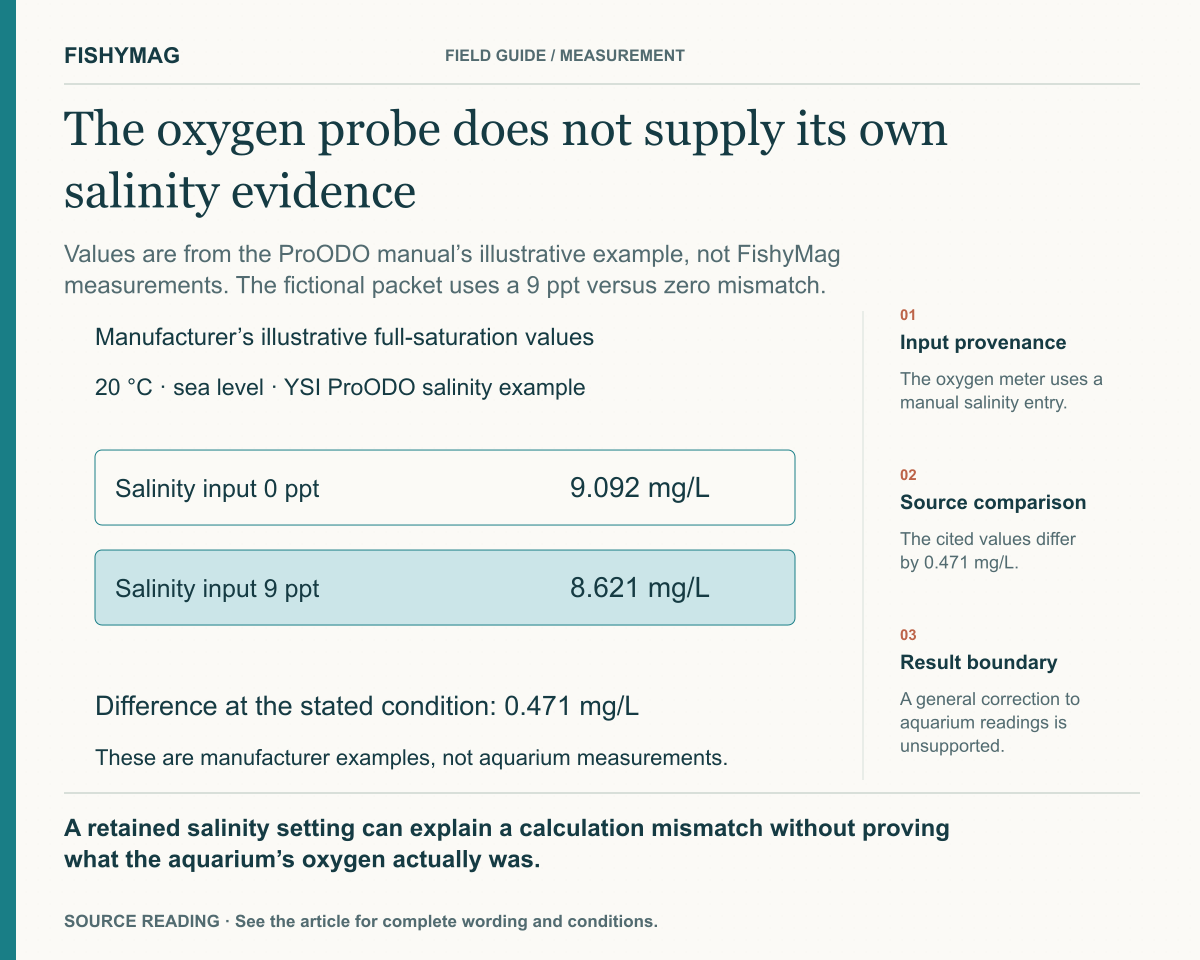
Figure data and explanation
Values are from the ProODO manual’s illustrative example, not FishyMag measurements. The fictional packet uses a 9 ppt versus zero mismatch.
- Input provenance
- The oxygen meter uses a manual salinity entry.
- Source comparison
- The cited values differ by 0.471 mg/L.
- Result boundary
- A general correction to aquarium readings is unsupported.
A retained salinity setting can explain a calculation mismatch without proving what the aquarium’s oxygen actually was.
Find out whether salinity was measured or merely entered
The manufacturer describes a manual salinity input, not a salinity measurement by the oxygen-only probe. In the fictional packet, a separate appropriately documented salinity report states 9 ppt, but the retained oxygen configuration says zero. Temperature is 20 °C and the case uses the manual’s stated sea-level condition. These are constructed case facts. They are not findings from FishyMag testing.
Complete the record and calculation review
To avoid inventing an instrument equation, this example uses the two values actually supplied by the manufacturer for fully oxygenated water. A real aquarium result at another saturation level requires its own original data and calculation basis.
| Record or calculation | Completed finding | Limit |
|---|---|---|
| Independent salinity report | 9 ppt in this fictional packet | The quantity basis must match the instrument input |
| Retained ProODO setting | 0 ppt | A setting is not proof of the sample’s salinity |
| Manual example at 0 ppt | 9.092 mg/L at full saturation | 20 °C and sea level only |
| Manual example at 9 ppt | 8.621 mg/L at full saturation | Same stated conditions |
| Displayed-source difference | 9.092 − 8.621 = 0.471 mg/L | Not a universal subtraction from recorded results |
Close the mismatch without rewriting the original reading
The completed finding is a documented mismatch between the sample’s declared salinity and the setting used for concentration calculation. Preserve the original concentration, percentage, temperature, calibration and salinity records. Request a reconstruction using the exact instrument basis if the data permit it, or an appropriately documented new comparison. Do not silently change ppt into g/L, assume that a visually marine aquarium proves salinity, or assign this 0.471 difference to an arbitrary sample. The example concerns concentration calculation; it does not establish animal requirements, identify treatment effects or verify every other aspect of the measurement chain.
Use your own details
Does the oxygen meter account for aquarium salinity? worksheet
Download the editable text file, fill it in on your device and keep it with the relevant record. This blank worksheet records your information; it does not verify entries or approve treatment.
- Aquarium and measurement location
- Exact oxygen meter, probe and sensor cap
- Manufacturer document and revision
- Original reading and compensation configuration
- Temperature, pressure and salinity bases
- Local conditions with evidence provenance
- Completed comparison and answerable claim
- Unresolved application or response limit
Put it into practice
Your checklist
- Distinguish a manual salinity setting from a salinity measurement.
- Keep the original setting and independent report together.
- Use the source example only at its stated conditions.
Sources and scope
This article distinguishes manufacturer statements from FishyMag’s own workflows and arithmetic examples. Linked formulation records retain their own evidence dates; publishing this article does not refresh those records.
AI-assisted writing and development. Not hands-on product testing or veterinary review. How we publish →
FishyMag reports what manufacturers say, quoted and linked. It does not diagnose illness or recommend a treatment, and it never infers that a product is safe from the absence of a warning — where no statement exists, it says so.
Formulations change. Always read the label on the bottle in your hand, and contact the manufacturer if your tank contains anything valuable or unusual.