Measurement
The pressure input behind an aquarium oxygen result
Resolve local versus sea-level pressure provenance and inspect verified paired USGS calculations without issuing an unsupported oxygen-meter correction.
By FishyMag · Published
Worked arithmetic example · Not a clinical review or treatment recommendation.
Quick answer
Use the pressure convention required by the instrument, not whichever weather number is easiest to find. The ProODO manual calls for true local pressure when checking its barometer. In this fictional packet, the retained local record is 740 mmHg and the 760 record is sea-level adjusted. Paired USGS calculations show why confusing them changes the model result.
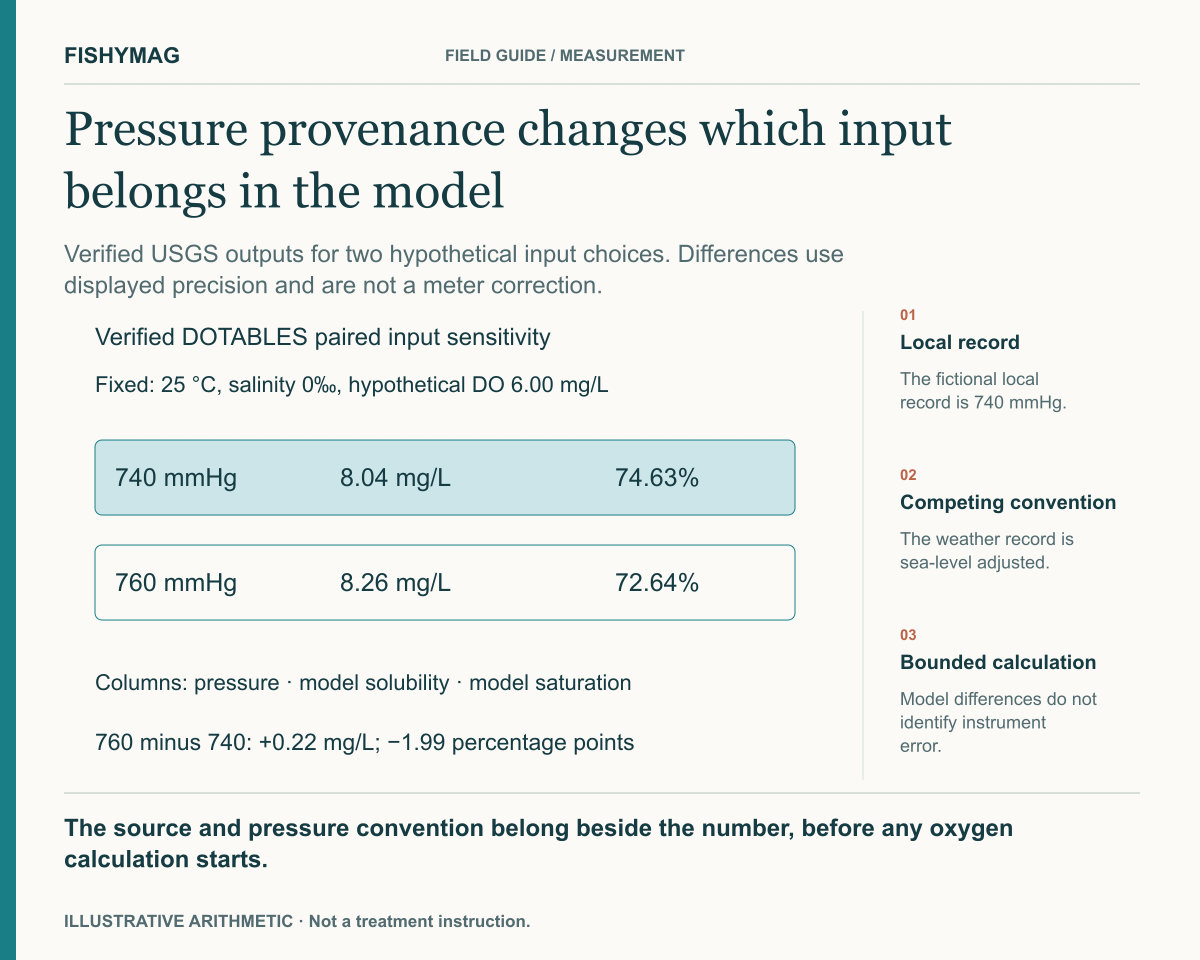
Figure data and explanation
Verified USGS outputs for two hypothetical input choices. Differences use displayed precision and are not a meter correction.
- Local record
- The fictional local record is 740 mmHg.
- Competing convention
- The weather record is sea-level adjusted.
- Bounded calculation
- Model differences do not identify instrument error.
The source and pressure convention belong beside the number, before any oxygen calculation starts.
Resolve provenance before comparing the numbers
The invented aquarium packet has a local barometer record of 740 mmHg with its verification record attached, and a weather export explicitly marked sea-level adjusted at 760 mmHg. The manufacturer’s ProODO manual distinguishes local pressure from a weather value corrected to sea level. For this packet’s local-pressure question, the 740 record has the appropriate convention; the 760 record is retained as a different quantity convention, not averaged with it. This is a document decision, not advice to adjust a live instrument.
Complete the separate model sensitivity calculation
FishyMag obtained the two DOTABLES responses with temperature, salinity and hypothetical DO held fixed. Differences below are calculated from the displayed service results. They describe the model input change, not an experimentally observed aquarium effect or a ProODO calibration error.
| Pressure input | Fixed conditions | Solubility returned | Saturation returned |
|---|---|---|---|
| 740 mmHg | 25 °C; 0‰; hypothetical DO 6.00 mg/L | 8.04 mg/L | 74.63% |
| 760 mmHg | Same three conditions | 8.26 mg/L | 72.64% |
| 760 minus 740 | Displayed-output difference | +0.22 mg/L | −1.99 percentage points |
Keep the model result separate from a meter repair
The ProODO has an internal barometer and a Local DO setting that changes the percentage convention; the manual says switching that selection does not change mg/L. The paired DOTABLES calculation therefore cannot justify subtracting 0.22 mg/L from a recorded meter result. Recover the actual calibration history, pressure record, percentage mode and temperature-salinity settings before asking whether an instrument output can be reconstructed. If the original pressure’s convention is unknown, leave that uncertainty visible. A sea-level weather value is not transformed into a local measurement merely by entering it into an instrument.
Use your own details
The pressure input behind an aquarium oxygen result worksheet
Download the editable text file, fill it in on your device and keep it with the relevant record. This blank worksheet records your information; it does not verify entries or approve treatment.
- Aquarium and oxygen measurement identity
- Instrument, probe and software revision
- Original concentration and percentage displays
- Temperature and salinity with their quantity bases
- Pressure value and local or sea-level convention
- Solubility source, inputs and output precision
- Completed calculation with units
- Unresolved instrument-specific reconstruction
Put it into practice
Your checklist
- Retain pressure units and local or sea-level basis.
- Resolve source provenance before choosing a pressure input.
- Do not transplant a model sensitivity difference into a meter correction.
Sources and scope
This article distinguishes manufacturer statements from FishyMag’s own workflows and arithmetic examples. Linked formulation records retain their own evidence dates; publishing this article does not refresh those records.
- YSI ProODO manufacturer user manual, Rev. C, pages 15 to 25 and Appendices A and B; reviewed November 8, 2026 ↗
- USGS DOTABLES v3.6; independently requested model outputs, November 8, 2026; reviewed November 8, 2026 ↗
AI-assisted writing and development. Not hands-on product testing or veterinary review. How we publish →
FishyMag reports what manufacturers say, quoted and linked. It does not diagnose illness or recommend a treatment, and it never infers that a product is safe from the absence of a warning — where no statement exists, it says so.
Formulations change. Always read the label on the bottle in your hand, and contact the manufacturer if your tank contains anything valuable or unusual.