Evidence decisions
When a nitrate report also includes nitrite
Reconcile a combined nitrate-plus-nitrite report with a compatible nitrite result, including the branch where nitrate cannot be derived.
By FishyMag · Published
Worked arithmetic example · Not a clinical review or treatment recommendation.
Quick answer
A combined nitrate-plus-nitrite result stays combined until a compatible nitrite result and the method support separating it. In the fictional matched case, 2.40 − 0.30 = 2.10 mg/L nitrate as nitrogen. Without the component result, 2.40 cannot simply be relabelled nitrate.
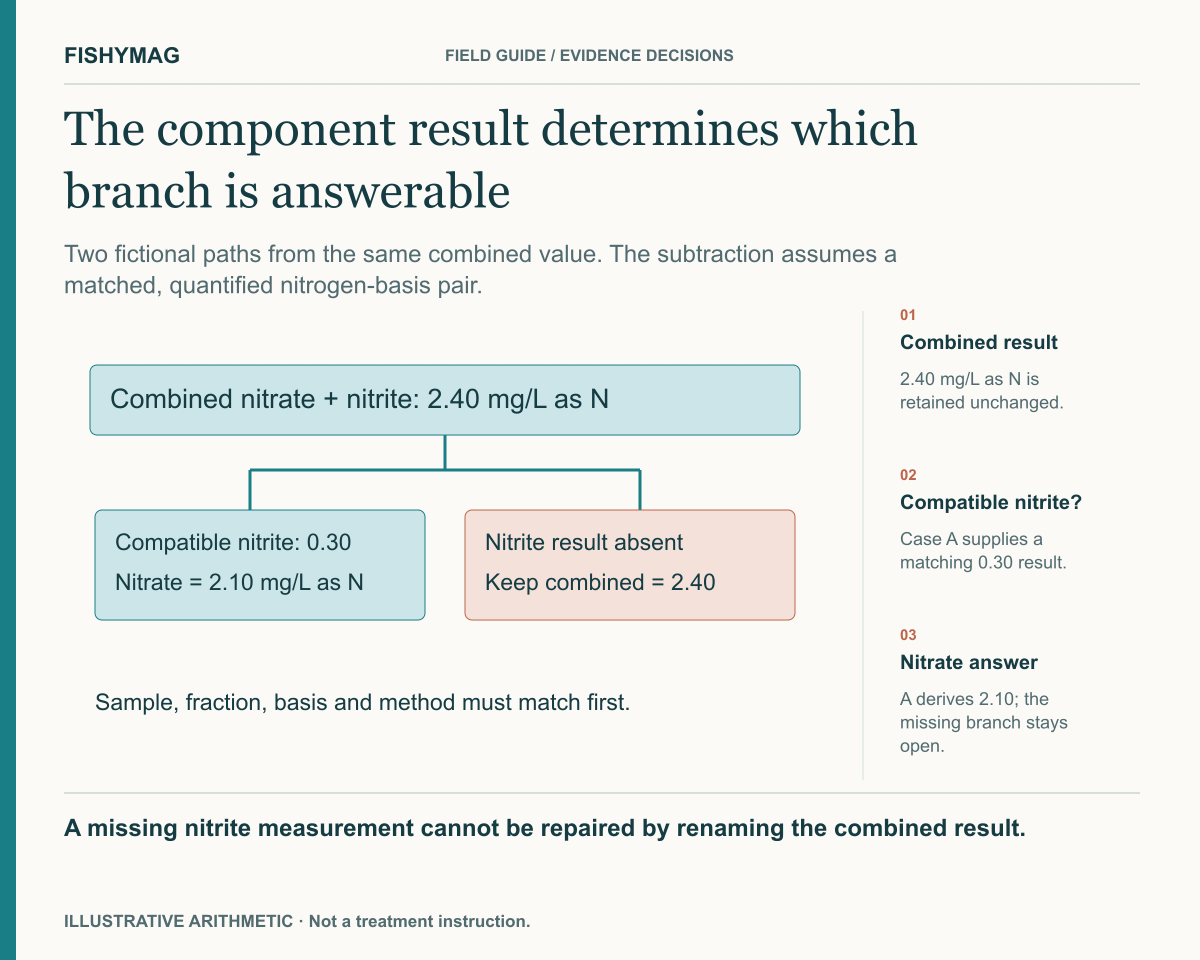
Figure data and explanation
Two fictional paths from the same combined value. The subtraction assumes a matched, quantified nitrogen-basis pair.
- Combined result
- 2.40 mg/L as N is retained unchanged.
- Compatible nitrite?
- Case A supplies a matching 0.30 result.
- Nitrate answer
- A derives 2.10; the missing branch stays open.
A missing nitrite measurement cannot be repaired by renaming the combined result.
Read the method’s combined result
EPA Method 353.2 distinguishes a combined nitrate/nitrite determination from nitrite alone. The result name therefore matters before a conversion to nitrate ion or any comparison. This article interprets existing laboratory reports; it gives no reagent preparation or analytical procedure. Confirm with the laboratory that the particular reported values support a derived nitrate result.
Compare the two complete case paths
The fictional packet declares one matched sample F9, the same filtered fraction, nitrogen mass basis and compatible method outputs. Both values are quantified without censoring. Their arithmetic difference is 2.10 mg/L as N. This is a derived value, not an additional independent measurement.
| Case | Combined, mg/L as N | Compatible nitrite, mg/L as N | Nitrate interpretation |
|---|---|---|---|
| A: matched quantified pair | 2.40 | 0.30 | 2.10 mg/L as N, derived |
| B: component missing | 2.40 | Not supplied | Nitrate-only value unresolved |
| C: different sample | 2.40 | 0.30 from another sample | Subtraction not supported |
| D: basis unspecified | 2.40 | 0.30, basis absent | Resolve basis before arithmetic |
Do not turn a censored component into zero
A nitrite result written “less than” a reporting limit is not the exact zero used by a simple subtraction. Ask the laboratory how its method and reporting rules handle that result and the uncertainty of any derived value. Keep the original component qualifiers attached. The same applies if the combined result has a qualifier or the two analyses represent different sample fractions. In case A, record the derivation and both report identifiers. In the other cases, the completed answer is a specific missing requirement, not a blank field that a later reader might mistake for zero.
Use your own details
When a nitrate report also includes nitrite worksheet
Download the editable text file, fill it in on your device and keep it with the relevant record. This blank worksheet records your information; it does not verify entries or approve treatment.
- Sample identity and time
- Test and mode used
- Original displayed quantity
- Chemical reporting basis
- Applicable source and revision
- Other method and sample match
- Supported comparison
- Specific unresolved evidence
Put it into practice
Your checklist
- Confirm the combined analyte name before conversion.
- Subtract only compatible and suitably reported component results.
- Retain original reports and mark nitrate as derived.
Sources and scope
This article distinguishes manufacturer statements from FishyMag’s own workflows and arithmetic examples. Linked formulation records retain their own evidence dates; publishing this article does not refresh those records.
AI-assisted writing and development. Not hands-on product testing or veterinary review. How we publish →
FishyMag reports what manufacturers say, quoted and linked. It does not diagnose illness or recommend a treatment, and it never infers that a product is safe from the absence of a warning — where no statement exists, it says so.
Formulations change. Always read the label on the bottle in your hand, and contact the manufacturer if your tank contains anything valuable or unusual.